
XPeng is keeping the door open to Canada while treating any North American entry as a long-term undertaking, a senior executive said on Thursday, in the company’s most direct public comment yet on a market that Chinese rivals are already entering.
Answering a question from EV at a round table following the global launch of the L03 in Munich, Alex Tang, XPeng‘s head of global business, said the company was “happy to see that more and more markets are open” to Chinese brands.
Additionally, Tang said that XPeng has kept close contact with Canadian governments and local partners over the past couple of years while it weighed when to enter.
“The door is open for us,” Tang said.
Asked whether XPeng viewed Canada as a gateway to North America or as a standalone market separate from the far harder United States, he framed it as the former, but a distant one.
Canada is “one of the most [inaudible] markets for us, similar to the United States,” Tang said, adding that XPeng did not simply want to sell a handful of cars there but to build “a careful long-term strategy plan.”
The remarks are the clearest signal so far that XPeng is interested in Canada but in no hurry.
The January Deal That Opened the Door
Canada reopened its market to Chinese-built electric vehicles on January 16, when Prime Minister Mark Carney and President Xi Jinping struck a bilateral framework in Beijing widely dubbed the “EVs-for-canola” deal.
The agreement replaced a 100.0% surtax, in place since October 2024, with the standard 6.1% most-favoured-nation tariff for up to 49,000 China-built EVs a year, a quota that grows about 6.5% annually toward 70,000 by 2030.
In exchange, Beijing eased retaliatory duties on Canadian canola and other farm exports.
Import permits opened on March 1, and by mid-year Canada had logged 6,531 Chinese-built EVs under the quota, though China-built cars remain excluded from the country’s C$5,000 federal purchase rebate.
Fewer than half of the vehicles brought in by mid-year were priced at or below C$35,000, the affordable tier the deal was meant to favour.
XPeng’s Engagement
XPeng‘s contact with Ottawa has already moved to the ministerial level.
In April, Canada’s International Trade Minister Maninder Sidhu met XPeng, BYD and GAC executives in Guangzhou to discuss market-entry pathways under the quota, regulatory and supply-chain requirements and longer-term investment.
Industry Minister Mélanie Joly followed with her own visit, pressing Chinese automakers to build on Canadian soil, and pointed to the clearest link XPeng already has to the country.
That link is Magna International, the contract manufacturer headquartered in Aurora, Ontario, which builds the G6, G9 and P7+ for XPeng at its plant in Graz, Austria.
Magna took the work on in 2025, its first full-vehicle assembly for a Chinese carmaker, and its chief executive said in June the company would be open to assembling Chinese vehicles in Canada if the plans were genuinely long-term.
For XPeng, that existing tie to a Canadian company offers a ready template for the local production Ottawa is demanding, a potential bridge into the market.
Beyond those talks, XPeng has shown little public movement, with no announced launch date, dealer network or model line-up, and it does not yet appear in Transport Canada’s pre-clearance registry of certified importers.
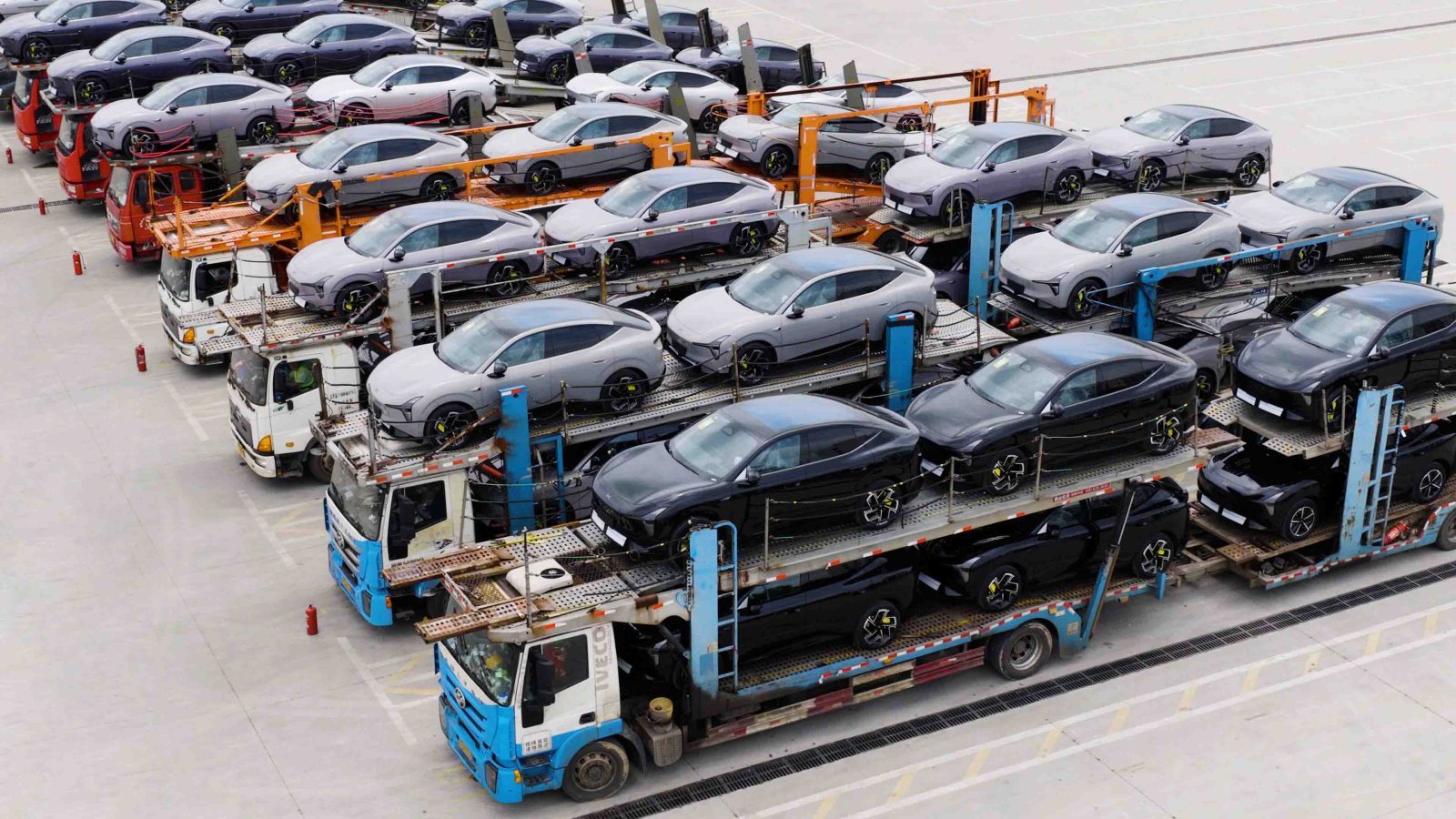
XPeng shipped 45,008 vehicles overseas in 2025, nearly double the year before, and now reaches 65 markets, though none in North America.
The Rivals Already Landing
While XPeng evaluates, other Chinese brands are moving into Canada now.
Geely’s Lotus became the first China-owned and China-built marque to arrive under the deal, landing its first Eletre SUVs as the quota passed its quarter mark, with the model cut to C$119,900 from the C$313,500 it would have cost under the old surtax.
State-owned Dongfeng, meanwhile, showcased its EVs in Montreal this week and set a 2027 Canadian entry, certifying the Vigo crossover and the Nammi Box 01 with Transport Canada and floating local production through the joint ventures it already runs with Stellantis and Nissan.
BYD has confirmed a late-2026 launch with more than 20 dealerships planned across Toronto, Vancouver, Montreal and Calgary and models from C$25,000, and is studying a wholly owned Canadian plant rather than the joint venture Ottawa favours.
Chery is completing certification and building a dealer network, while Geely has confirmed its own entry and pointed to local production.
For all that activity, the biggest user of the quota so far has been Tesla, which pulled its US-built Model 3 from Canada and now imports the Shanghai-built sedan at the 6.1% rate, undercutting most rivals at C$39,490.
Six months in, the quota’s main beneficiary has been an American brand rather than the Chinese newcomers it was written to attract.
The Barriers
Any entrant must certify its models to Canadian Motor Vehicle Safety Standards, stand up dealer, service and warranty networks across a vast geography, and absorb those costs against a capped, shared quota, all without access to the federal rebate.
Ottawa is also weighing per-company caps to stop any single brand from taking too much of the allocation.
Ottawa has raised the bar further, with Carney saying Canada wants material Canadian production rather than low-value assembly of imported kits, and Joly framing a joint venture with a Canadian firm as effectively the only alternative to importing under the quota.
The politics are fraught, with Ontario Premier Doug Ford opposing the deal, the United States warning about USMCA and threatening tariffs, and industry groups pressing concerns about data security on connected Chinese vehicles.