
Two and a half years after unveiling it, Nio is still developing its 120-kWh battery pack, chief executive officer William Li confirmed on Friday.
The larger battery pack was first announced with the ET9 flagship in December 2023, and was absent from that car’s launch spec a year later, re-promised at the ES8’s debut, and still without a defined launch timeline.
The founder of the CYVN-backed EV maker revealed on Friday that the pack will be usable across the Nio brand’s entire lineup rather than reserved for the flagship, as it fits the company’s swappable pack dimensions.
Li made the remarks on Friday at a user face-to-face event in Quanzhou, Fujian province, answering a question about whether the ET9 flagship sedan would receive an exclusive larger battery.
“There will be a 120-kWh battery, and of course all cars can use it,” Li said, adding that the pack sits within Nio’s current ternary chemistry system and the company’s standard battery pack dimensions, according to event notes shared by the automotive blogger ‘董买买’.
The chief executive gave no launch timeline, and no details on pricing, cell format or production status were reported from the event.
The admission makes the pack one of the longest-running open promises in the company’s product catalog — outlasting the development window of entire vehicles: the ES9 went from regulatory filing to 20,000 deliveries inside eight months, over a stretch in which the 120-kWh pack produced only restatements of intent.
2023 Announcement
Nio first announced a 120-kWh pack at the ET9’s debut in December 2023, built on in-house-developed 46105 large cylindrical cells with an energy density of 292 Wh/kg, 5C charging on the sedan’s 925-volt architecture, and a claimed 255 km of range added in five minutes.
The capacity carried through the ET9’s regulatory filing coverage in October 2024, but when the production sedan launched that December at 788,000 yuan ($116,600), the specification had quietly settled at 100 kWh and 650 km of CLTC range.
The promise resurfaced at the third-generation ES8’s launch in September 2025, when Nio said the SUV would gain a 120-kWh option supporting 5C charging in the future.
Eleven months later, the ES8 and the ES9 flagship SUV launched in May both remain capped at a 102-kWh CATL pack, delivering up to 635 km and 620 km of CLTC range respectively — a ceiling that stands out against six-figure-yuan rivals advertising longer legs.
Li’s universal-fitment framing is consistent with his public push in July for industry-wide battery standardization, which he argued could unlock more than 100 billion yuan ($14.8 billion) in supply-chain savings.
The Shadow of the 150-kWh Pack
The unhurried timeline has a precedent inside Nio‘s own catalog.
The company’s 150-kWh semi-solid-state pack, announced in January 2021 and mass produced from April 2024 after repeated delays, was discontinued after only several hundred units.
With thousands of swap stations available, 97% of users choose the 75-kWh pack over the 100-kWh version, Li said at the time — the network itself functions as the range extender, thinning demand for expensive long-range hardware.
A ternary 120-kWh pack in the standard container is a structurally cheaper proposition than the WeLion semi-solid cells that priced the 150-kWh unit near the cost of an ET5 sedan, but the same demand arithmetic hangs over its business case.
Any new capacity must also be stocked across the network: packs in circulation already span the 42.1-kWh Firefly unit, Onvo‘s 65- and 85-kWh packs, and the Nio brand’s 75-, 100- and 102-kWh options.
Last January, the company was forced to rush more than 4,200 long-range packs into stations after ES8 and Onvo L90 demand drained inventory.
Milestone Day in Quanzhou
At 8:09 a.m. Beijing time on Friday — 8:09 p.m. ET Thursday — the network completed its 120 millionth battery swap, roughly six months after passing the 100 million mark on February 6, a pace of about 111,000 swaps per day.
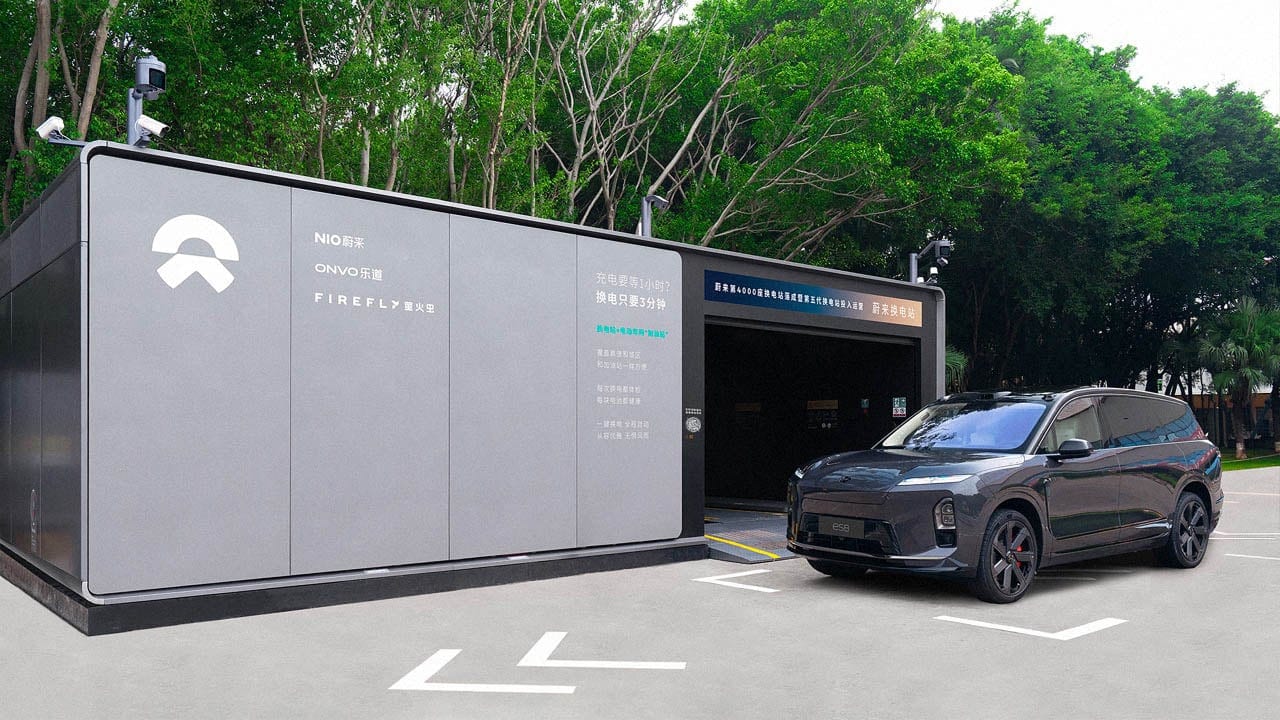
Hours later, the company put its first batch of fifth-generation stations into operation across seven cities, as EV reported ahead of the launch — with the Quanzhou site, opened by Li, becoming the 4,000th swap station in China.
The rollout timeline that slipped three times from an original pre-Christmas 2025 target.
The rebuilt architecture accommodates wheelbases up to 3.5 meters, letting the 5.37-meter ES9 and the 4-meter FireflyEV share one swap mechanism — making the fifth generation the first in the network able to serve all three group brands, and ending the budget marque’s exclusion from the infrastructure it was marketed with.
The fifth-generation hardware cuts the fastest swap to one minute and 48 seconds, a 25% reduction from the fourth generation’s two minutes and 24 seconds, lifts daily capacity to about 500 swaps, and stores between 21 and 28 packs per station.
Firefly Gets Bigger Battery
Firefly chief Daniel Jin said the brand will receive a larger battery pack, targeting a launch before the Chinese New Year holiday in February 2027 and possibly by the end of this year.
The brand’s single model currently ships with a 42.1-kWh lithium iron phosphate pack and 420 km of CLTC range — and delivered 5,771 vehicles in July, up 143.9% from a year earlier, making it the group’s fastest-growing marque off a small base.
Jin also addressed driver-assistance hardware, saying Firefly was conceived as a fun-to-drive car but that the company has noted demand for LiDAR-based assisted driving and is studying it, while ruling out a short-term introduction.
The sensor comes standard on Nio-brand models and on higher Onvo trims.
CATL, Nio‘s primary battery supplier and an investor, is building a rival swap network that has been closing in on Nio‘s station count while signing EV maker partners Nio‘s own alliance never converted.
July Figures
Nio delivered 191,123 vehicles in the first half, up 67.4% from a year earlier, with July adding 20,008 units for the main brand and 10,155 for Onvo.
The ES9 passed 20,000 deliveries this week, roughly ten weeks after launch, and the main brand’s average transaction price reached 434,600 yuan ($64,400) in July on the strength of the two flagship SUVs.