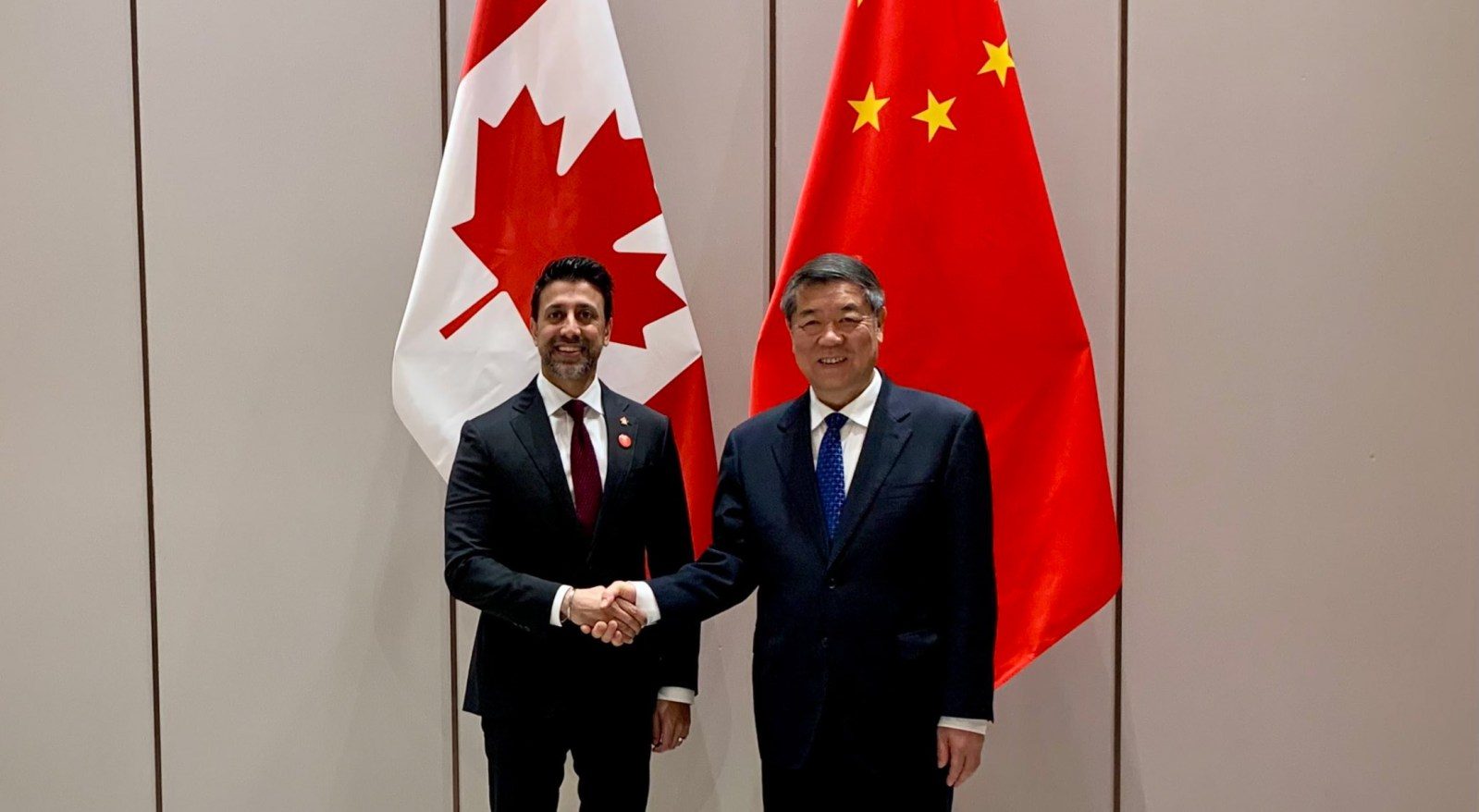

Canada’s International Trade Minister Maninder Sidhu met with three of China’s largest automakers in Guangzhou on Thursday, the latest in a series of ministerial engagements with Chinese carmakers since the January trade deal.
Sidhu held discussions with BYD, XPeng and Guangzhou Automobile Group on market-entry pathways under Canada’s electric vehicle import quota, regulatory supply chain requirements and longer-term investment opportunities.
The meetings mark the most concrete step yet toward the joint-venture investment commitments that were a central condition of the January agreement between Prime Minister Mark Carney and Chinese President Xi Jinping.
They are also the first ministerial-level engagement with Chinese automakers on Chinese soil since Industry Minister Mélanie Joly met BYD and Chery during Carney’s Beijing visit three months ago.
The January deal
Carney and Xi announced the bilateral framework on January 16 during the first visit by a Canadian prime minister to China since 2017.
Under the terms, Canada agreed to allow up to 49,000 Chinese-built EVs into its market annually at the most-favoured-nation tariff rate of 6.1%, down from the 106.1% effective rate that had applied since October 2024.
The 49,000-vehicle cap approximates the volume imported from China in 2023, before the previous Liberal government under Justin Trudeau matched US tariff hikes on Chinese EVs.
Carney said the quota will rise by approximately 6% annually, reaching about 70,000 units within five years.
More than half of the vehicles admitted over the five-year horizon are expected to carry an import price below C$35,000.
In exchange, China agreed to lower its retaliatory tariffs on Canadian canola seed, canola meal, lobster, crab and peas.
The agreement also includes a clause requiring Chinese automakers to pursue joint ventures or local manufacturing and battery production in Canada within three years of market entry, framed by the government as a mechanism to protect domestic auto manufacturing jobs and build out the Canadian EV supply chain.
Joly’s earlier engagement
Joly, who accompanied Carney to Beijing, met directly with BYD and Chery executives during the state visit. She also met with Canadian auto parts supplier Magna International during the trip as the government prepared its Auto Strategy.
“I already had meetings with different automakers,” Joly said in late January, naming Hyundai, Volkswagen, BYD and Chery as examples.
“I’ve had these conversations, and will continue to have these conversations. I think we have to be not naive, but we also have to be open minded,” the Minister added.
A few weeks later, Carney and Joly outlined a new federal Auto Strategy that confirmed Canada-China joint venture assembly plant talks aimed at producing electric vehicles for international sales.
“We believe that these great Canadian champions can partner with Chinese EV companies to make a Canadian-Chinese car to export it around the world,” Joly told Bloomberg at the time, adding that security concerns over Chinese vehicle technology could be addressed through software solutions and labour standards.
Finance Minister François-Philippe Champagne launched consultations in late February to tighten Canada’s automotive remission framework, with the goal of forcing global carmakers to choose between local production and stiff surtaxes on imports.
Chery, BYD position for entry
Chery Automobile Co. is positioning itself to become the first Chinese automaker to sell mainstream passenger EVs in Canada.
Recruiters working on behalf of Chery have contacted Canadian auto industry professionals on LinkedIn about roles to support the company’s expansion.
The messages indicate Chery is hiring for positions needed to build a Canadian sales operation from scratch, with some specifically mentioning the company’s Omoda and Jaecoo sub-brands.
Chery sold more than 2.8 million passenger cars in 2025, of which more than 900,000 were new energy vehicles, and has set a 2026 sales target of 3.2 million units.
The company operates in more than 130 countries and describes itself as China’s top automaker by export volume. Chery has filed Canadian trademark applications for its Exeed, iCar, Jaecoo, Lepas, Luxeed and Omoda sub-brands.
In March, Chery confirmed it is “closely studying” the Canadian market in its first official statement on a potential entry.
BYD executive vice president Stella Li told Bloomberg last month that the company is considering a Canadian plant but would insist on owning and operating the facility directly, rejecting the joint-venture model Ottawa has emphasized.
Geely Holding has also confirmed preparations. The conglomerate trademarked its premium electric brand Zeekr in Canada in 2025 and already maintains a Canadian presence through Volvo Cars and Polestar, both of which manufacture vehicles in China for export.
Lotus, another Geely-owned brand, is on track to become the first Chinese-built passenger EV to enter the Canadian market with the Eletre, targeting third-quarter 2026 deliveries.
While Tesla, Volvo Cars and Polestar manufacture vehicles in China for export to Canada, no China-headquartered automaker has yet entered the Canadian passenger vehicle market with its own brand.
Implementation to date
Global Affairs Canada opened the first application window for import permits on March 1, making up to 24,500 permits available through August 31 on a first-come, first-served basis.
A second window from September 1 through February 28, 2027 will allocate another 24,500 permits plus any unused capacity from the first phase.
The final quota rules published in the Canada Gazette on March 11 did not require any of the 49,000 vehicles entering the country in the first 12 months to meet the sub-$35,000 affordability threshold Carney cited in January — a relaxation from the prime minister’s original framing of the deal.
Ford’s escalating criticism
Ontario Premier Doug Ford has been the most prominent domestic critic of the deal.
Hours after Carney announced the agreement on January 16, Ford posted on X that the deal had given Beijing a “foothold in the Canadian market” that would be used at the expense of Canadian workers.
Speaking to reporters in Toronto the same day, Ford called the agreement a “lopsided deal” and a “knee-jerk reaction” that had not been consulted with the provincial government or the auto sector. He also referred to Chinese-made vehicles as “subsidized spy cars.”
Ford escalated the criticism on January 19 in an address to the Rural Ontario Municipal Association, labeling Chinese EVs as “spy vehicles” and comparing the agreement to the Huawei controversy.
“I’m not too sure if President Trump wants Chinese spy vehicles coming across the border, but I’m betting the answer is no,” Ford said. He said Chinese manufacturers will “never” open auto manufacturing facilities in Ontario.
The criticism carries weight given Ontario’s role as the centre of Canada’s auto industry, where assembly plants employ tens of thousands of workers.
Sidhu’s Guangzhou visit
Sidhu’s visit concluded the first trip by a Canadian minister to South China since 2018 and followed the sixth China International Consumer Products Expo in Haikou, where Canada served as Guest Country of Honour with a delegation of nearly 40 Canadian companies.
In Guangzhou, Sidhu met with BYD, XPeng and GAC executives.
Guangzhou-based XPeng operates two manufacturing facilities in the city and has invested in eVTOL aircraft production through its AEROHT subsidiary.
GAC produces vehicles under the Trumpchi, Aion and Hycan brands, with Aion operating as its dedicated EV marque.
BYD is headquartered in Shenzhen but has expanded production across multiple provinces.
In a post on X, Sidhu wrote that “China makes some of those most advanced electric vehicles in the world, and ensuring Canadians have access to affordable EVs means working with global partners.”
“That’s why I met with some of the largest EV manufacturers like BYD, XPeng and Aion in Guangzhou to discuss collaboration and investment in Canada’s leading automotive sector and utilizing the Canadian supply chains to build the very cars in Canada,” Sidhu added.
Sidhu also met with tech giants Alibaba Group and Jingdong Group to discuss Canadian goods exports through the Chinese e-commerce platforms.
China is the second-largest single-country merchandise trading partner of Canada, with $125.1 billion in two-way trade in 2025.
The US-Canada divergence
Canada’s decision to reduce tariffs on Chinese EVs runs counter to the current US posture.
President Donald Trump said earlier this month that the 100% US tariff on Chinese car imports has successfully kept Chinese automakers out of the US market and protected Detroit manufacturers General Motors and Ford.
US Trade Representative Jamieson Greer said Chinese automakers will struggle to establish a presence in the United States, as Washington discussions continue on their potential indirect entry via Canada.
US Ambassador to Canada Pete Hoekstra flagged data and intelligence concerns about Chinese-made vehicles earlier this month, drawing on his experience chairing the US House Intelligence Committee.
“Coming out of the intelligence world, that car driving around from China, it’s a great gobbler of data and information, it’s consuming and getting information,” Hoekstra said.
Trump himself called the Canada-China deal “OK” when asked by reporters on January 16, telling reporters outside the White House that it was what Carney “should be doing.”
Canada’s auto sector is integrated with the US through the United States-Mexico-Canada Agreement, and the January deal has drawn scrutiny over whether Chinese-built vehicles could reach the US market through the Canadian route.
The joint-venture requirement in the Canada-China framework is one of the government’s responses to that concern.