
Xiaomi said on Wednesday that it delivered “more than 30,000” vehicles in June across China, holding above that mark for a third straight month.
The June figures, disclosed as a round number in keeping with the company’s practice, left the tech giant with an estimated first-half total above 180,000 vehicles.
Reaching its target of 550,000 vehicles delivered in 2026 requires an average of nearly 62,000 deliveries a month across the second half, well above the all-time monthly peak of 50,212 the brand set last December.
The First-Half Baseline
Xiaomi delivered 80,856 vehicles in the first quarter, up 6.6% year over year, before April’s 36,702 and a May figure the company reported only as “over 30,000” — which the CPCA later detailed as 32,759, up 16.94% from a year earlier but down 10.74% from April.
Through the first five months, the tech giant delivered 150,317 vehicles, a 13.48% year-over-year gain, banking about 27% of its target before June.
Adding the month’s 30,000-plus lifts the half-year tally past an estimated 180,000 units, a figure that will firm only once the CPCA publishes the exact June count in the coming days.
That base covers close to a third of the 550,000 goal, a share that leaves the company needing a far steeper second half than anything it has yet sustained.
The Second-Half Model Bet
The path to 550,000 runs through a product pipeline the company has yet to launch, a wager that four new nameplates arriving from mid-year can lift volume where its two current models cannot.
Xiaomi has shown three of them testing in China: a long-wheelbase SU7L executive sedan aimed at the business segment that Audi’s A6L and BMW’s 5-series command, and a pair of extended-range SUVs in five- and seven-seat configurations — the automaker’s first vehicles to pair a battery with a fuel-burning generator.
The extended-range move marks the sharper departure, carrying Xiaomi into a segment it has never served and, according to trademark filings and industry reporting, under a separate sub-brand named Xuntian, or SKYNOMAD, badged apart from the main marque and pitched at families, long-distance drivers and outdoor buyers.
The flagship of that line, a full-size three-row SUV internally codenamed Kunlun, is expected to stretch beyond 5.2 meters, pair a 1.5-liter range-extender with a dual-motor all-wheel-drive system for roughly 400 horsepower, and offer a combined range near 1,500 kilometers.
Xiaomi‘s model positioned against the Li Auto L9 and the Huawei-backed Aito M9 at an expected 350,000 to 450,000 yuan.
Both the SU7L and the extended-range SUVs are planned to be launched in the second half of 2026.
The Order-Momentum Question
The central question hanging over the second half is whether order intake can hold the run rate once launch-period backlogs clear.
The YU7 SUV has framed that concern all year, sliding for a fifth straight month to 8,736 units in May from a January peak of 37,869, even as the model stayed one of Xiaomi‘s two volume pillars.
The SU7 sedan accounted for 24,023 of May’s deliveries, an eighth consecutive year-over-year decline as buyers worked through the second-generation switchover that began in March.
Across the first five months the YU7 delivered 90,235 units and the SU7 60,082, the sedan down 54.6% from a year earlier when it was the company’s only nameplate.
The YU7’s waiting list, which had stretched to as long as 53 to 56 weeks at launch, shortened to a matter of weeks and, for some inventory cars, hours — a shift the company attributed to added capacity but that skeptics read as a thinning order book.
Founder and chief executive Lei Jun pushed back on that reading in June, saying the fast-delivery stock consisted mainly of cancelled and abnormal orders rather than unsold demand.
YU7 GT
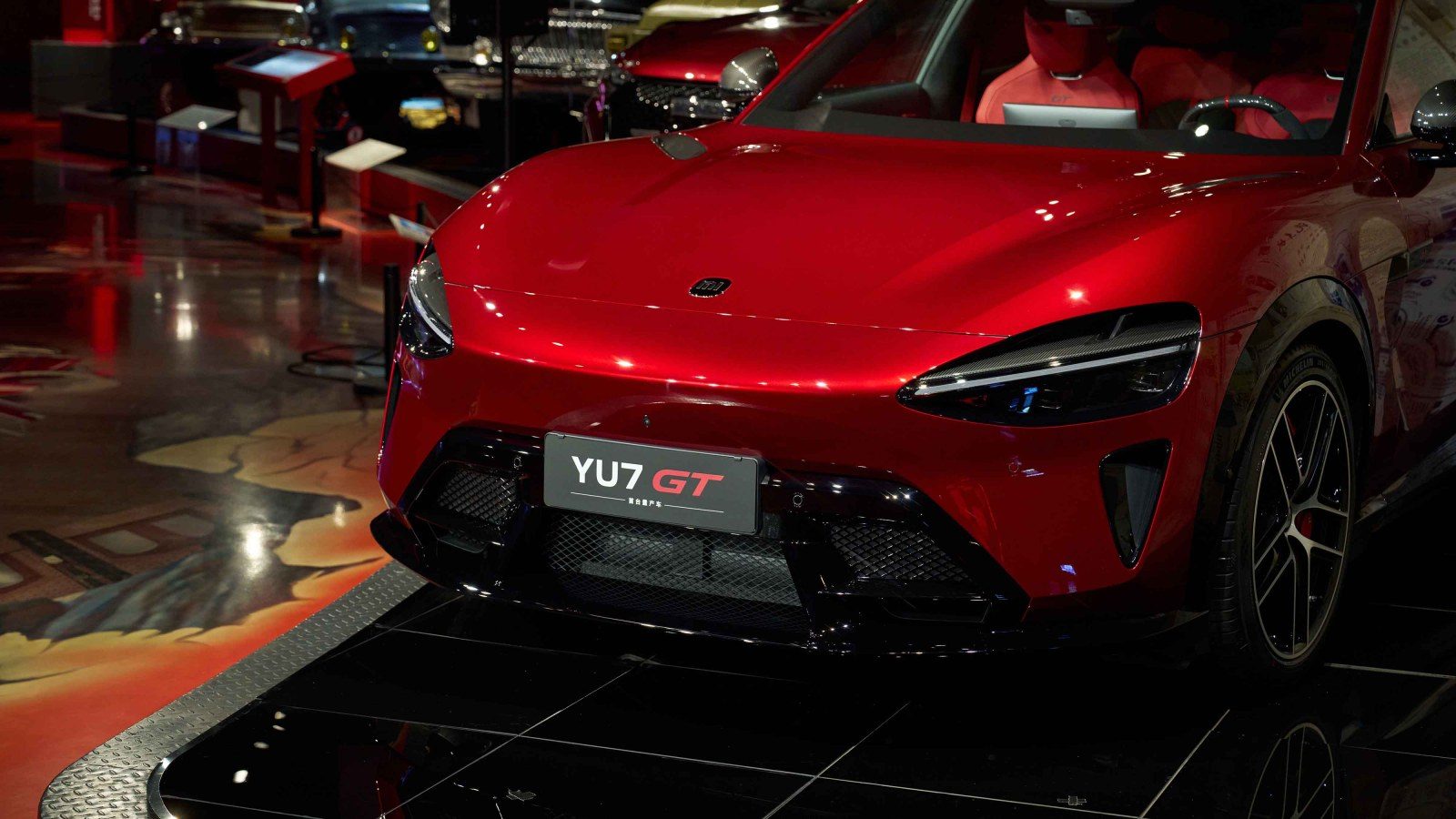
The company widened the YU7 line on May 21, launching the high-performance YU7 GT from 389,900 yuan — a 1,003-horsepower SUV that set a 7:22.755 lap of the Nürburgring Nordschleife, the fastest for a production SUV — alongside a cheaper standard YU7 from 233,500 yuan, both shaped by the company’s Munich research center.
Lei Jun framed the cheaper car as built to “once again challenge the Model Y on sales,” reviving the rivalry with Teslathat has defined the brand’s push into the SUV segment.
Four to six new models are planned for 2026, among them the SU7L sedan and the extended-range YU8 and YU9 SUVs, a first step beyond a two-nameplate lineup and possibly toward a separate sub-brand.
Tesla Veteran
The company hired Tesla China’s former general manager Kong Yanshuang in March to build a sales system less dependent on Lei Jun’s personal following, a direct answer to the order-momentum concern.
That rebuild sits alongside a leadership overhaul that installed the division’s first-ever chief technology officer ahead of the Beijing Auto Show, part of a wider push to professionalize an operation that scaled faster than almost any carmaker before it.
The EV and AI unit posted a first-quarter operating loss of 3.1 billion yuan on revenue of 19.9 billion yuan, a loss of about $5,600 for every car sold, even as gross margin held at 20.1%.
That result broke a run of two profitable quarters at the end of 2025, with the company tracing the swing to the Spring Festival lull and the SU7 model changeover.