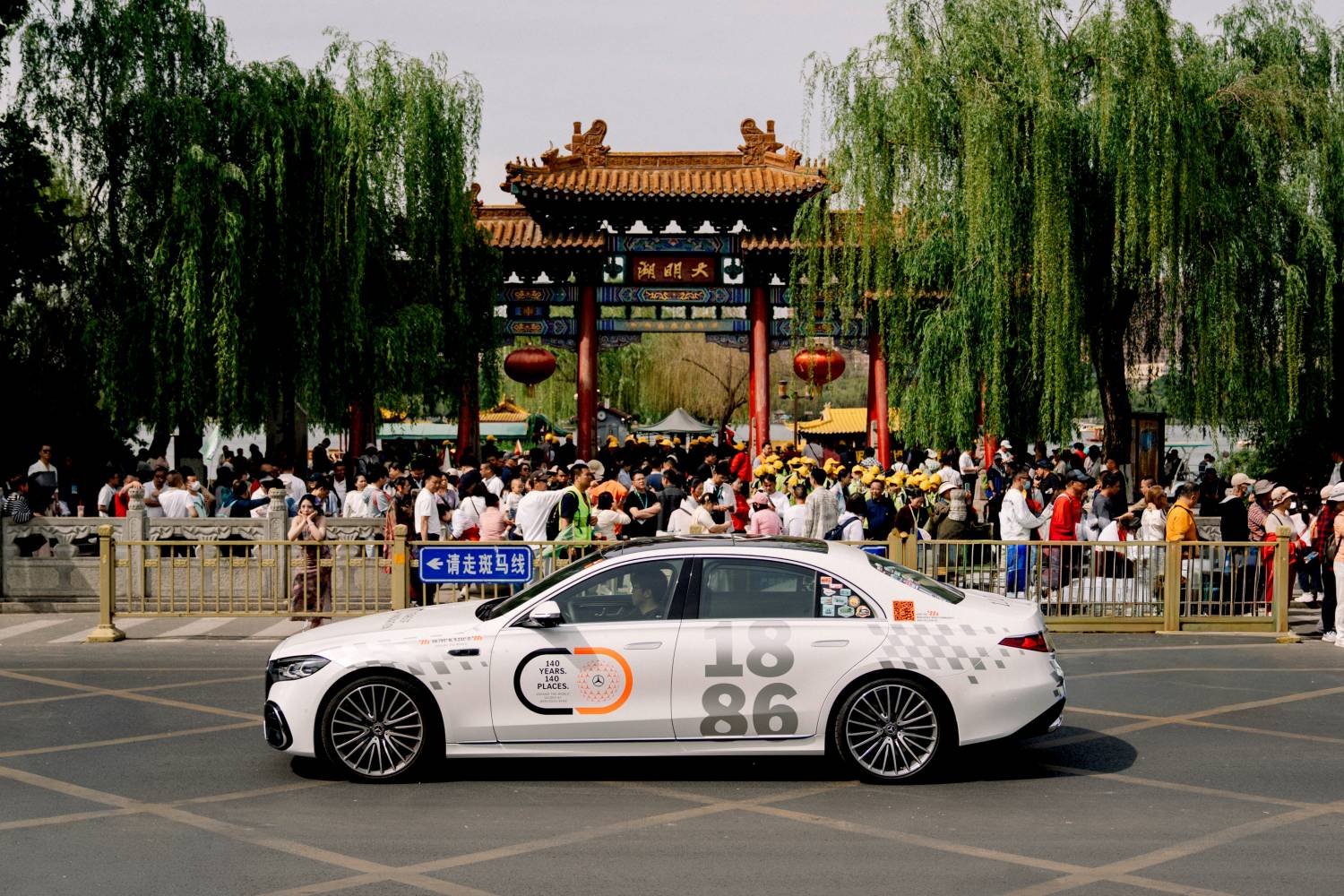

Mercedes-Benz disclosed last week that it sold 98,600 passenger cars in China in the second quarter of 2026, down 30% from a year earlier.
The result marks the automaker’s steepest quarterly decline yet in a downturn that has lasted for more than two years.
During the same period, Chinese tech giant Xiaomi — which only entered the auto market in April 2024, compared with Mercedes‘s more than two decades in China — delivered 104,199 battery electric vehicles (BEVs) in the country, surpassing Mercedes‘ passenger car sales.
Xiaomi first moved ahead of Mercedes in the fourth quarter of 2025, when it delivered a record 145,115 EVs, making the latest quarter the second time the tech company has outsold the German automaker in China.
However, the latest crossover is particularly significant because it coincides with Mercedes‘ sales falling below the 100,000-unit mark for the first time in more than a decade.
The crossover, first spotted by X user and content creator Felix Hamer, captures one of the starkest inflection points in the global auto industry.
Two years ago, Mercedes sold 176,000 cars in China in Q2 2024, while Xiaomi sold 29,984 — in its first quarter in the industry, and with only its debut, fully electric SU7 sedan.
Drop from Top 20
Mercedes is not merely losing ground to a single upstart, however.
The Stuttgart-based company has dropped out of China’s top 20 passenger vehicle brands by wholesale volume in the first half of 2026, according to data released by the China Passenger Car Association (CPCA).
In full-year 2025, the brand ranked 18th, with a lineup still composed primarily of internal combustion engine (ICE) vehicles.
Its absence from the latest ranking highlights how sharply it has declined in what was until recently its largest and most profitable market.
The drop reflects the struggles of German legacy automakers to keep pace with intensifying competition and the rapid shift toward electric vehicles in China.
Q2 Sales Figures
Mercedes-Benz‘s decline in China is not a single bad quarter. Annual sales peaked at around 765,000 vehicles in 2023.
The trajectory since then has been consistently downward: approximately 684,000 in 2024, around 552,000 locally produced units in 2025 — roughly 575,000 including imports — and now a first-half 2026 tally of 210,200, down 28% year over year.
At the current run rate, Mercedes is on track to sell fewer than 450,000 cars in China this year, a figure that would represent a decline of roughly 40% in just three years.
The company’s press release begins by noting that “sales outside China increased by 3%,” underscoring the company’s emphasis on growth in markets beyond China.
Europe grew 4% during the quarter, North America increased 13%, and the United States rose 10%.
The challenge is concentrated almost entirely in China, where the business has contracted faster than the overall market.
CPCA lowered its full-year forecast for the Chinese passenger car market in June, but the broader decline is roughly 20% — far less severe than the 28% to 30% that Mercedes is absorbing.
CFO Harald Wilhelm acknowledged the scale of the retreat at the company’s annual meeting in April, setting a medium-term target of 500,000 to 600,000 annual China sales with high single-digit margins.
Even the upper end of that range sits well below the volumes Mercedes routinely achieved between 2020 and 2023.
China Strategy
Mercedes has spent the last several years pursuing a deliberate shift upmarket, concentrating investment on its most expensive models — the S-Class, Mercedes-Maybach, G-Class, AMG and the EQS family — where margins are highest.
The strategy generated returns when China’s luxury segment was expanding and domestic competition was limited.
In the second-quarter, however, ‘Top-End’ sales fell 10% globally to 58,100 vehicles.
The segment’s share of total deliveries stood at just above 14% in the first half, at the lower boundary of the company’s target corridor, the company’s report showed.
Mercedes-Benz attributes the weakness primarily to the S-Class model changeover, noting that order books for the new generation stretch into next year across Europe.
The Core segment, which includes C-Class and E-Class derivatives, dropped 9%, while the company’s Entry segment, built around A-Class and B-Class models, fell 4%.
The new electric CLA and electric GLC are generating strong order intake in Europe, but their availability in China remains limited.
A Market That Moved Without MB
China’s passenger car market has undergone a structural transformation that foreign legacy automakers have struggled to match.
New energy vehicles — battery electric, plug-in hybrid and extended-range models — surpassed 50% of all vehicle sales in the country for the first time in late 2025 and have continued to gain share since.
The shift has rewarded domestic brands with vertically integrated EV platforms, AI-enabled cockpits, advanced driver-assistance systems and aggressive pricing, while punishing incumbents still reliant on combustion-engine lineups.
Mercedes-Benz‘s global BEV sales rose 51% in the second quarter to 52,900 units, and its BEV share climbed to 13% from 7.7% a year earlier.
In Europe, BEV sales surged 87% to 43,500, with German volume more than doubling as subsidies continue to increase demand.
For Mercedes, however, the acceleration is happening overwhelmingly in Europe, not in China, where the brand is struggling to compete.
BYD leads a price war started roughly a year ago and even the Shenzhen-based giant has seen domestic sales falter in 2026, while newcomers like Xiaomi went from zero to over 410,000 vehicle deliveries in roughly 20 months.
Nio, XPeng, Li Auto, Chery and Changan are all expanding their lineups and cutting prices in a market where the China Automobile Dealers Association reported an inventory alert index of 57.2% in June — above the warning threshold.
China’s retreat is part of a broader reordering.
Tesla overtook Mercedes-Benz Group in global quarterly vehicle sales in Q3 2025.
The Elon Musk-led company reached a record number of deliveries between July and September 2025, with 497,099 vehicles, against an estimated 453,671 for Mercedes, including both cars and vans.
Financials
Mercedes‘s full-year 2025 global sales fell 10% to 2.16 million vehicles.
Revenue dropped 9% to €132.2 billion ($157.1 billion) and EBIT plunged 57% to €5.8 billion.
Net profit nearly halved to €5.3 billion. Revenue from China alone fell 33.6% to €16.5 billion ($19.6 billion).
The company warned at the time that its car division’s adjusted profit margin could fall to 3% to 5% in 2026, down from 5% in 2025.
Mercedes has framed 2026 as a transition year, with the largest model offensive in its history and order books that stretch well into the second half.
As part of its efforts towards electrification, Mercedes opened orders for the new electric C-Class in May, and the all-electric GLA is set for its world premiere in late July.
The electric CLA, electric GLC, electric GLB and the new S-Class are already generating strong demand in Europe.