
Xiaomi delivered “more than 30,000” vehicles in May, holding above that level for a second straight month after deliveries slipped to about 20,000 in February and March.
By then, the company was battling both an industry-wide slowdown and the switch of SU7 production to the new iteration.
The company does not disclose precise monthly delivery figures, instead reporting rounded estimates.
Exact data is released later by the China Passenger Car Association (CPCA). In April, Xiaomi delivered 36,702 vehicles, according to the association.
May’s preliminary figures indicate that the company delivered at least 2,000 more units than it did a year ago, when 28,013 vehicles were handed over to customers.
Through the first five months of 2026, Xiaomi has delivered an estimated 147,558 vehicles — representing approximately 26.8% of its full-year target of 550,000 units, which was reiterated late last month.
The brand delivered more than 79,000 vehicles in the first quarter, with January accounting for over 39,000 units and both February and March reporting more than 20,000.
March’s figures was weighed down by the SU7 production line switchover to the second-generation model. As of May 6, the new-generation SU7 — launched in March — had secured over 80,000 firm orders.
To meet its 550,000-unit annual target, Xiaomi must average roughly 57,500 monthly deliveries from June through December — above the previous peak of 50,000 set in December 2025.
YU7 Standard
The Chinese giant launched a cheaper standard variant of its YU7 SUV on May 21, with co-founder and CEO Lei Jun framing the model as a renewed direct challenge to Tesla‘s Model Y on sales.
Lei Jun acknowledged during the launch event that cancelling the original standard variant before the YU7’s June 2025 debut had been a mistake. The version had been planned three years ago but was dropped at the last minute, he said.
The new YU7 “true standard” version starts at 233,500 yuan ($34,500), undercutting the previous standard YU7 by 20,000 yuan, or about 7.9%.
The new variant differs from the Long Range edition only in range — it carries a 73.0 kWh lithium iron phosphate battery and delivers a CLTC-rated range of 643 km (398 miles).
The rest of the specification mirrors the existing car: it retains the LiDAR, the Xiaomi HAD assisted-driving system, and the Xiaomi V6s Plus super motor.
For comparison, the Model Y rear-wheel-drive carries a 62.5 kWh battery with a CLTC range of 593 kilometers (368 miles).
Tesla currently sells the Model Y in four variants in China, priced from 263,500 yuan ($38,900).
The Xiaomi YU7 standard sits below every Model Y trim on offer.
Customers who place orders before June 30 receive a five-year low-interest loan and free lifetime access to the HAD system.
Deliveries of the YU7 standard began on May 26.
YU7 GT
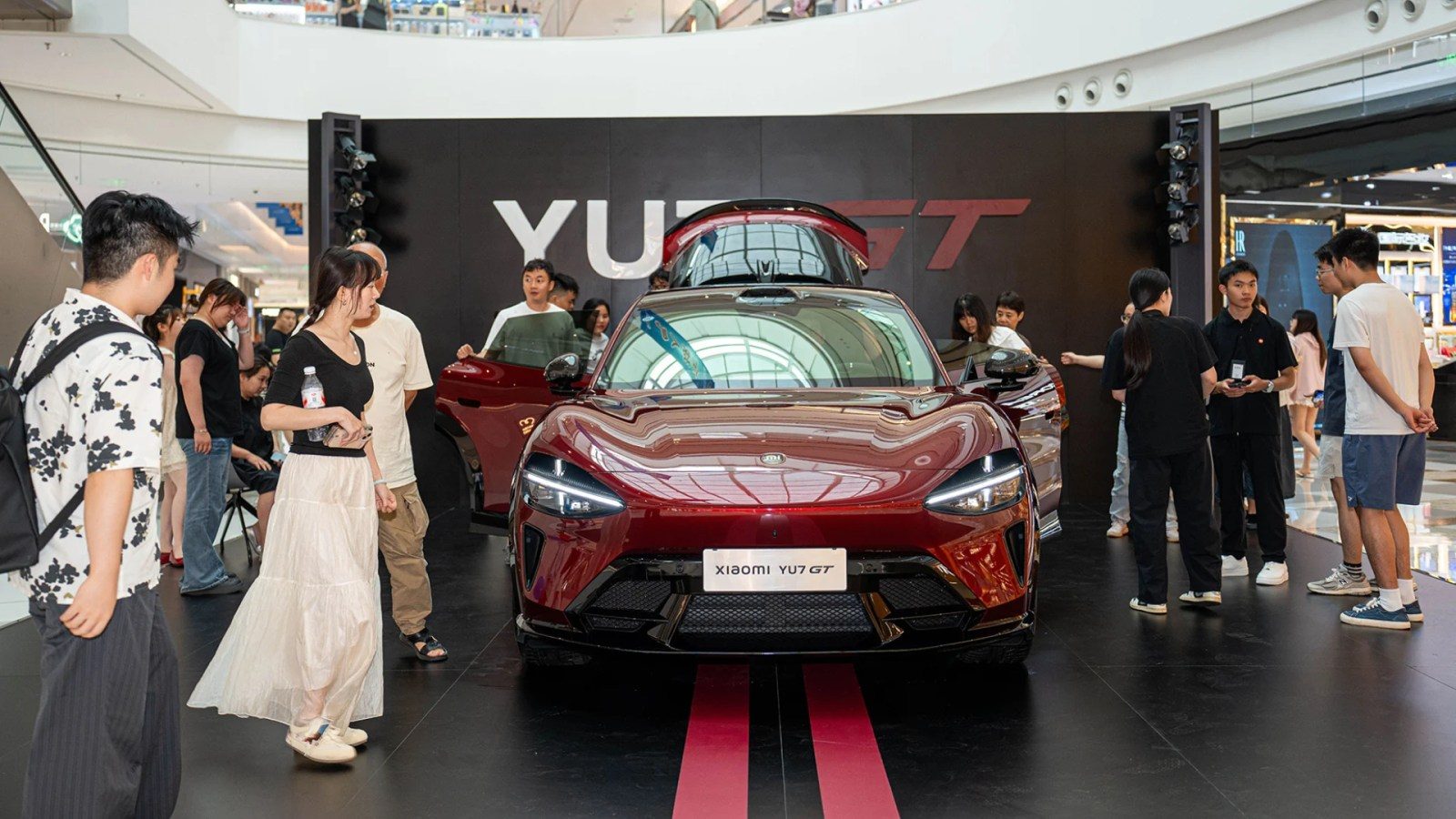
Xiaomi launched the YU7 GT at the same May 21 event, pricing the high-performance SUV from 389,900 yuan ($57,600).
A fully-loaded “Big Full Pack” configuration is priced at 429,900 yuan ($63,500). An optional GT Sport Package adds 34,000 yuan at list price, discounted to 14,000 yuan during the launch period.
The model is positioned as a GT-class SUV combining long-distance touring capability with track-level performance.
Xiaomi‘s YU7 GT produces 1,003 horsepower from a dual-motor all-wheel-drive system (288 kW front, 450 kW rear), reaches a top speed of 300 km/h, accelerates from zero to 100 km/h in 2.92 seconds, and offers a CLTC-rated range of 705 km (438 miles).
Development was led by the brand’s European R&D center in Munich, established in March 2025. The YU7 GT is the center’s first production-ready output.
It had been spotted testing at the Nürburgring in recent months ahead of the launch, and its regulatory filing appeared in February.
Xiaomi had pre-positioned display vehicles at 268 stores in 82 Chinese cities ahead of the launch.
CEO Lei Jun personally delivered six YU7 GT units to the first customers on May 29 during a livestream, alongside Taiwanese actress and brand ambassador Shu Qi.
Nürburgring Record
The Xiaomi YU7 GT set a 7:22.755 lap of the Nürburgring Nordschleife on April 2 with the optional Track Package installed, making it the fastest production SUV in the circuit’s recorded history.
That time is 14 seconds quicker than the previous record held by the Audi RS Q8 Performance (7:36.698). The Porsche Cayenne Turbo GT’s previous best of 7:38.925 ranked third.
Two days before the May 21 launch event, Xiaomi announced a separate certified run of 7:34.931 without the Track Package, driven by Xiaomi chief test driver Ren Zhoucan.
Ren became the first Chinese professional racer to receive official Nürburgring lap certification through the run.
Q1 Financial Results
Xiaomi released its first-quarter 2026 financial results on May 26.
The smart electric vehicle and AI innovation segment generated 19.9 billion yuan ($2.9 billion) in revenue, up 6.9% year-on-year. EV revenue alone reached 19.0 billion yuan.
The segment posted an operating loss of 3.1 billion yuan ($457 million), returning to the red after achieving its first quarterly profit in the third quarter of 2025 and a full-year operating profit for 2025.
Xiaomi attributed the margin compression to vehicle purchase tax subsidies, a lower delivery proportion of the higher-margin SU7 Ultra, and rising costs for core components.
The average selling price per vehicle was approximately 235,000 yuan ($34,700).
Cumulative deliveries since Xiaomi‘s first handover in April 2024 surpassed 655,000 vehicles by late April.
Europe Expansion
Xiaomi confirmed at its April 27 Investor Day that it will officially enter the European market in the second half of 2027, starting with Germany.
The company plans to move into right-hand drive markets in the first half of 2028, progressively covering the UK, Japan, Australia, and India.
Chief Technology Officer Hu Zhengnan said at the Beijing Auto Show that Europe was selected as the first stop based on two considerations: the need for a local team to understand European user needs and the continent’s concentration of high-performance and luxury vehicle engineering talent.
Spanish Prime Minister Pedro Sánchez visited Xiaomi’s Beijing headquarters in April as the company prepares to expand its European offensive.
Premium Strategy and Upcoming Models
CEO Lei Jun has ruled out entering China’s sub-100,000 yuan ($14,700) vehicle segment for up to a decade, reaffirming the brand’s premium positioning alongside Porsche and Tesla.
The company plans to launch four to six new vehicles this year, with prices ranging from roughly 200,000 to 550,000 yuan.
Beyond its all-electric lineup, Xiaomi is preparing to enter the extended-range electric vehicle (EREV) segment for the first time.
The company’s upcoming EREV SUVs — codenamed YU8 and YU9 — were spotted testing in China earlier this year in five- and seven-seat configurations, respectively.
According to Chinese media outlet ItHome, Xiaomi may launch the EREV family under a new sub-brand called “Sky Nomad” (寻天 in Chinese), with its own badge distinct from the Xiaomi car logo.
The sub-brand would reportedly sit below the main Xiaomi auto brand and focus on family-oriented and outdoor-use SUVs, with three models under the internal “Kunlun” codename.
Trademark filings show Xiaomi registered “寻天” across multiple categories as early as April 2023.