Xiaomi announced on Friday that it delivered “more than 30,000” vehicles in April, marking a sharp rebound from more than 20,000 units delivered in March.
The result compares to the more than 28,000 vehicles delivered in April 2025, when the brand’s lineup consisted solely of the SU7 sedan.
“In April 2026, Xiaomi Auto delivered over 30,000 vehicles,” the company wrote on the Chinese social media platform Weibo. “Thank you all for your choice and support!”
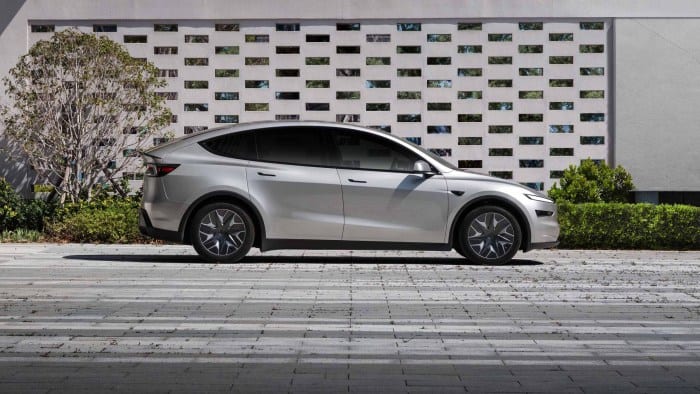
Xiaomi currently sells two fully electric models, the sedan SU7 and the SUV YU7.
The company does not disclose precise monthly delivery figures, instead reporting rounded estimates.
Exact data is released later by the China Passenger Car Association (CPCA).
Through the first four months of 2026, Xiaomi has delivered an estimated 109,000 vehicles — representing approximately 19.8% of its full-year target of 550,000 units.
The brand delivered more than 79,000 vehicles in the first quarter, with January accounting for over 39,000 units and both February and March reporting more than 20,000.
The March figure was weighed down by the SU7 production line switchover to the second-generation model.
At the Beijing Auto Show last week, co-founder and CEO Lei Jun disclosed that cumulative deliveries since the brand’s first delivery in April 2024 had surpassed 655,000 vehicles in 24 months.
He also confirmed that the second-generation SU7 had reached 60,000 locked orders and 26,000 deliveries in the 35 days since its March 19 launch.
The YU7 SUV — Xiaomi‘s second model, launched in June 2025 — reached 231,000 cumulative deliveries in 10 months.
To meet its 550,000-unit annual target, Xiaomi must average roughly 55,125 monthly deliveries from May through December — above the previous peak of 50,000 set in December 2025.
Beijing Auto Show
Xiaomi showcased its full production lineup at the 2026 Beijing Auto Show, which opened on April 24 in the tech giant’s home city and runs through May 3.
The company’s booth displayed the second-generation SU7, the YU7 SUV, and the SU7 Ultra — alongside a fully stripped SU7 body shell that allowed visitors to inspect the vehicle’s structure and engineering in detail.
The event also featured the domestic debut of the Xiaomi Vision Gran Turismo concept — a collaboration with Sony’s Gran Turismo racing franchise.
Xiaomi is the first Chinese brand to participate in the Vision Gran Turismo project.
The concept car, which first appeared in Spain ahead of MWC 2026, features an aerodynamic efficiency of 4.1 and a wind-resistance coefficient of 0.29. It will not enter production.
YU7 GT
Lei Jun used the Beijing show to officially confirm the YU7 GT, a high-performance variant of the YU7 SUV, for a late-May launch.
The model is positioned as a GT-class SUV combining long-distance touring capability with track-level performance.
Xiaomi’s YU7 GT produces 1,003 horsepower, reaches a top speed of 300 km/h, and offers a CLTC-rated range of 705 km.
The model measures 5,015 mm long, 2,007 mm wide, and 1,597 mm tall, with a 3,000 mm wheelbase — longer, wider, and lower than the standard YU7.
Development was led by Xiaomi‘s European R&D center in Munich, which was established in March 2025.
The YU7 GT is the Munich center’s first production-ready output. It has been spotted testing at the Nürburgring in recent months.
Leadership Overhaul
Xiaomi has been restructuring its auto division’s leadership ahead of its product expansion.
Earlier in April, the company appointed Hu Zhengnan as Vice President of Xiaomi Group and the first-ever CTO of its auto division.
Hu is an industry veteran who previously developed the BYD F3, Great Wall Haval H6, and Geely Boyue — some of China’s most commercially successful vehicles.
Song Gang, a former VP of Manufacturing at Tesla‘s Shanghai Gigafactory, was simultaneously appointed VP of the Auto Division and Chief of Staff.
Song is credited with leading the construction and ramp-up of the facility that became Tesla‘s highest-volume production plant globally.
The hires follow the recruitment of Kong Yanshuang, Tesla China’s former General Manager, who joined Xiaomi in early March to take charge of automobile sales.
Premium Strategy
CEO Lei Jun has ruled out entering China’s sub-100,000 yuan ($14,700) vehicle segment for up to a decade, reaffirming the brand’s premium positioning alongside Porsche and Tesla.
The strategy has been reinforced through brand partnerships. Xiaomi sponsored Maison Margiela’s Fall/Winter 2026 runway show in Shanghai on April 1 — the French fashion house’s first presentation outside Paris in its history.
The company plans to launch four to six new vehicles this year, with prices ranging from roughly 200,000 to 550,000 yuan ($29,300—$80,600).
EREV Expansion
Beyond its all-electric lineup, Xiaomi is preparing to enter the extended-range electric vehicle (EREV) segment for the first time.
The company’s upcoming EREV SUVs — codenamed YU8 and YU9 — were spotted testing in China earlier this year in five- and seven-seat configurations, respectively.
According to Chinese media outlet ItHome, Xiaomi may launch the EREV SUV family under a new sub-brand called “SKYNOMAD” (寻天 in Chinese), with its own badge distinct from the Xiaomi car logo.
The sub-brand would reportedly sit below the main Xiaomi auto brand and focus on family-oriented and outdoor-use SUVs.
The reports indicate three models under the internal “Kunlun” codename: a compact five-seat SUV, a large five-seat SUV, and a large seven-seat SUV.
A roof-rising camper variant has also been sighted in spy photos.
Trademark filings show Xiaomi registered “寻天” across multiple categories as early as April 2023.