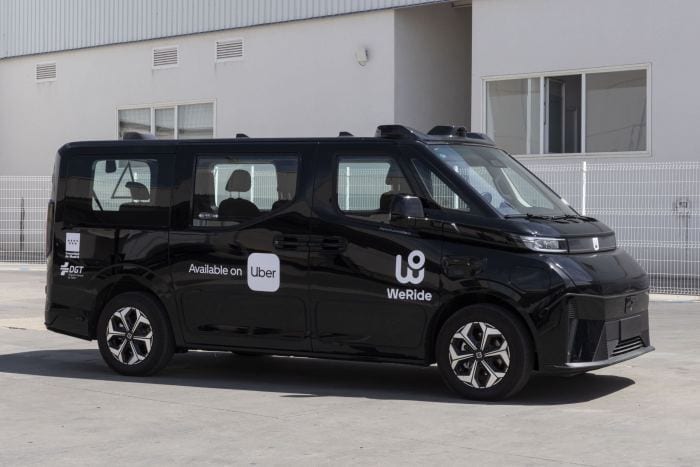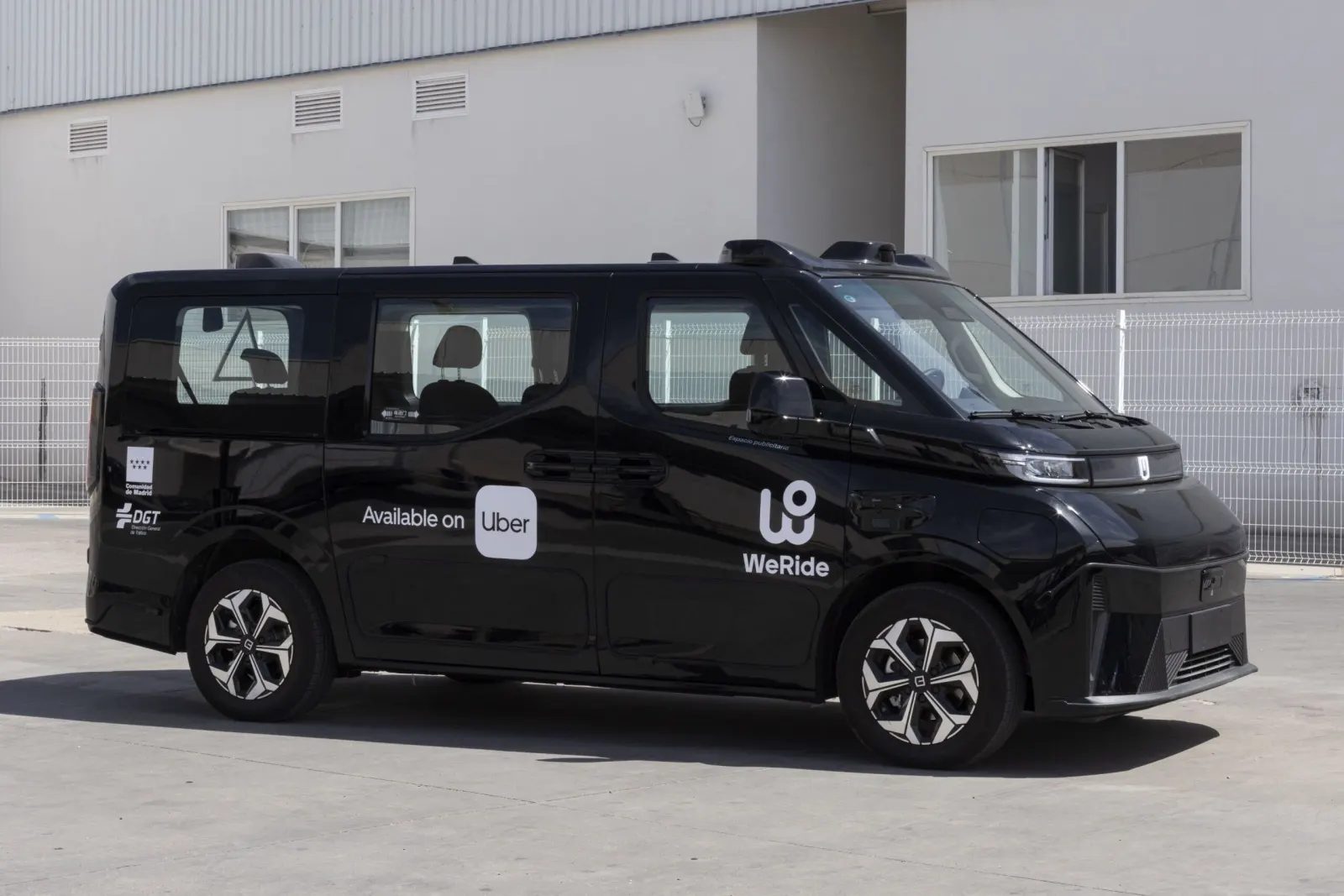

Spain’s Directorate General of Traffic (DGT) granted WeRide, Uber, and AVOMO the country’s first national permit for Level 4 autonomous passenger vehicles to operate on public roads.
The permit, issued on Thursday under the DGT’s ES-AV regulatory framework and announced with the Regional Government of Madrid as partner, authorizes an initial fleet of 20 WeRide GXR vehicles in the Greater Madrid region for mapping, route validation and operational-readiness testing.
The companies target commercial robotaxi service on the Uber app by the end of 2026, which depends on further regulatory and operational milestones the permit does not itself grant.
Vehicles will carry an in-car specialist during the initial phase. Mapping, route validation, and operational readiness testing begin immediately.
ES-AV is the DGT’s national programme for evaluating automated vehicles before regular service, with phased testing that begins with a safety operator on board.
The DGT permit covers the vehicles and their testing. Authorisation to carry paying passengers is a regional matter, which is why the Madrid government’s role is named in the release.
Fourth City Under the 15-City Deal
Madrid is the fourth city the release counts under the strategic partnership WeRide and Uber expanded to cover 15 cities and tens of thousands of autonomous vehicles on public roads by 2030.
The prior three cities named — Abu Dhabi, Dubai, and Riyadh — are all in the Middle East. Abu Dhabi’s fleet was averaging dozens of daily trips per vehicle and approaching breakeven unit economics as of February, according to company disclosures.
WeRide described the Spanish permit as its ninth autonomous driving authorization worldwide.
“Receiving this permit is a significant achievement for WeRide as it marks our ninth autonomous driving permit worldwide and a testament to our global leadership in commercializing autonomous vehicle services,” said Jennifer Li, Chief Financial Officer and Head of International at WeRide. “The Madrid region is a key gateway for our European expansion.”
AVOMO, the autonomous vehicle division of the Moove Cars Group, will handle fleet operations in Madrid — the same role the firm plays for Uber’s AV programs in Austin and Atlanta, where it manages around 400 vehicles with more than 200 specialists.
The arrangement follows WeRide’s asset-light model, in which local partners contribute fleet investment and day-to-day operations while WeRide supplies the autonomous driving technology and Uber provides the ride-hailing platform.
Uber’s European Robotaxi Push
The Madrid permit lands as Uber assembles an autonomous ride-hailing footprint across Europe, with a different technology partner in each city. Two supervised services are running, Zagreb and London.
Madrid is the first city with a national Level 4 passenger permit tied to the Uber app, and Zurich holds a driverless vehicle permit ahead of an Uber service.
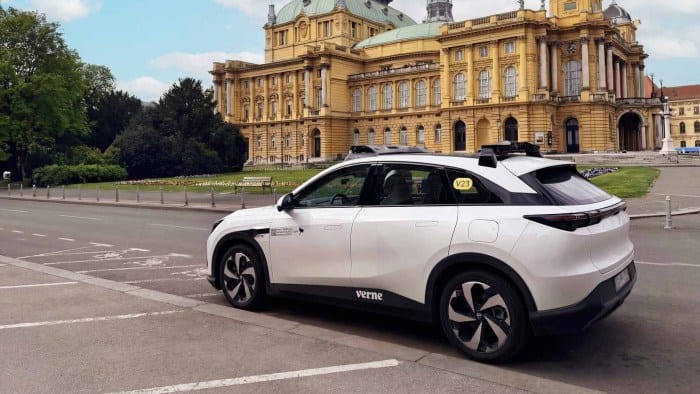
Zagreb became the first European city where passengers could book an autonomous ride through Uber on August 19, when Pony.ai, Rimac-backed Verne, and Uber launched commercial service in the Croatian capital.
Verne had separately launched what it called Europe’s first commercial robotaxi service in Zagreb in April using Pony.ai’s Gen-7 system on the Arcfox Alpha T5 electric SUV.
A licensed safety operator remains onboard at launch.
London followed on September 3.
Wayve and Uber began offering supervised autonomous rides using all-electric Ford Mustang Mach-E vehicles equipped with Wayve’s AI Driver.
Riders requesting UberX, Uber Electric, or Uber Comfort may be matched with a Wayve vehicle at no extra cost.
A Transport for London–licensed private-hire driver sits behind the wheel; fully driverless approval has not yet been granted.
More than 140,000 Londoners had opted in to receive autonomous rides through their Uber settings ahead of launch.
In Switzerland, WeRide and Uber announced plans in June to launch commercial robotaxi services in the Greater Zurich region, with Rydera as fleet operator.
WeRide secured a driverless permit from Switzerland’s Federal Roads Office in November 2025 — the first of its kind for a robotaxi in Europe — enabling autonomous operations on public roads in Zurich’s Furttal area. Commercial service through the Uber app is expected later this year, subject to remaining regulatory approval.
Broader European Landscape
Other programs are advancing but have not yet reached the same stage.
Uber is preparing to test Level 4 robotaxis with Chinese startup Momenta in Munich, though no commercial permit or public Uber-app service has been granted.
Waymo announced in August that Munich will be its second European city, with commercial rides targeted for the end of 2027.
WeRide also holds L4 permits in France for its Robobus in Valence and in Belgium for its Robobus in Leuven, but those services are not operated through the Uber app.
Sarfraz Maredia, Uber’s Global Head of Autonomous Mobility and Delivery, framed Madrid as a signal of the region’s direction.
“The Madrid region is quickly establishing itself as one of Europe’s most forward-looking environments for autonomous mobility, and we’re excited to be working alongside our partners to help make that vision a reality,” Maredia stated.
WeRide’s Asset-Light Playbook
WeRide says it has deployed autonomous vehicles across more than 60 cities in 13 countries, according to the company’s latest disclosure.
Each new market follows the same structure: WeRide provides the autonomous driving technology through its WeRide One platform, a local partner runs the fleet, and a ride-hailing platform — in this case Uber — handles demand and rider experience.
Uber has committed more than $10 billion to purchasing autonomous vehicles and taking equity stakes in AV developers, according to Financial Times calculations based on deal disclosures and analyst estimates.
CEO Dara Khosrowshahi has described the multi-partner model as a deliberate platform strategy.
In February, the company formed Uber Autonomous Solutions, a business unit consolidating physical and digital infrastructure, rider experience tools, and fleet operations services for AV developers.
The Madrid deployment remains subject to additional operational and regulatory milestones before commercial rides begin.
WeRide said commercial operations are expected by the end of 2026, with the permit now establishing the regulatory foundation for autonomous transportation services across Spain and the broader European market.