
The next checkpoint in Lucid‘s robotaxi programme with Nuro and Uber falls in August, which begins on Saturday.
A timeline published in the EV maker’s first-quarter shareholder deck on May 5 sets out eight dated stages between the July 2025 signing and commercial launch.
Five carry completion marks, the last of them in April. The next, completing 35 product-validation prototypes, is dated August.
Two remain after that.
Production of vehicles for commercial launch and the start of safety and validation work are both scheduled for early in the fourth quarter, with the start of commercial operation in late 2026.
The company reports second-quarter results on August 4, the first scheduled opportunity to confirm whether the August milestone is on course.
The Roadmap Lucid Published
The slide, headed “Uber / Nuro partnership on-track for commercial launch this year,” charts the programme against dates rather than quarters.
Marked complete were the agreement signed in July 2025, delivery of the first alpha prototype in September, public road testing in January that produced the first public sighting weeks later.
Additionally, also the delivery of 75 alpha prototypes in March, and in April, both the California DMV driverless testing permit and the start of robotaxi test rides by Uber and Nuro employees.
On July 17, 2025 Uber committed $300 million and at least 20,000 vehicles. On April 14, 2026 it added $200 million and raised the purchase commitment to at least 35,000.
Thirty-five validation prototypes in August, production beginning early in the fourth quarter, and paying passengers before the year closes compresses roughly four months of work into a sequence with no stated slack.
The Fleet Count, Clarified
The deck also narrows a figure that had been reported two ways.
Nuro said in March that its engineering fleet numbered “almost 100” vehicles, a figure it repeated in mid-April.
Lucid‘s own timeline records 75 alpha prototypes delivered in March, matching what management told the first-quarter call.
The two counts measure different things rather than contradicting each other, as Lucid reports what it delivered, and Nuro reports what it operates.
What Uber Has Committed
Uber‘s original agreement covered at least 20,000 Gravity SUVs over six years, alongside a $300 million equity investment in Lucid that closed in September 2025 and a separate multi-hundred-million-dollar stake in Nuro.
On April 14 the commitment rose to a minimum of 35,000 vehicles and the equity investment to $500 million, with an additional $200 million injected.
The enlarged order splits into at least 10,000 Gravity SUVs and 25,000 vehicles built on Lucid‘s forthcoming midsize platform.
Uber reported holding 37,753,583 Lucid Class A shares through its SMB Holding Corporation subsidiary in April.
Vehicles will be owned and operated by Uber or third-party fleet partners and offered exclusively through its app.
Lucid management has consistently framed the volume as a floor rather than a ceiling.
Chief financial officer Taoufiq Boussaid told the company’s inaugural Investor Day in March that “20,000 over six years is a drop of water for us,” while former interim chief executive Marc Winterhoff had earlier said the company wanted the number “to be much bigger than that.”
Nuro President Dave Ferguson has declined to size Uber’s investment in his own company, saying only that “Uber is investing in Nuro in a standard equity stake.”
The Vehicle
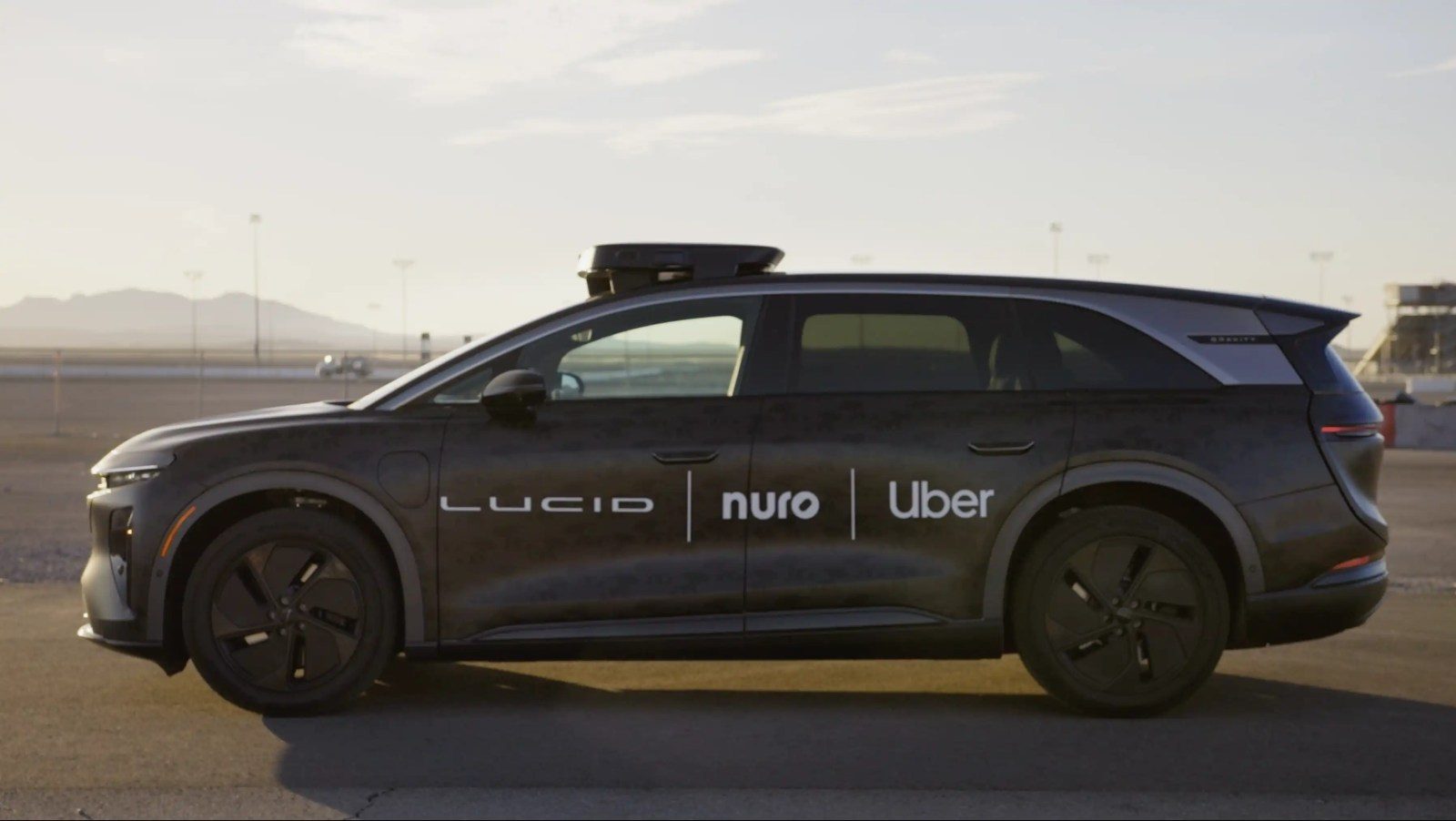
Robotaxi-specification Gravity SUVs are assembled at Lucid‘s AMP-1 plant in Casa Grande, Arizona, with Nuro‘s autonomy hardware integrated directly on the production line rather than retrofitted afterwards.
Nuro installs and commissions its Level 4 software before vehicles enter Uber‘s fleet.
The sensor package centres on a low-profile roof-mounted module Nuro calls Halo, supported by high-resolution cameras, solid-state LiDAR and radar giving 360-degree coverage, with compute provided by Nvidia’s DRIVE AGX Thor platform.
The production-intent vehicle and Uber-designed cabin were unveiled at CES in January.
Configurations seat up to six with luggage space, and riders get interactive screens for climate, seating and audio, the ability to request a pull-over, and a visualisation display showing what the vehicle perceives. An exterior display shows passenger initials at pickup.
Sarfraz Maredia, Uber‘s global head of autonomous mobility and delivery, described the objective at the unveiling as “affordable and scalable autonomous rides in the San Francisco Bay Area and beyond.”
Twelve Months of Milestones
The first robotaxi prototype was already running autonomously on a closed circuit at Nuro’s Las Vegas proving grounds on the day the partnership was announced.
Lucid delivered its first engineering prototype in September 2025, built in Arizona and shipped to Nuro’s Newark, California headquarters, where Level 4 systems were installed less than two months after the deal was signed.
Autonomous on-road testing began in the Bay Area in December, supervised by human operators. The first public sighting followed in February, when a Reddit user photographed a sensor-equipped Gravity near Levi’s Stadium in Santa Clara.
April brought test rides for Uber employees, requested through the Uber app in the Bay Area with a safety driver aboard. Nuro said the rides allowed teams to evaluate the experience “from requesting a ride in the Uber app to pickup, the in-vehicle experience, and dropoff.”
May delivered the regulatory breakthrough. Nuro’s six-year-old California DMV driverless testing permit, previously covering only its low-speed delivery vehicles, was extended to the Lucid Gravity — first disclosed by Winterhoff on the first-quarter call, then confirmed by the DMV.
Days later the company secured a Drivered Pilot Permit from the California Public Utilities Commission, allowing passenger carriage during pilot testing with a safety driver.
The DMV authorisation covers driverless operation in Santa Clara and San Mateo counties at speeds up to about 45 mph, day or night, and in conditions including light rain and fog.
Neither authorisation permits paid commercial rides. Charging passengers for driverless service requires a further DMV deployment permit and separate CPUC ride-hailing authorisation, neither of which has been granted.
In mid-June Napoli disclosed that Lucid was preparing to build the first production validation robotaxis at Casa Grande. Winterhoff had told the first-quarter call that validation builds would start in the second quarter, with regular production for commercial sale targeted for the fourth.
On June 17 the partners named Houston as the second market, for launch in mid-2027.
The city was selected as the fourth-largest in the United States, for the variety of trip types it generates and for a regulatory environment the partners described as supportive.
Nuro has operated in Houston since 2019 and has already run Level 4 autonomous driving on its public roads, accumulating experience in rain, storms and roadway debris.
Uber has secured a 50,000 square foot depot and dedicated charging facility there, specified for 40 fast chargers, 15 service bays and roughly 4 MW of power, with construction due to begin in early 2027. Nuro is running round-the-clock supervised autonomous testing in both Houston and the Bay Area.
On July 7, after hosting Uber staff at its headquarters, Nuro said the programme remained on track for a Bay Area launch this year, citing “lots of great progress and momentum” as the three teams geared up.
The company has separately published video of the robotaxi in testing.
Napoli took his first ride in a robotaxi alongside Nuro co-founder and co-chief executive Jiajun Zhu, writing afterwards that the integration was impressive and that the speed of progress across the three companies was more so.
The Opening Nobody Has Claimed
A third market may already be in play.
In late June Uber confirmed it was preparing a new autonomous vehicle partnership in Phoenix, days after Waymo robotaxis disappeared from the Uber app there, ending an arrangement that had run for close to three years.
Uber has not named a partner.
Lucid and Nuro are the obvious candidates: Casa Grande sits roughly 50 miles from Phoenix, the vehicles are already built in Arizona, and no other Uber autonomy partner has a comparable local manufacturing presence.
Neither company has commented.
Scale Against the Incumbent
The programme has yet to carry a paying passenger.
Waymo, by contrast, operated roughly 3,000 vehicles across eleven US metropolitan areas and reported about 500,000 paid rides a week in March, has since added driverless service in further markets, and is targeting one million weekly rides by the end of the year.
Its sixth-generation Driver uses 13 cameras, four LiDAR units and six radars — a multi-sensor architecture closer to Nuro’s than to Tesla’s camera-only approach.
Lucid, Nuro and Uber are aiming at a premium segment rather than at Waymo’s volume, and the vehicle reflects that: a six-seat luxury SUV with a bespoke cabin rather than a converted crossover.