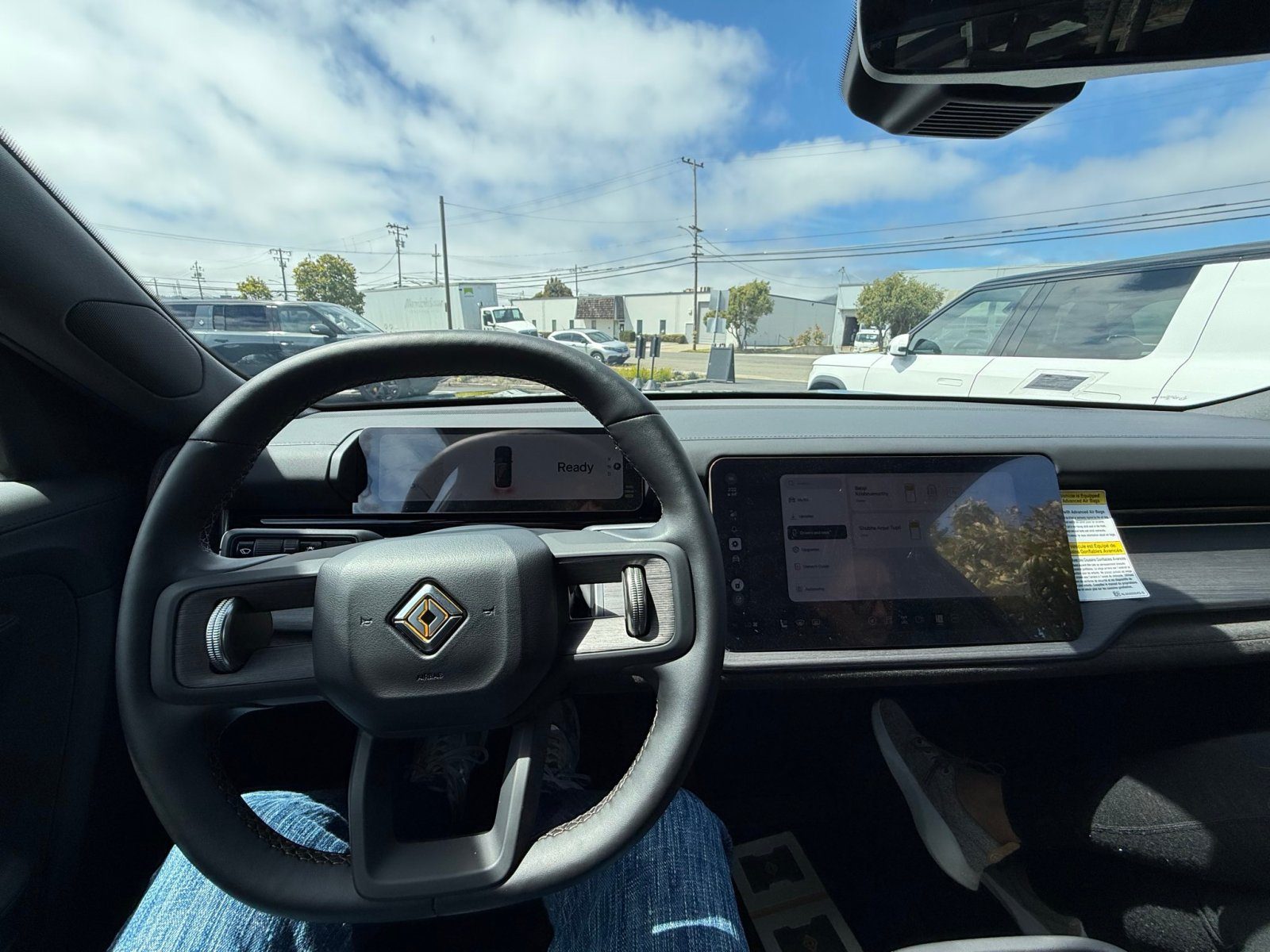

Uber’s chief financial officer said on Friday he had bought a Rivian R2 Launch Edition, days after Rivian‘s founder and CEO personally demonstrated the company’s forthcoming Autonomy+ system to him.
Balaji Krishnamurthy wrote on X that RJ Scaringe had given him a preview of the system the previous week, and that “it flawlessly drove from Sunnyvale to Cupmertino and back.”
Sunnyvale and Cupertino are about seven miles apart.
He said he had traded in his own car for the R2 while sharing photographs of the vehicle.
Uber committed in March to invest up to $1.25 billion in Rivian and to purchase autonomous R2s, in an agreement whose remaining tranches depend on Rivian meeting autonomy milestones that neither company has disclosed.
The Buyer
Krishnamurthy became Uber’s chief financial officer on February 16, one month before the Rivian agreement was announced.
He joined Uber in 2019, led investor relations from 2020 to 2023 and served as vice president of strategic finance from 2023 until his promotion.
Chief Executive Dara Khosrowshahi described him in the announcement filing as “a brilliant, decisive strategist.”
He is Uber’s third finance chief in just over three years, succeeding Prashanth Mahendra-Rajah, who held the role from November 2023 and remained as a senior finance adviser until July 1.
Krishnamurthy held a board seat at the autonomous trucking company Waabi from September 2024 until March 2026, according to his LinkedIn profile.
On Uber’s fourth-quarter earnings call, he said the company would invest capital in its autonomous vehicle software partners, take equity stakes in or sign offtake agreements with vehicle makers, and support infrastructure partners.
What the Deal Requires
Uber’s initial $300 million investment in Rivian was committed on signing, equivalent to about 19.55 million shares.
The remaining $950 million is contingent on Rivian achieving autonomous performance milestones by specific dates through 2031. The milestones have not been made public.
Uber, or its fleet partners, are expected to purchase 10,000 fully autonomous R2 robotaxis, with an option to negotiate up to 40,000 more from 2030. Deployments are planned for San Francisco and Miami in 2028, scaling to 25 cities by 2031, with the vehicles available exclusively on Uber’s platform.
Autonomy+
Rivian has said it is aiming for supervised point-to-point driving — address to address, including city streets and intersections — in a limited rollout later this year, ahead of a broader release in 2027 and Level 4 operation for the Uber deployments in 2028.
The post does not say whether a safety driver was present, what route was taken, how long the drive lasted, or whether the vehicle was a production R2 or a development mule.
Rivian’s third-generation autonomy platform, announced in December, pairs 11 cameras totalling 65 megapixels with five radars and one lidar, running two in-house RAP1 chips rated at 1,600 TOPS. The hardware is due to reach R2 late this year.
The Vehicle
The R2 Launch Edition is the only configuration Rivian currently sells, at $57,990 before destination.
A Premium trim follows at $53,990 in late 2026, a Standard Long Range at $48,490 in early 2027 and a further Standard at $44,990 in the summer of 2027.
Rivian has declined to disclose how many R2s it built in the second quarter, leaving most of a 20,000-to-25,000 full-year target to the second half. Cox Automotive data implies about 789 units reached US buyers between April and June.
The model has also produced five separate quality issues in the first 47 days of customer deliveries, spanning paint, exterior lighting software, high-voltage battery hardware, charging equipment and cabin components.
EV exclusively reported in July that a person familiar with the matter attributes the pre-delivery inspection failures to the October 2025 restructuring that dismantled the teams responsible for them.
An owner reported last week that a day-old R2 had been towed after failing to wake from deep sleep, with Rivian ordering a rear multifunction module.
Uber’s Wider Position
Khosrowshahi told investors in February that autonomous vehicles would unlock what he called a “multitrillion-dollar opportunity,” and that Uber expected to facilitate autonomous trips in as many as 15 cities globally by the end of 2026 and to be the largest facilitator of such trips worldwide by 2029.
Uber formed partnerships with at least 20 autonomous vehicle companies, including a separate agreement with Lucid and Nuro covering a minimum of 35,000 vehicles, Waymo vehicles bookable through the Uber app in Atlanta and Austin, and Volkswagen ID. Buzz vans.
Its robotaxis will be available only through Uber while Uber’s platform carries multiple suppliers.