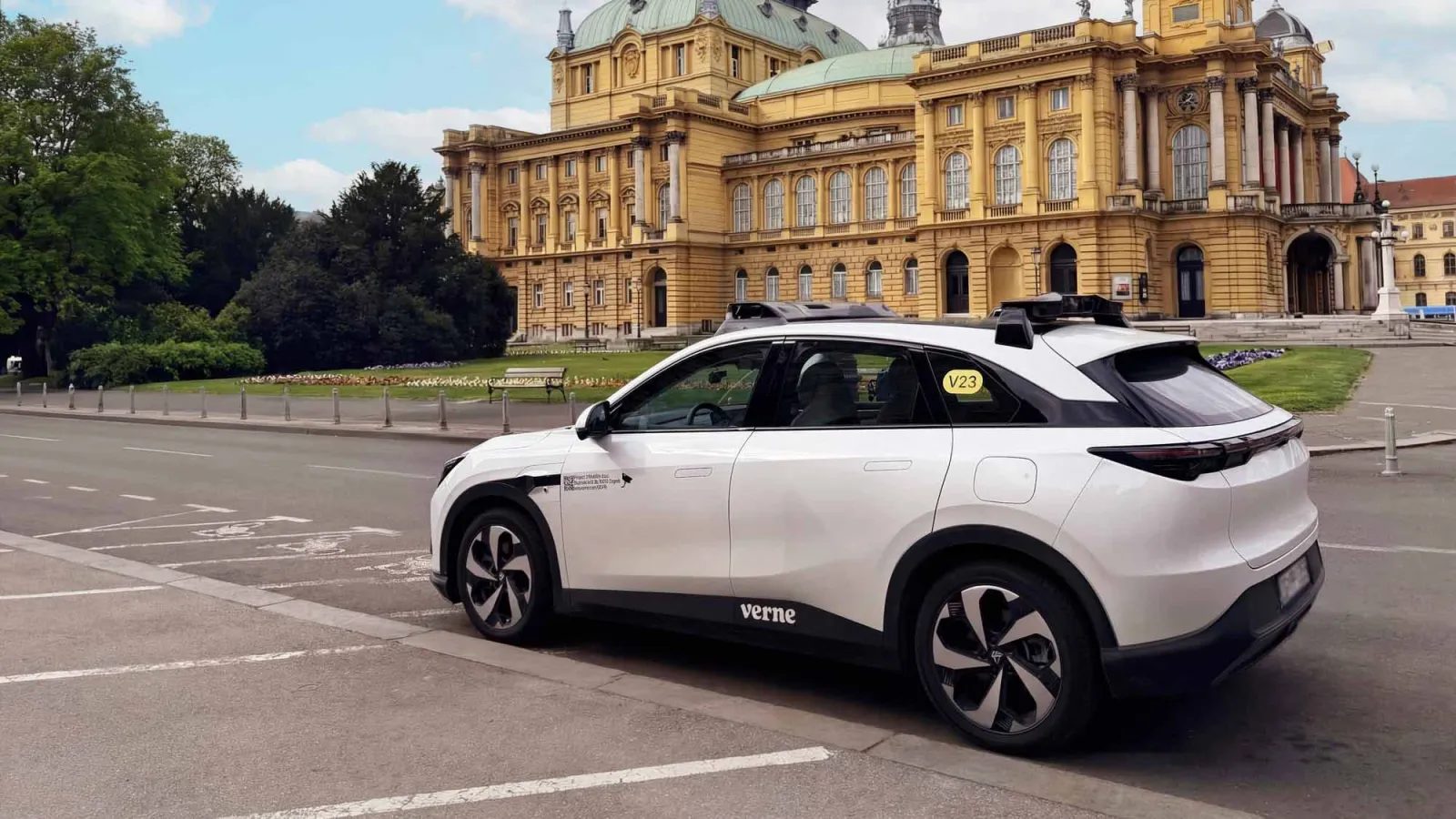

Pony.ai and Verne have begun fully driverless robotaxi test rides with passengers on public roads in Zagreb, Croatia, removing the human safety operator from the vehicle for the first time in a European robotaxi program.
Invited passengers can ride a 22-kilometer route linking Verne’s headquarters and one of Zagreb’s main business districts with Franjo Tuđman Airport.
Pony.ai described the milestone on Thursday as a European first.
Fully driverless routes will be expanded over the coming months to cover Verne’s entire operating area in the Croatian capital, the companies said.
What Changed
Verne launched what it called Europe’s first commercial robotaxi service in Zagreb on April 8, with rides bookable through the Verne app and fares charged to the public, across about 90 square kilometres of the wider city centre including the airport, from 7 a.m. to 9 p.m.
Uber integration followed on August 19, when passengers could begin hailing Pony.ai-powered vehicles through the Uber app.
Both of those services run with a licensed safety operator behind the wheel monitoring every trip.
Thursday’s announcement is different in kind, not degree. Pony.ai and Verne are now conducting parallel test rides with no human operator in the vehicle — a step toward eventually removing the operator from the commercial service entirely.
Verne CEO Marko Pejković framed the move as advancing “from autonomous driving with an onboard AV operator toward fully driverless operations.”
Access remains restricted to invited passengers, and the commercial Uber-integrated service continues to operate with an operator onboard.
The companies have not said how many vehicles are in the driverless test, whether the cars are monitored remotely, or which Croatian approval covers the passenger tests beyond “applicable Croatian regulations.”
Since the April launch, the Zagreb fleet has logged more than 200,000 kilometers in operations, completed several thousand customer rides, and achieved an average passenger rating of 4.7 out of 5, according to the companies.
Technology and Safety
The test rides use Pony.ai’s seventh-generation robotaxi, powered by an L4 domain controller the company developed on Nvidia DRIVE AGX and running on the safety-certified DriveOS operating system.
Pony.ai said the vehicle features a safety architecture combining 360-degree sensor coverage with multiple layers of redundancy and fail-operational capabilities.
The system has been deployed on the Arcfox Alpha T5, a battery-electric SUV produced by BAIC’s premium EV brand.
Pony.ai pointed to its Chinese operations as validation.
The company currently runs fully driverless commercial services in four major Chinese cities and has logged more than 100 million kilometers in autonomous operations worldwide, including over 40 million kilometers in fully driverless mode.
Moving that technology into European conditions — different road infrastructure, driving patterns, and regulatory frameworks — and running without a human operator represents a distinct operational challenge.
Fully driverless testing in Zagreb is being conducted in accordance with applicable Croatian regulations and the approvals required for autonomous vehicle testing with passengers on public roads, the companies said.
Pony.ai’s European Expansion
Zagreb is one node in a broader European push.
Pony.ai expanded its collaboration with Uber in August to deploy more than 2,000 robotaxis across five European cities, adding four markets to the existing Zagreb operation.
The deal also includes plans for deployment in the Middle East.
Recent partnerships have expanded Pony.ai’s overseas deployment pipeline to more than 4,000 robotaxis in total.
Pony.ai is targeting a global fleet of more than 3,500 robotaxis by the end of 2026, with operations spanning more than 20 cities worldwide.
Pony.ai founder and CEO James Peng said the Zagreb progress “provides a strong foundation for expanding fully driverless mobility across Europe and other international markets.”
Pony.ai calls its expansion approach a “dual-engine” growth strategy, scaling its robotaxi business across both China and international markets simultaneously.
Overseas, the company operates through a joint deployment model — Pony.ai provides the autonomous driving technology, a local partner handles fleet operations, and a ride-hailing platform supplies rider demand.
The mix of partners can vary by market.
Separately, Stellantis and Pony.ai have an agreement to build robotaxis for European deployment using Peugeot e-Traveller vans, with testing underway in Luxembourg.
European Robotaxi Landscape
Uber is rapidly assembling an autonomous ride-hailing footprint across Europe, each market paired with a different technology partner.
Zagreb was the first European city where passengers could book an autonomous ride through the Uber app, followed by London on September 3, when Wayve and Uber began offering supervised autonomous rides in all-electric Ford Mustang Mach-E vehicles.
A Transport for London–licensed private-hire driver sits behind the wheel in London; fully driverless approval has not been granted.
In Spain, WeRide and Uber secured the country’s first national Level 4 autonomous vehicle permit for an initial fleet of 20 vehicles in the Greater Madrid region, with commercial service expected by the end of 2026.
In Switzerland, WeRide holds a driverless permit from the Federal Roads Office for operations in Zurich’s Furttal area — the first of its kind for a robotaxi in Europe — with commercial Uber-app rides expected later this year.
Waymo announced in August that Munich will be its second European city, with commercial rides targeted for the end of 2027.
Uber is also preparing to test Level 4 robotaxis with Chinese startup Momenta in Munich.
None of those programs, however, have reached the stage Zagreb reached on Thursday.
Across Europe, all commercial robotaxi rides on public roads still require a human operator inside the vehicle.
Zagreb’s fully driverless test rides — even limited to invited passengers — represent the first time a European robotaxi program has moved to testing without anyone behind the wheel.