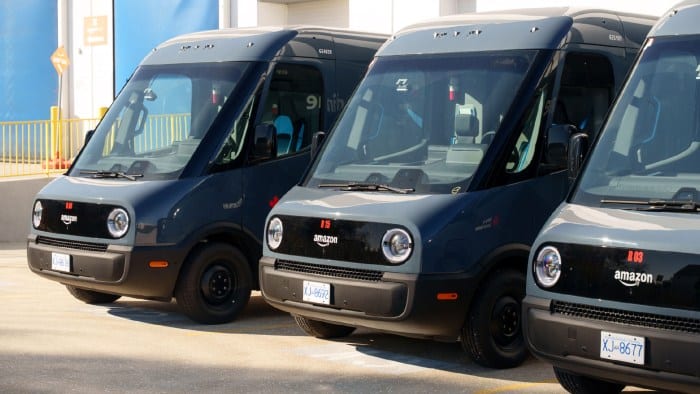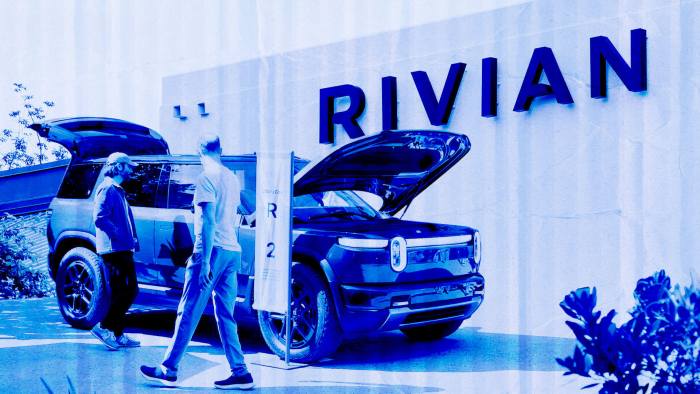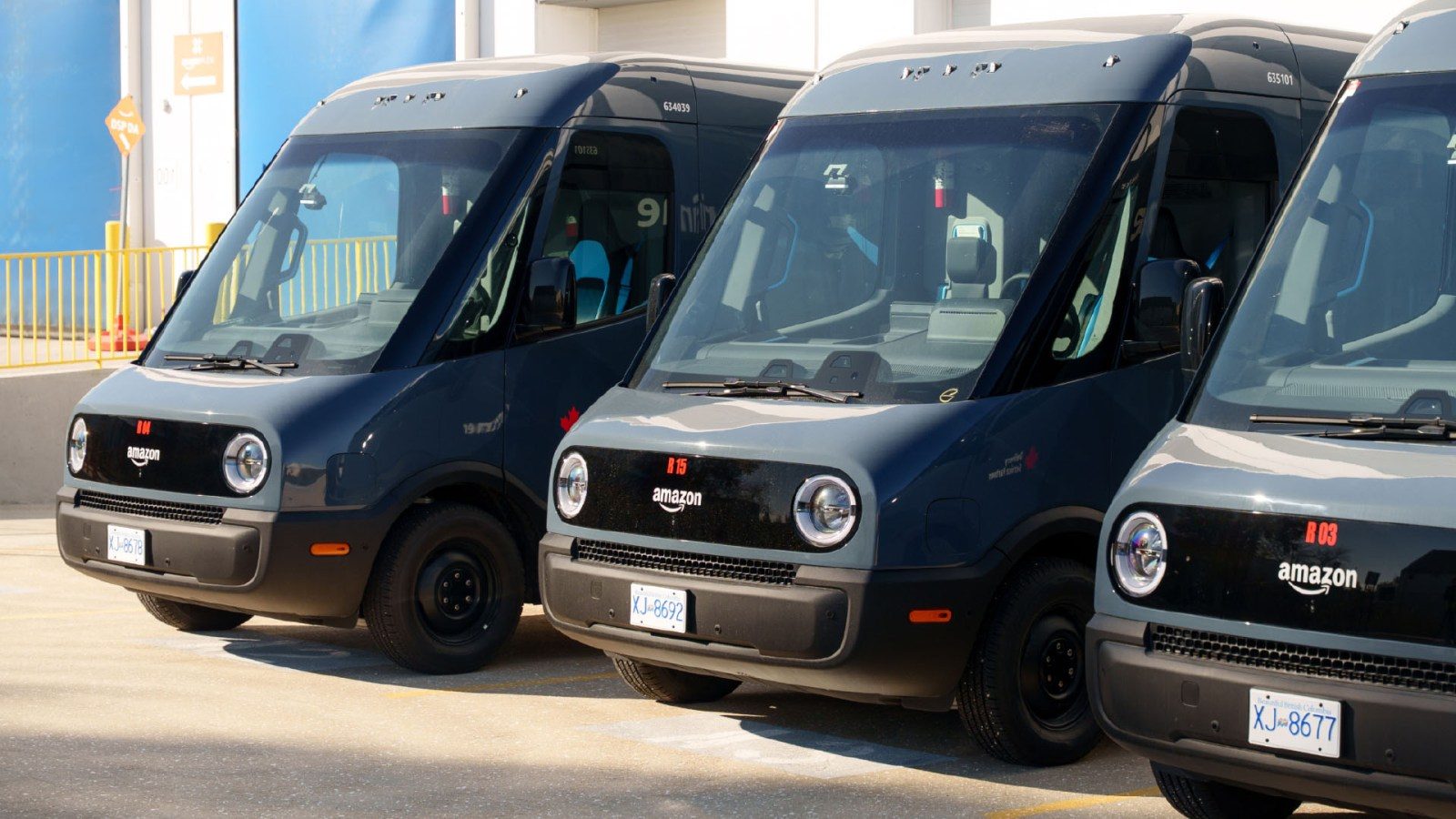

Rivian sold an estimated 8,469 electric delivery vans in the US in the third quarter, more than three times as many as a year earlier and the highest quarterly total in Cox’s estimates, according to data released on Monday.
The figure was up 220.9% from 2,639 in the third quarter of 2025 and 111.6% from 4,003 in the second quarter.
It was also 87.8% above the previous quarterly peak of 4,509 in the third quarter of 2024, in Cox’s revised estimates.
Cox reports the EDV 500 and EDV 700 as a single line. Rivian builds the vans at its plant in Normal, Illinois, alongside the R1 and the R2.
Most of the vans go to Amazon, whose founder, Jeff Bezos, announced an order for 100,000 of them at the National Press Club in Washington on September 19, 2019, seven months after Amazon led a $700 million investment round in Rivian.
Bezos said at the time that he expected the first vans on the road in 2021 and all 100,000 by 2024.
Amazon began rolling out the vans in the summer of 2022 and now aims to have at least 100,000 electric delivery vans on the road globally by 2030, according to the company.
The 2019 agreement required Rivian to sell its vans only to Amazon until the order was fulfilled, a restriction the two companies ended in November 2023, allowing Rivian to sell to other fleets.
Amazon, which owned about 17% of Rivian at the time, remained its largest shareholder until Volkswagen overtook it in May 2026.
Neither Cox nor Rivian discloses how many vans go to Amazon.
Cox’s US van estimates add up to about 40,800 from 2022 through the second quarter of 2026, close to the more than 40,000 vans Rivian said were in Amazon’s North American fleet at the end of that period.
9 Months, a Full Year’s Volume
Rivian sold an estimated 15,685 vans in the US in the first nine months of 2026, up 130.4% from a year earlier, according to Cox.
That is more than in any full year in Cox’s estimates, 59.6% above the 9,830 vans sold in all of 2025 and 16.9% above the 13,423 sold in 2024.
Quarterly sales ran between 2,207 and 4,509 vans in 2024, before dropping to 1,469 in the first quarter of 2025.
Van sales fell about 27% in 2025 as a whole, after Rivian said it expected fewer van deliveries that year because it had delivered additional vans to Amazon in the fourth quarter of 2024.
Sales then rose each quarter, from 3,021 in the fourth quarter of 2025 to 3,213 in the first quarter of 2026, 4,003 in the second and 8,469 in the third.
Cox’s quarterly figures are estimates and have been revised over time. The firm raised its third-quarter 2024 estimate from 4,170 vans in its original report to 4,509, and cut its second-quarter 2024 figure from 2,344 to 2,207.
A Bigger Share of Rivian
The vans accounted for 44.0% of Rivian’s estimated 19,239 US sales in the third quarter, up from 35.1% in the second quarter and 20.0% a year earlier.
They outsold the new R2 SUV, at an estimated 3,456 units, by nearly 2.5 to 1, and the R1S, at 5,582, by 51.7%.
Cox’s estimate of Rivian’s US sales rose by 7,834 units from the second quarter, and the vans accounted for 4,466 of that increase, or 57.0%.
Rivian delivered a record 19,248 vehicles in the quarter, without breaking out its vans.
The company said earlier this year that its automotive revenue per unit had declined partly because of “a higher mix of commercial vans.”
Chief Financial Officer Claire McDonough said on April 30 that Rivian anticipated “R1 combined with the commercial vans to be roughly flat relative to our 2025 delivery results,” with the R2 making up the rest of its growth.
Cox’s estimates put combined R1 and van sales in the first nine months 16.1% above the same period of 2025, as the vans more than offset a 14.4% decline in the R1.
The vans took 3.2% of the US electric vehicle market in the quarter, in which total sales rose 7.7% from the second quarter to 266,630, according to Cox Automotive.
The Amazon Account
Amazon’s purchases have reshaped Rivian’s revenue.
Revenue from Amazon, mainly from van sales, reached $554 million in the second quarter, up from $176 million a year earlier, and $1.02 billion in the first half, according to Rivian’s quarterly filing.
Amazon accounted for 52% of Rivian’s automotive revenue in the first quarter, up from about 11% a year earlier.
Rivian recognizes revenue from van sales under a bill-and-hold arrangement, the filing shows, an accounting treatment under which revenue can be booked while the seller still holds the vehicles.
Amazon passed 50,000 electric vans in its fleet in June, more than half of them from Rivian.
Rivian said in July that Amazon’s fleet of its vans had passed 40,000 across North America in the second quarter, up from more than 30,000 in February, and that the vans had covered one billion miles.
Amazon began deploying the vans in Canada last year, and about 600 operate in Germany.
“You’re seeing this already in the numbers of the first two quarters this year, that Amazon is purchasing more vans,” founder and CEO RJ Scaringe told analysts on July 30.
“Now, that has taken longer than we would have expected, or we would have hoped for,” he said.
Amazon has also tested electric delivery vans from General Motors, piloting about a dozen in 2025.
Amazon’s plan to cut its use of the US Postal Service in favor of its own delivery network could add further demand for the vans.
The fleet has also drawn regulatory scrutiny, with US safety regulators opening a probe into 17,200 Rivian vans over seat-belt anchor failures in 2025, and Rivian issuing an over-the-air update to fix seat-belt damage in nearly all of its delivery vans that December.
New Variants and Other Fleets
The van line is about to widen.
Rivian won US Environmental Protection Agency certification in September for all-wheel-drive and larger-battery versions of the van, which it is developing with Amazon, with the 129-kilowatt-hour pack adding about 36% to the van’s range in laboratory testing.
The company has not said when deliveries of those versions will begin.
Rivian is also investigating more autonomy for future versions of the van, James Philbin, Senior Vice President of Autonomy and AI, said this month.
Rivian opened van orders to other fleets in early 2025, at $79,900 for the 500 and $83,900 for the 700, and has since delivered 70 vans to HelloFresh and added customers such as Slice, Illinois service firm Wm. Masters, Texas finance company Xcelerate Auto and Vancouver-based Jetson.
Rivian appointed Dan Pisegna as Director of Fleet Sales in August.
The company is also hiring for its van engineering team, and vans from Rivian and General Motors earned the only Good ratings in the Insurance Institute for Highway Safety’s first pedestrian crash-avoidance test for commercial vans this month.
The Rivian van was rated Marginal in the institute’s vehicle-to-vehicle test.
Rivian will report third-quarter results on October 29.