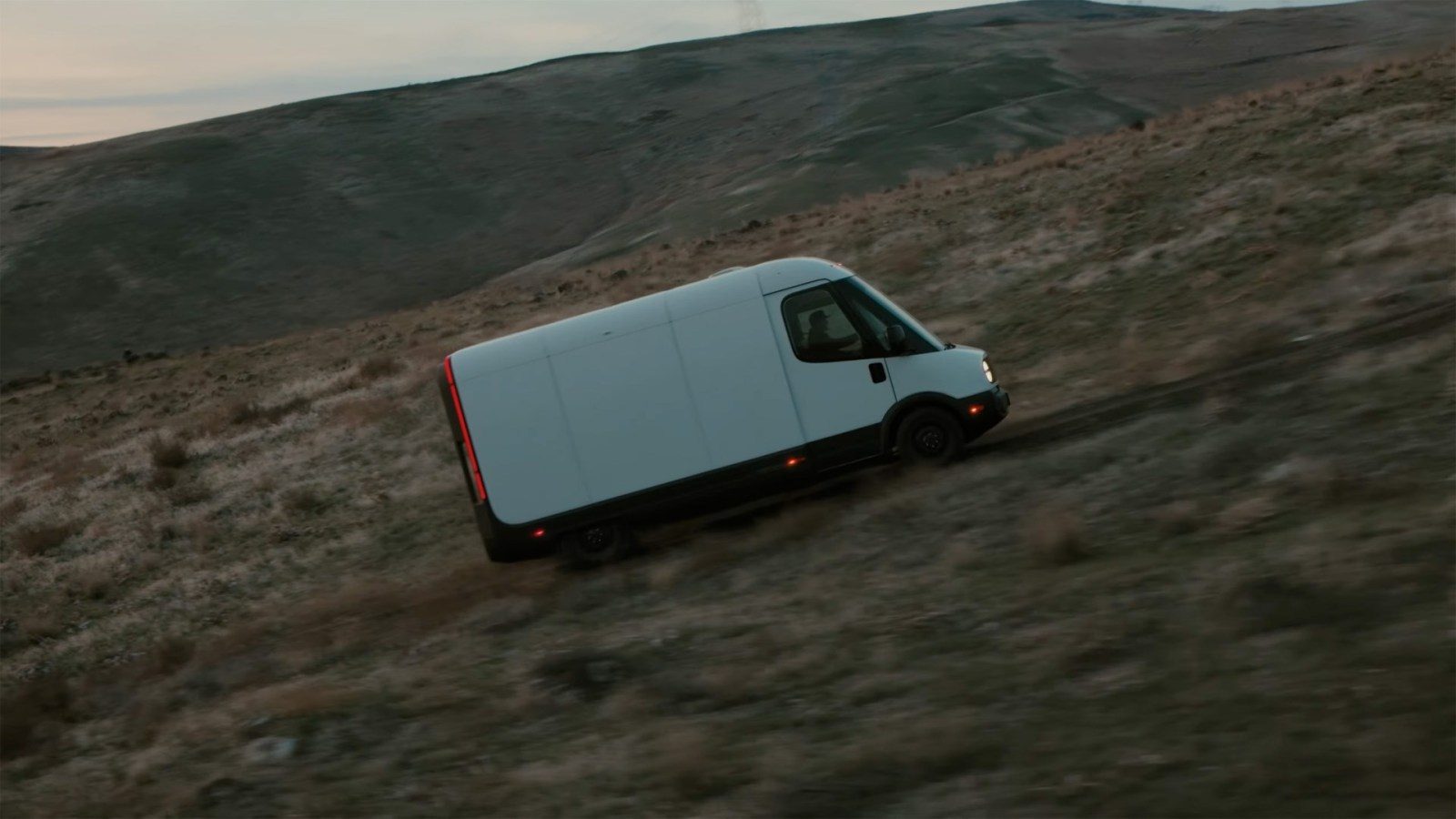

Rivian sold 4,003 of its commercial delivery vans in the second quarter, its strongest quarter in more than a year, according to Cox Automotive figures released on Friday.
The tally is up 48% from the 2,701 vans sold a year earlier and 25% higher than the first quarter’s 3,213.
Cox counts the two commercial models — the EDV 500 and the larger EDV 700 — as a single figure and does not split them out.
These are sales estimates drawn from registration data, a separate measure from Rivian‘s company-wide delivery total and from what it builds at its Normal, Illinois plant.
The strongest quarter since 2024
At 4,003 units, the quarter was Rivian‘s best for van sales since the fourth quarter of 2024 and its highest-ever second quarter.
Only two quarters have run higher — the third quarter of 2024, at 4,509, and the fourth, at 4,397.
The first half brought 7,216 vans, up 73% from the 4,170 sold a year earlier, and already more than the 6,809 Rivian sold across the first nine months of 2025.
The rebound follows a weak year, in which full-year van registrations fell about 27% to just under 10,000.
The figures are also lumpy, a reflection of Amazon’s habit of ordering in bursts: US EDV sales more than doubled in the first quarter to 3,213, after a 67% drop the quarter before.
About a third of Rivian’s deliveries
The vans now account for a large share of Rivian’s volume.
On Cox‘s estimate, the 4,003 figure equals roughly a third of the 12,194 vehicles Rivian delivered worldwide in the quarter.
The comparison is approximate — Cox tracks US van sales, while Rivian reports global deliveries across all models — but it echoes the first quarter, when the EDV made up an estimated 31% of deliveries.
Rivian does not break out van deliveries in its headline numbers, which leaves Cox‘s data as the main public gauge of the commercial line.
The Amazon concentration
Amazon was recently surpassed by Volkswagen Group, which became the EV maker’s largest shareholder.
In the first quarter, Amazon-related revenue reached $468 million, or 52% of Rivian’s automotive revenue, up from about 11% a year earlier — a 373% increase, the company said in its quarterly filing.
Rivian tied the shift directly to the vans. Its 20% rise in first-quarter deliveries came mainly from Amazon EDV recognition rather than R1S and R1T volume, and the heavier van mix lowered revenue per unit.
Automotive revenue fell 2%, which the company attributed in part to “a decline in automotive revenue per unit delivered due to a higher mix of commercial vans.”
The ties run through the balance sheet as well. Amazon-related deferred revenue stood at $359 million at the end of March, little changed from $365 million three months earlier, a sign that new prepayments largely offset the deliveries booked in the quarter.
Amounts owed by Amazon in accounts receivable jumped to $127 million from $11 million at the start of the year, as recent van deliveries worked through the billing cycle.
Rivian also pays Amazon for hosting, storage and compute services, and those costs climbed to $78 million in the quarter from $31 million a year earlier.
Amazon passed 50,000 electric vans in June, more than half of them from Rivian.
The retailer ordered 100,000 vans in 2019 and has taken delivery of more than 30,000, and chief executive RJ Scaringe has said the 100,000-unit target remains on track.
Amazon‘s plan to cut back US Postal Service shipments in favour of its own network could push more volume toward the fleet.
Beyond the anchor customer
Rivian is working to widen the base. It opened EDV orders to outside fleets in early 2025, pricing the vans from $79,900 for the EDV 500 and $83,900 for the EDV 700.
Since then it has delivered 70 vans to HelloFresh, its first major fleet client, and signed pizza-delivery firm Slice.
Vans carrying a Cintas logo and at least one bought by Illinois firm Wm. Masters have been spotted, and DHL was seen piloting the vans in 2024, though no purchase has been disclosed.
To lead the next phase, Rivian late last month rehired Aaron Hensler as chief engineer for the commercial-van platform, back from a short spell at General Motors.
Bigger batteries and all-wheel drive
The vehicle is also changing. In its fourth-quarter shareholder letter, Rivian said it is co-developing new EDV variants with Amazon: a larger battery pack for 30% more range and an all-wheel-drive option for traction in mud and snow. The current vans are front-wheel drive with a standard pack.
The EDV 700 offers about 652 cubic feet of cargo and 160 miles of range; the EDV 500 provides roughly 487 cubic feet. Rivian has not said whether the new variants keep those dimensions.
Scaringe told analysts to expect “some growth” in EDV demand this year, with the variants helping “unlock specific use cases within the Amazon network.”
Asked on the last earnings call when the new product would arrive, he left the timing unanswered.
Not all the recent news has been positive. Regulators opened a probe into 17,200 vans over seat-belt anchor failures last September, and in June several Amazon-operated vans were destroyed in a suspected Portland arson.
A software update this spring fixed a drive-unit fault and added Google Maps.
What 2026 hinges on
Even a strong van quarter leaves Rivian‘s year resting on its consumer models. Management has guided to 62,000 to 67,000 total deliveries in 2026, and finance chief Claire McDonough has said R1 and commercial-van volumes should stay roughly in line with 2025’s 42,247 units.
That implies the EDV will make up about 15% to 16% of Rivian’s 2026 total.
The rest of the growth — 51,635 to 56,635 deliveries over the final nine months — depends almost entirely on the R2 SUV, which entered volume production in mid-April.