
Rivian is investigating whether future versions of its electric delivery van could have more autonomous capability, Senior VP of Autonomy and AI James Philbin said, without disclosing details.
“We’re actively investigating supporting future versions of the van that could have more capability in terms of autonomy,” Philbin said at Evercore ISI’s ADAS, AV & AI Forum in New York on Tuesday.
The current van already supports active safety features, he said.
He did not say which features Rivian was considering, when they might arrive or whether Amazon had asked for them.
Amazon is the van’s main customer, and sales to other fleets remain rare more than a year after Rivian opened orders to them in early 2025.
Amazon accounted for 52% of Rivian’s automotive revenue in the first quarter, up from about 11% a year earlier, the company’s quarterly filing showed.
Built to Adapt
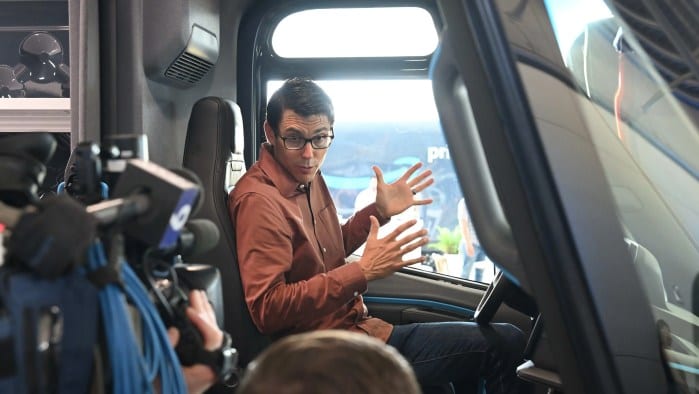
Philbin was answering a question from the audience on whether the van could become autonomous.
“In terms of the stack, it is a general stack,” he said. “We can move sensors around, we can change the vehicle configuration.”
“We can support new vehicle types and different sets of modalities as well,” Philbin added.
Rivian would first calibrate the system for a new vehicle and then collect a certain amount of expert driving data on it to fine-tune the model, he said.
He said the stack was also built to run on different generations of Rivian’s autonomy computers, including the second and third generations.
What the Van Has Today
Amazon lists automatic emergency braking, adaptive cruise control and collision warnings among the van’s safety features.
Amazon’s fleet of Rivian’s custom-built delivery vans passed 40,000 across North America in the second quarter, Rivian said in July.
Rivian is co-developing new variants with Amazon that add a larger battery, for about 30% more range, and an all-wheel-drive option.
Asked at the same event whether those variants were on track, Vice President of Investor Relations Chip Newcom said they were “continuing to progress well,” without giving a date.
Van Sales Pick Up
Rivian does not disclose van deliveries, but Cox Automotive’s Kelley Blue Book estimates 4,003 of the vans were sold in the U.S. in the second quarter, up 48% from a year earlier and 25% from the first quarter.
That was the van’s third-best quarter on Cox’s figures, behind only the third and fourth quarters of 2024, at 4,509 and 4,397.
First-half sales reached 7,216, up 73% and more than the 6,809 Cox estimated for the first nine months of 2025, a year in which van sales fell 27%.
Cox counts the EDV 500 and EDV 700 as a single model and does not separate Amazon from other buyers, and its third-quarter estimates are not yet out.
The van was Rivian’s second-best seller in the U.S. in the second quarter, behind the R1S at 6,183 and ahead of the R1T at 1,219, Cox estimates.
“You’re seeing this already in the numbers of the first two quarters this year, that Amazon is purchasing more vans,” founder and CEO RJ Scaringe told analysts on July 30.
He said other commercial operators would follow once they saw the cost benefits, but added: “Now, that has taken longer than we would have expected, or we would have hoped for.”
Autonomy Push
Rivian’s autonomy efforts are focused on its SUVs.
Rivian plans to begin rolling out point-to-point driving on the second-generation R1 and the R2 at the end of this year, to employees first, and to reach all Autonomy+ customers in 2027, VP of Investor Relations Chip Newcom said.
“For employees, the plan is to start rolling out [RAP1], so our third-generation computer plus the LiDAR to go into the vehicle later this year for employees and then start rolling that out to customers next year,” Newcom said.
The company is also developing a robotaxi version of the R2 for Uber, with service targeted for late 2028.