
Rivian disclosed on Thursday that revenue from Amazon climbed to $468 million in the first quarter, accounting for roughly half of its total automotive revenue.
The figures represent a sharp escalation in the EV maker’s dependence on its largest shareholder and anchor commercial customer, just as the R2 begins ramping up production and demand for R1S and R1T models continues weakening.
The Irvine, California-based company recognized $468 million in Amazon-related revenue in the three months to March 31, up from $99 million in the same period last year — a 373% year-over-year increase, according to its first quarter 2026 financial filing.
Amazon-related revenue accounted for 52% of Rivian’s total automotive revenue in the quarter, up from roughly 11% in the same period last year.
Customer Concentration Climbs
The 20% increase in deliveries that Rivian reported for the first quarter was driven primarily by accelerating Amazon EDV recognition rather than R1S and R1T volume, with the higher commercial van mix translating into lower automotive revenue per unit.
“Automotive revenue decreased 2% year-over-year primarily due to a $100 million decrease in sales of automotive regulatory credits and a decline in automotive revenue per unit delivered due to a higher mix of commercial vans, which were partially offset by a 20% increase in vehicle deliveries,” Rivian said in its quarterly filing.
It was the most explicit attribution to date of a per-unit revenue decline to higher EDV mix.
The customer concentration is likely to remain elevated until the R2 SUV — which entered volume production in mid-April and is expected to begin customer deliveries in June — starts contributing meaningful consumer volumes in the second half of the year.
Rivian reported Amazon-related deferred revenues of $359 million as of March 31, 2026, down only marginally from $365 million at the end of 2025, suggesting that net new Amazon prepayments have largely offset the deliveries recognized in the quarter.
Uncollected amounts in accounts receivable from Amazon climbed sharply, however, reaching $127 million at quarter-end versus $11 million at the start of the year — a sign that recent EDV deliveries are still working their way through the company’s billing cycle.
Rivian also disclosed that it pays Amazon for hosting, storage, and compute services, with related expenses rising to $78 million in the first quarter from $31 million a year earlier.
EDV Volume Behind the Growth
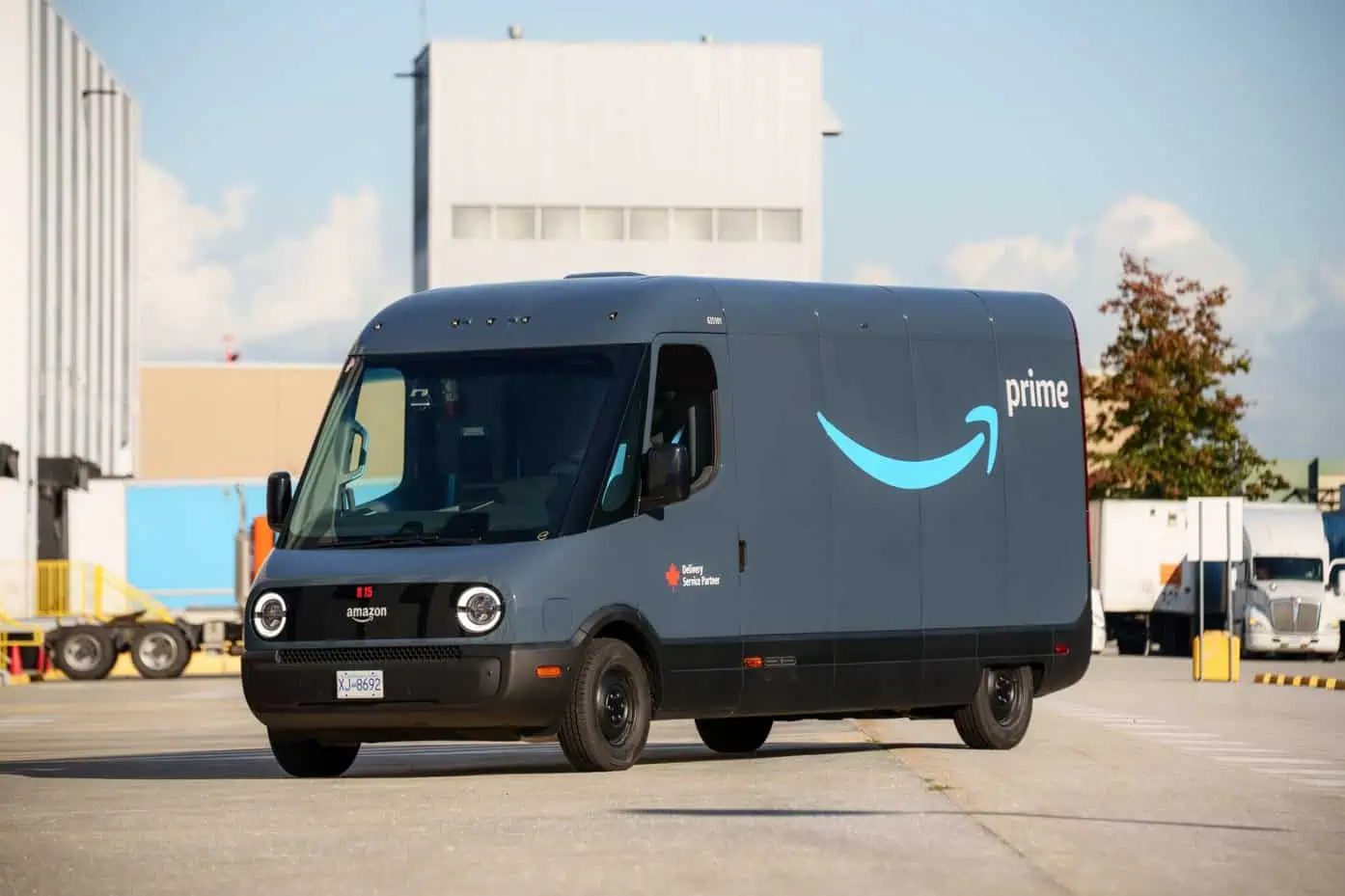
While investor attention has been fixed on the R2 launch, the company’s EDV business — co-developed with Amazon — has been quietly gaining momentum.
Rivian does not break down deliveries per model, however, Cox Automotive data estimates that US sales of the EDV more than doubled in the first quarter — to 3,213 units.
Based on the data, the EDV accounted for an estimated 31.0% of Rivian‘s total first-quarter deliveries.
The rebound follows a difficult 2025 for the EDV programme.
Full-year US van registrations fell 27% year over year to just under 10,000 units, despite the cumulative total of Amazon-branded electric delivery vans on the road surpassing 30,000.
Expanding Beyond Amazon
The sales growth coincides with Rivian‘s push to diversify its commercial customer base.
The company opened EDV orders to third-party fleet buyers in early 2025, pricing the vans from $79,900 for the EDV 500 and $83,900 for the EDV 700.
Since then, Rivian has announced HelloFresh as its first major fleet client and signed a deal with pizza delivery firm Slice.
Other branded vans — including units carrying a Cintas Corp. logo and at least one vehicle purchased by Illinois-based firm Wm. Masters — have been spotted, suggesting that small fleet purchases are beginning to accumulate.
Global logistics giant DHL was also seen piloting the vans in mid-2024, though no purchase agreement has been disclosed.
Amazon remains the anchor customer.
The retail giant ordered 100,000 electric delivery vans from Rivian in 2019 and has taken delivery of more than 30,000 units, as of its latest update.
Rivian founder and chief executive officer RJ Scaringe reaffirmed that the 100,000-unit target remains on track and said the company is already considering what comes beyond that initial contract.
The EDV opportunity may be expanding further.
In March, reports emerged that Amazon was preparing to slash its partnership with the US Postal Service, doubling down on its own delivery network instead — a shift that could accelerate the timeline for expanding the Rivian fleet.
New Variants
Rivian disclosed in its fourth-quarter shareholder letter that it is co-developing new EDV variants with Amazon, introducing a larger battery pack and All-Wheel Drive.
The current models are Front-Wheel Drive with a standard battery.
The larger pack offers a 30% increase in range, while AWD improves traction on routes involving mud and snow.
The company said the new variants will expand EDV route coverage within Amazon’s delivery network.
It remains unclear whether the new variants will retain the existing sizes — the EDV 700 offers approximately 652 cubic feet of cargo space and 160 miles of range, while the EDV 500 provides roughly 487 cubic feet — or introduce different dimensions.
When Goldman Sachs analyst Mark Delaney questioned on the last earnings call about when to expect the new commercial product, the question was left unanswered.
Scaringe said only that Rivian expects “some growth” in EDV demand this year and that the new variants will “help unlock specific use cases within the Amazon network.”
To lead the programme’s next chapter, the company late last month rehired Aaron Hensler as chief engineer for the commercial van platform.
Hensler spent nearly four years at Rivian in director-level roles focused on thermal and powertrain systems before leaving in mid-2025 for General Motors.
EDV Volume in 2026
Management has guided for 62,000 to 67,000 total vehicle deliveries this year, with CFO Claire McDonough saying that R1 and commercial van volumes are expected to remain roughly in line with 2025’s 42,247 units.
That implies the EDV will account for approximately 15–16% of Rivian‘s total volume in 2026.
The remaining growth — which requires between 51,635 and 56,635 deliveries over the final nine months of the year — hinges almost entirely on the R2.