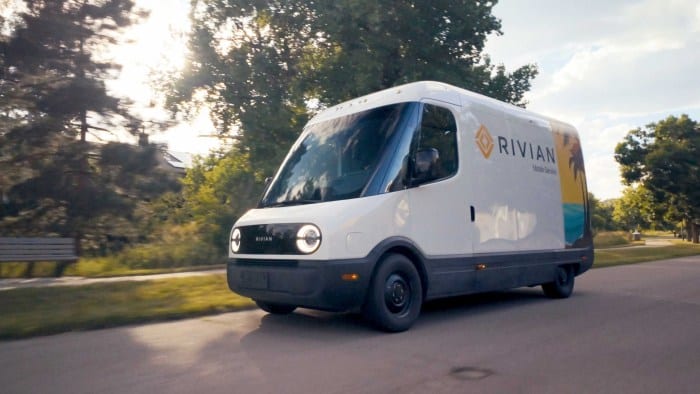
Electric delivery vans from Rivian and General Motors earned the only good ratings in the Insurance Institute for Highway Safety’s (IIHS) first pedestrian crash avoidance tests of commercial vehicles, while none of the four heavy-duty work pickups tested did better than acceptable.
The 2025 Rivian RCV-Delivery 500 and the 2025-26 Chevrolet BrightDrop 400, which GM no longer builds, led the pedestrian ratings in the first crash avoidance results for commercial vehicles that the insurer-funded institute published on Thursday.
The pickups also trailed in the vehicle-to-vehicle test, where three of the four were rated poor.
The results cover seven cargo vans and four Class 3 pickups, and marginal and poor ratings were common across both groups.
“These results are a wake-up call for commercial vehicle makers,” IIHS President David Harkey said.
“Front crash prevention is especially important for these larger, heavier vans and trucks because of the danger they pose to other road users.”
EV Vans Lead on Pedestrians
IIHS rated each vehicle on the scale it uses for passenger cars, good, acceptable, marginal or poor, with the same test protocols.
The pedestrian test covers an adult or child crossing the road in daylight or at night and an adult walking in the travel lane at night.
The Rivian van avoided a crossing child in daylight at 12 mph and reduced its impact speed by 16 mph at 25 mph, according to its IIHS rating page.
At night, it avoided a crossing adult at 12 and 25 mph with both high and low beams, and avoided an adult walking along the lane at 25 mph.
In the 37 mph version of that test, it avoided the collision on low beams, and cut its speed by 36 mph on high beams, with warnings 1.3 and 1.9 seconds before impact.
The BrightDrop 400 earned its good rating while cutting its speed by 22 mph in the 25 mph child test, and by 20 mph and 18 mph in the 37 mph test with high and low beams, its rating page shows.
Among the other vans, the 2025 Mercedes-Benz Sprinter 2500 was acceptable, the 2025 Ford Transit T250 and the 2025-27 Ram ProMaster 2500 were marginal, and the 2025-27 Chevrolet Express 2500 and GMC Savana 2500 were poor.
The Express and Savana were rated poor in both tests because they lack automatic emergency braking and offer only optional forward collision warning, IIHS said.
Work Pickups Lag
Among the pickups, the 2025 Ford F-350 and the 2025-27 Ram 3500 were acceptable in the pedestrian test, and the 2025-26 Chevrolet Silverado 3500HD and its twin, the 2025-26 GMC Sierra 3500, were marginal.
Several vehicles, including the F-350 and Ram 3500, had more trouble detecting a child in daylight than an adult at night, IIHS said.
It linked the problem to the child’s height and the tall front ends of the trucks, whose sensors sit near the rearview mirror, and said the child dummy sometimes “disappeared” as the vehicle got closer.
The poor and marginal systems also failed to slow enough in most nighttime trials with the adult, and some did substantially worse on low beams, according to IIHS.
In the vehicle-to-vehicle test, the Silverado, Sierra and F-350 were rated poor and the Ram 3500 marginal.
The Silverado 3500HD and its Sierra twin slowed by 12 mph in one car run and not at all in the other five, and slowed by 7 mph in one motorcycle run, with no timely warnings against the motorcycle.
The F-350 avoided the car target at 31 mph and slowed in three of the four other runs, but gave no timely warning in the two 31 mph car runs and in three of the six motorcycle runs, according to its rating page.
IIHS said some systems “successfully slowed to avoid or mitigate collisions at most speeds” but were downgraded because they did not warn the driver in time.
The Ram 3500 avoided the car at 31 and 43 mph, earning the best pickup score at marginal.
Class 3 pickups have a gross vehicle weight rating of 10,001 to 14,000 pounds.
The Vehicle-to-Vehicle Test
The Sprinter was the only vehicle rated good in the vehicle-to-vehicle test, and the BrightDrop was acceptable.
The Rivian van was marginal, and the Transit and ProMaster were poor.
No vehicle earned a good rating in both tests, and the top performers in each were cargo vans, IIHS said.
The test runs the vehicle toward a stopped passenger car and a stopped motorcycle at 31, 37 and 43 mph, with each target centered in the lane and offset, and checks warnings against a semitrailer.
IIHS counts a warning as timely if it comes at least 2.1 seconds before the projected impact, and speed reductions make up two-thirds of the score, with warnings the remaining third, according to the test description.
“The motorcycle target was the biggest challenge,” IIHS said, adding that several systems “did not issue warnings or slow at all in most of the motorcycle trials.”
The BrightDrop avoided the motorcycle in four of six runs and cut its speed by 36 to 39 mph in the other two, while braking hard against the car target at every speed.
It and the ProMaster were the only vehicles to issue a timely warning in every car and motorcycle run, though the ProMaster braked little or not at all at the higher speeds.
The Rivian van’s weakness was the motorcycle.
Against the passenger car, it avoided a collision in four of six runs, nearly avoided it in a fifth and cut its speed by 38 mph in the sixth, issuing a timely warning every time.
Against the motorcycle, it recorded no speed reduction and no timely warning in any of the six runs.
It warned in time in all three semitrailer runs.
The van’s standard system is listed as “Driver +” on its IIHS rating page.
Rivian’s own R1T pickup scores better in the same test. The 2027 R1T is rated acceptable for vehicle-to-vehicle front crash prevention, and it avoided the motorcycle target in five of six runs.
The R1T and R1S also hold good pedestrian ratings, and the R1S is a 2026 Top Safety Pick+.
A Van GM No Longer Builds
GM confirmed in October 2025 that it had ended BrightDrop production at its CAMI plant in Ingersoll, Ontario, where output had been paused since May, and the plant has remained idle since.
GM still sold 1,344 BrightDrop vans in the third quarter, all built before the halt.
Rivian’s vans are mainly used by Amazon, whose fleet of the custom-built model passed 40,000 in the second quarter, when Rivian said the platform had covered more than one billion miles.
Rivian is investigating more autonomy for future versions of the van, Senior Vice President of Autonomy and AI James Philbin said on September 29, adding that the current van already supports active safety features.
Driver Protection
IIHS began its commercial vehicle program in June with a driver protection check of nine of the same vehicles, covering airbags, seat belt technology and seat belt reminders.
Many federal standards for passenger vehicles, including airbag requirements, do not apply to delivery vans, box trucks and larger work pickups, the institute says.
Only four of those nine had all five features it considers essential.
The BrightDrop, ProMaster, Silverado and F-350 have all five, while the Transit, Sprinter, Express and Ram 3500 lack an effective seat belt reminder, and the Express has no standard force limiter.
The Rivian van has standard front and side curtain airbags, seat belt pretensioners and force limiters, but also lacks an effective seat belt reminder, IIHS found.
Its reminder does not start in time, is not loud enough and lasts under eight seconds, against the institute’s requirement of an alert of at least 90 seconds.
IIHS says persistent reminders raised belt use by 30% among part-time users in one of its studies, and that delivery drivers may skip their belts on frequent stops.
Why Work Vehicles
Crashes involving heavy- or medium-duty vehicles or light vans killed 6,215 people in the US in 2024, 16% of all road deaths, according to IIHS.
Cutting that toll is part of the institute’s goal of reducing road deaths by 30% by 2030, and IIHS said the ratings are meant to help fleet buyers choose safer vehicles and push manufacturers to improve them.
The institute will add headlight and rear automatic emergency braking ratings for Class 3 vehicles this year and next, and test Class 4-6 trucks later.
Separately, Rivian’s Senior Manager of Vehicle Safety, who named the delivery van among the programs he worked on, left the company this month after nearly eight years.