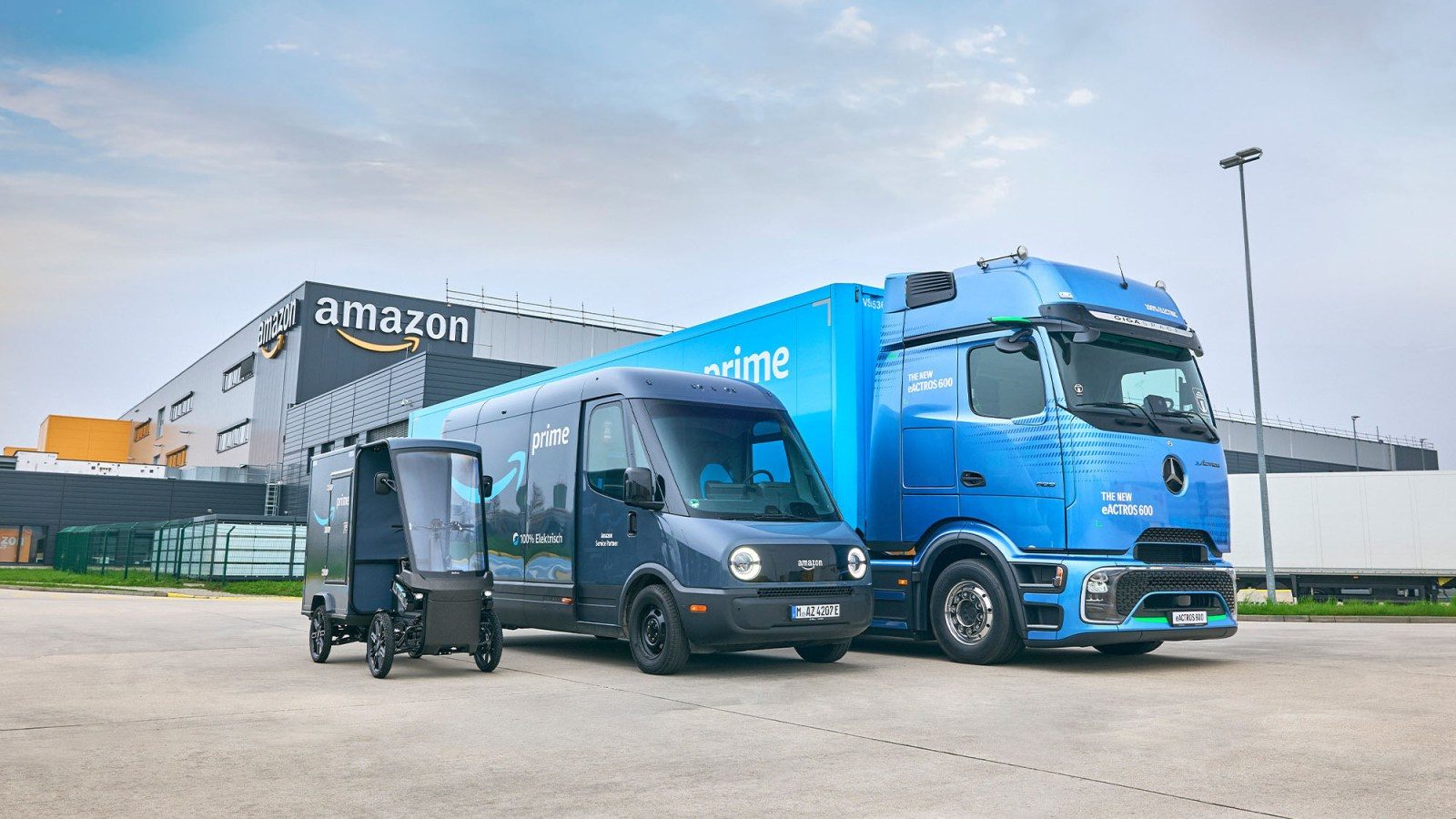

Amazon has deployed more than 50,000 electric delivery vans across its global fleet, reaching the halfway mark toward its goal of at least 100,000 by 2030.
More than 30,000 of those vans come from Rivian, the US automaker that built its commercial business around the Amazon account.
Amazon Chief Sustainability Officer Kara Hurst framed the milestone in a post on LinkedIn. “Over 50,000 electric delivery vans are now on the road in our global network — and they delivered more than 2.4 billion packages to customers across Europe, the US, and India last year, with zero tailpipe emissions,” she wrote.
The vans draw on what Hurst called one of the largest private EV charging networks in Europe and the US. “They’re powered by tens of thousands of chargers across our facilities,” she wrote, adding: “It’s incredible to see how far we’ve come by staying the course — and we’re not stopping.”
The milestone ranks Amazon among the largest operators of electric delivery vehicles in the world. It also underscores how central the partnership has become to Rivian, whose latest results show Amazon now accounts for roughly half of its automotive revenue.
Halfway to 100,000
Amazon‘s 50,000 vans represent half of its stated goal of at least 100,000 by 2030, a target that sits within a commitment to reach net-zero carbon emissions by 2040.
The retailer ordered 100,000 vans from Rivian in 2019 and has taken delivery of more than 30,000, according to its latest update.
Rivian founder and chief executive RJ Scaringe said the 100,000-unit target remains on track and that the company is already weighing what comes after the initial contract.
Amazon frames the rollout as one piece of a wider decarbonisation push that also includes nuclear power for its data centers, lower-carbon engineered wood in its buildings, and reduced packaging.
The company has launched a carbon credit service through its Sustainability Exchange and deployed AWS-based tools to cut water and energy use at its sites.
Amazon Now Half of Rivian’s Revenue
Rivian disclosed in the last quarterly report that revenue from Amazon climbed to $468 million in the first quarter, about half of its total automotive revenue.
The figure marked a sharp escalation in the EV maker’s dependence on its largest shareholder and anchor customer. Rivian recognised the $468 million in the three months to March 31, up from $99 million a year earlier — a 373% increase.
Amazon-related revenue accounted for 52% of Rivian‘s total automotive revenue in the quarter, up from roughly 11% a year earlier.
The shift came as deliveries rose without a matching gain in revenue.
“Automotive revenue decreased 2% year-over-year primarily due to a $100 million decrease in sales of automotive regulatory credits and a decline in automotive revenue per unit delivered due to a higher mix of commercial vans, which were partially offset by a 20% increase in vehicle deliveries,” Rivian said in its filing.
It was the company’s most explicit attribution yet of falling per-unit revenue to a heavier van mix.
Other figures traced the depth of the relationship. Rivian reported Amazon-related deferred revenue of $359 million as of March 31, down only marginally from $365 million at the end of 2025, suggesting new prepayments largely offset the deliveries recognised in the quarter.
Uncollected amounts owed by Amazon climbed to $127 million at quarter-end, from $11 million at the start of the year, as recent deliveries worked through the billing cycle.
The reliance runs both ways. Rivian also pays Amazon for hosting, storage, and compute services, with those expenses rising to $78 million in the first quarter from $31 million a year earlier.
EDV Volume Behind the Growth
Rivian does not break out deliveries by model, but Cox Automotive data estimate that US sales of the electric delivery van more than doubled in the first quarter, to 3,213 units.
The figures implied the van accounted for about 31% of Rivian‘s total first-quarter deliveries.
A Fleet Beyond Vans
The vans are the largest single component of Amazon’s electric fleet, but not the only one.
The company runs electric cargo bikes in two-, three-, and four-wheel configurations, all with pedals and motors for pedal assistance.
Amazon began testing them in 2017 and now uses them in New York City and Washington, D.C., supported by more than 70 micromobility hubs across more than 50 European cities.
In India, more than 80% of Amazon deliveries are made by electric scooters, which navigate congested streets more easily than larger vehicles. Amazon also runs electric three-wheelers, developed with manufacturers to match the cargo capacity of internal-combustion four-wheelers.
The company selects each vehicle type to fit specific regions and routes.
Trucks Join the Network
Beyond last-mile delivery, Amazon has begun electrifying heavier links in its logistics chain.
Amazon plans to add more than 1,000 electric light- and medium-duty trucks in India over five years, joining more than 10,000 electric vehicles already operating there.
In its drayage operations — the short-haul movement of containers — Amazon put its first electric heavy-duty trucks on the road in 2024.
In Europe, the company placed its largest-ever single order for more than 200 electric heavy-duty trucks. More than 100 are in operation, and Amazon expects to more than double that fleet by year-end.
“We’re getting great reviews from drivers — they love the smooth, quiet ride and the comfortable design of the cab,” said Apoorva Prasad, vice president of Amazon Global Logistics.
New Variants and a Bigger Battery
Rivian is co-developing new van variants with Amazon, adding a larger battery pack and all-wheel drive to models that are currently front-wheel drive with a standard battery.
The larger pack offers a 30% increase in range, while all-wheel drive improves traction on routes involving mud and snow. The company said the variants would expand the vans’ route coverage within Amazon’s network.
It is not yet clear whether the new versions will keep the current dimensions. The EDV 700 offers about 652 cubic feet of cargo space and 160 miles of range, while the EDV 500 provides roughly 487 cubic feet.
Asked by Goldman Sachs analyst Mark Delaney on the latest earnings call when to expect the new commercial product, Rivian left the question unanswered. Scaringe said only that the company expects “some growth” in van demand this year and that the new variants will “help unlock specific use cases within the Amazon network.”
To lead the programme’s next phase, Rivian has recently rehired Aaron Hensler as chief engineer for the commercial van platform.
Hensler spent nearly four years at the company in director roles focused on thermal and powertrain systems before leaving in mid-2025 for General Motors.
R2 Holds the Key
The concentration in Amazon is likely to stay elevated until the R2 SUV begins contributing consumer volume in the second half of the year.
Rivian began production of the R2 in mid-April and will start customer deliveries on June 9, with hundreds of employees already driving early units.
Management has guided for 62,000 to 67,000 total deliveries this year. Chief financial officer Claire McDonough said R1 and commercial van volumes are expected to stay roughly in line with 2025’s 42,247 units, implying the van will account for about 15% to 16% of Rivian‘s 2026 total.
The rest of the growth — between 51,635 and 56,635 deliveries over the final nine months — hinges almost entirely on the R2.