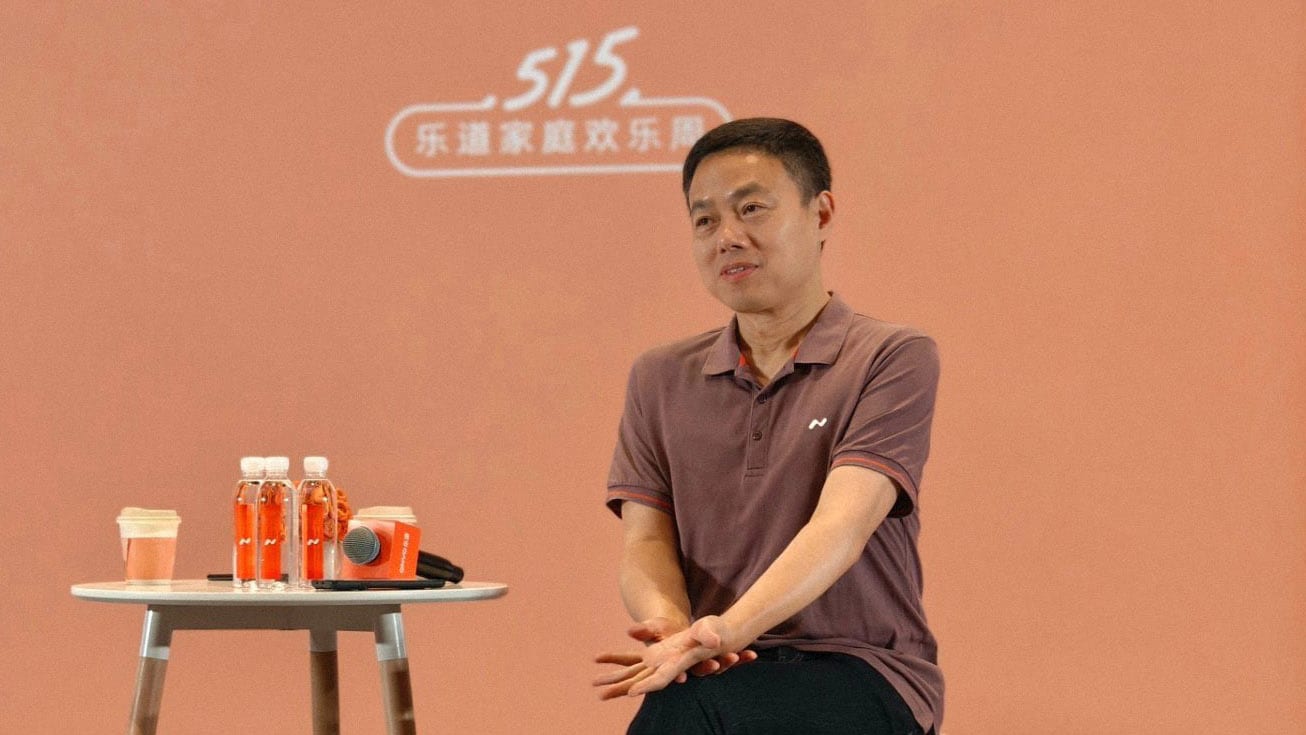

Shen Fei, the chief of Nio‘s family-focused sub-brand Onvo, said on Monday that selling cars is tougher than earning a place at Tsinghua University, one of China’s most selective universities, or building the EV maker’s battery-swap network from nothing.
Onvo was launched in May 2024 and has since launched three fully electric SUV models: the five-seat L60, the three-row L90, and the recently debuted flagship five-seat model L80.
“Looking now, the easiest was getting into Tsinghua,” Shen told 21st Century Business Herald in an interview, ranking the family-brand presidency above both his elite-university entrance exam and the energy business he spent years constructing at Nio.
The remark lands as Onvo passes its second anniversary having completed a sweeping product overhaul, yet still wrestling with thin margins and a recognition problem its own executives concede is the main hurdle.
A sales job that “can’t be dialled up”
Before taking the brand’s helm, Shen led the Nio Power unit and built Nio‘s charging and swap business, the role that made him one of the company’s most visible engineers.
That work, he said, was a complex but plannable kind of systems engineering: with clear goals and resources in place, the number of stations could be broken down, advanced and verified.
“Selling cars is far less controllable,” Shen said, explaining that volume cannot be set as freely as a target for new swap stations.
Sales instead answer to user awareness, rivals’ moves, price swings, regional gaps and the hesitation of every family buyer at the moment of decision — variables no station-building plan ever had to manage.
To close that gap, Shen said he bought more than 20 books on the history of car retailing in the US, many of them out-of-print editions sourced secondhand, and now travels most weeks to tour stores across a region rather than chase a single event.
Recovery, but on contested ground
Onvo‘s numbers have swung sharply over the brand’s first half of 2026.
Deliveries sank below 2,000 units a month for the L60 in January and February, the model’s worst run since launch, before the lineup refresh drove a rebound that carried May volume past 12,000 units.
That refresh ran lineup-wide. Now, Nio‘s in-house chip and a LiDAR option spanned all three Onvo models, capped by a third-generation L60 that began deliveries this month.
Cumulative deliveries are now “close to 160,000,” Shen said, with the brand’s net promoter score running near 71%.
He pushed back on judging the brand by single-month peaks, arguing that the figure that matters is share during the steady-sales period between launches — which he said is slowly climbing even as retail sales trail year-earlier levels.
May’s surge is itself a case in point.
The new L80 led the month with 5,949 deliveries in its first weeks on sale, ahead of the L90’s 4,052 and an L60 that managed just 2,023 as old stock cleared before the refresh.
Without that launch, the brand’s two established models were running well off their 2025 form — making May exactly the kind of spike Shen warns against reading too much into.
“Onvo is in a group brawl,” Shen said of the 200,000-to-300,000-yuan segment, where Tesla‘s Model Y, Xiaomi‘s YU7 and a wave of Huawei-aligned and joint-venture rivals fight at close quarters.
Even Tesla, he noted, is slowly losing share — a sign, in his telling, that no brand can expect to dominate the field outright.
The price-discipline question
Shen’s most consequential comments concern pricing, and they sit in direct tension with a warning Nio issued only days earlier.
Onvo has held headline prices steady through its refreshes, absorbing higher component costs rather than passing them on.
Shen framed that as a deliberate stance: adding configuration while keeping the sticker flat is, he argued, “another kind of price cut,” and slashing prices outright would pull the brand away from its buyers’ spending band and erode a sustainable business.
Nio chief executive William Li recently described the new L60’s margins as “pretty dire” amid rising costs — even though the third-generation SUV reached the market at 192,800 yuan, below its predecessor rather than carrying the near-20,000-yuan increase the brand had signalled weeks earlier.
Shen’s answer is that running the business well, not chasing volume, is the better guarantee for customers — a framing that casts margin restraint as a feature rather than a constraint.
“Not a downgrade from Nio”
Much of the interview went to dismantling a perception that has dogged the brand since launch: that buyers choose Onvo only because they cannot afford Nio.
Shen called that an early misunderstanding, insisting the two brands share one quality-management system and that Onvo is positioned differently rather than built to a lower standard.
The real buyer, he said, is often a mid-level corporate manager who weighs whether a car is tasteful and fits the family rather than chasing a pricier badge.
He pointed to a recent owner gathering of nearly 300 people that included more than 50 children — the most he had seen at any Nio-group event — and to a car-club head who traded a BMW for an L90 despite being able to afford the flagship Nio ES9.
Awareness, not appeal, is the harder fix, and one Onvo leadership has tied to Nio‘s own standing in 2019, the year the company nearly ran out of cash.
“What really puzzles me is how to make this group quickly know Onvo,” Shen said, naming reach as the binding constraint.
The road ahead
For the second half, Shen sketched a plan built on grinding execution rather than a single breakthrough.
Onvo will add roughly 1,000 more battery-swap stations within the year, extending a network that already offers its users more than 2,500 of the some 3,800 stations Nio runs nationwide.
The brand will open 200 to 300 new sales points by the end of next year, mixing three-brand flagship stores with smaller, more flexible mall outlets, and roll out a July software update across the lineup — its latest step after Nio began pushing a second-generation driving model across its platforms — alongside a refreshed “Every journey, the Onvo way” identity.