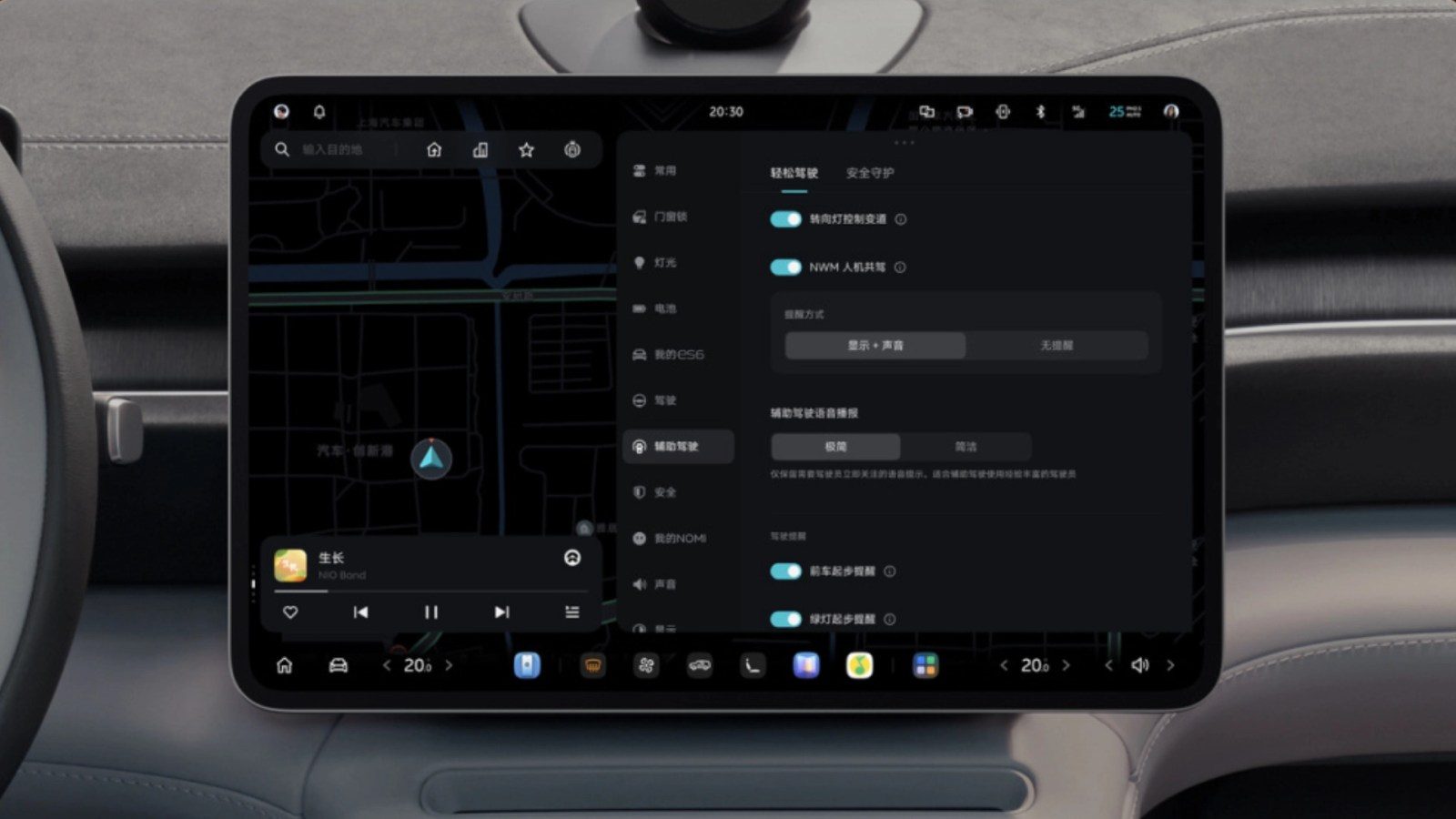

Chinese EV maker Nio began rolling out a new version of its Nio World Model (NWM) assisted-driving software on Thursday, delivering a simultaneous upgrade across three distinct software platforms to more than 700,000 vehicles in China.
Founder and CEO William Li first teased the multi-platform update during the company’s first-quarter earnings call last month.
By then, he stated that “in June, both Nio and Onvo users will receive the next major NWM upgrade, bringing noticeable improvements across driving, parking, and active safety scenarios.”
The release spans the ‘Cedar,’ ‘Cedar S,’ and ‘Banyan’ OS — marking what Nio described as the first time an automaker has achieved parallel development and synchronized releases across both third-party chip platforms and its own in-house silicon.
Vehicles powered by four Nvidia Orin-X chips and those running on Nio‘s proprietary Shenji NX9031 processor received the update at the same time.
Separately, Nio Inc.‘s mass-market sub-brand Onvo also started pushing an update to its Coconut operating system on the same day, extending the NWM architecture further across the group’s portfolio.
Key Technical Upgrades
Nio said the new NWM is the first driver-assist system in China to directly output steering wheel angle and pedal signals, rather than generating sampled trajectory points for the vehicle to follow.
The approach shortens the computational path and lowers latency, which the company said substantially improves control smoothness and precision.
Nio described the method as the foundation for its next generation of assisted driving.
The update also introduces a three-layer training framework.
Building on the closed-loop reinforcement learning the company first deployed in January, the new version adds a supervised fine-tuning stage that uses high-quality behavioural data to teach the model human-like driving patterns.
According to Nio, the added layer gives the model what it described as “high-limit, realistic, and reasonable” characteristics — combining a high performance ceiling with compliance.
On the road, the upgraded NWM now handles tidal lanes and variable-lane overhead signs in real time — a first among automaker-developed systems in China, according to the company.
Route-selection accuracy without high-definition or enhanced navigation maps has reached what the company called an industry-leading level.
Nio added that the new version leads the industry simultaneously on two traditionally conflicting metrics — false braking and risk intervention — balancing reassurance with efficiency.
Usage time and adoption rates have seen what the company described as “explosive growth” since January.
Cross-Platform Engineering
Nio said it achieved what it called “one model for multiple uses” across platforms through a multi-camera sensor software migration architecture and model-sharing multi-sensor fusion technology, eliminating the need for heavy retraining or fine-tuning when deploying the same model across different chip platforms.
On the software side, Nio built its own deployment framework and AI compiler rather than using the general-purpose toolchain Nvidia supplies for Orin-X.
The in-house compiler shortened the new model development cycle by one to two months compared with general tools, boosted inference performance by 20%, and cut the model quantization cycle from weekly to within two hours, the company said.
Cedar, Cedar S, and Banyan
The flagship ‘Cedar’ platform update — version 1.5.0 — delivers more than 80 new features and optimisations to owners of the ET9 executive sedan, the third-generation ES8 SUV, and the recently launched ES9 flagship SUV.
‘Cedar’ runs on Nio‘s Shenji NX9031 chip, with the ET9 and ES9 equipped with two of the processors and the ES8 carrying one.
The update follows ‘Cedar’ 1.4.0, which rolled out in February.
The ‘Cedar S’ variant — which powers the refreshed ES6, EC6, ET5, and ET5 Touring on a single Shenji NX9031 chip — also received version 1.5.0, bringing the upgraded NWM alongside more than 50 new features across assisted driving, the smart cockpit, and ‘NOMI,’ Nio‘s in-car voice assistant.
The broadest portion of the rollout targets ‘Banyan’, which serves more than 460,000 vehicles built on Nio‘s older NT 2.0 architecture.
These models — including pre-refresh versions of the ES6, EC6, ET5, and ET5 Touring, as well as the ET7, ES7, EC7, and earlier generations of the ES8 — run on four Nvidia Orin-X chips.
‘Banyan’ 3.5.0 is the 42nd major update for the platform and includes the upgraded NWM alongside more than 30 new features.
Nio emphasized that even owners who purchased their vehicles up to four years ago can access the latest technology — a point the company has repeatedly highlighted as evidence that its early investment in hardware reserves is paying off.
Onvo’s Coconut Update
On the same day, Onvo began rolling out ‘Coconut+’ 3.0.2, which brings further enhancements to the sub-brand’s all-scenario Navigation Assisted Driving (NAD) system.
Nio said that because the underlying software is all developed in-house, it can complete the migration of mainline features to Onvo models on the Shenji NX9031 platform in as little as two weeks.
Onvo also confirmed that vehicles equipped with the Nvidia Orin-X platform will receive a major upgrade by the end of July, with continuous iterations to follow.
The brand had previously announced its ‘Coconut‘ 3.0 update during the launch of the revamped 2026 L90 in April, describing it as the most significant overhaul of the software platform since the brand launched in May 2024.
Onvo currently sells the L60, L90, and L80 SUVs in China.
Europe Left Behind
The software update applies exclusively to vehicles in China.
European Nio owners, who drive NT 2.0-generation vehicles running a local version of the Banyan operating system, will not receive the NWM upgrade.
As EV exclusively reported last month, Nio does not expect to bring NWM to Europe until approximately 2030.
European vehicles currently run an early, largely rule-based version of the driver-assistance system, while Chinese vehicles use a far more advanced machine-learning-based stack.
The most recent European update — ‘Banyan’ 2.4.3 — arrived in April after a six-month gap and primarily added system-language support rather than addressing existing software issues.
The next major European update is not expected until the fourth quarter of 2026.
The Software Map Across Nio Group
Nio Inc. now operates four distinct software platforms across its three brands, including the ‘Cedar’ and ‘Banyan’ OS for its main brand.
Firefly, the group’s compact car brand, runs its own ‘Aster’ operating system.
The brand recently rolled out ‘Aster‘ 1.5.0 in mid-May — which added battery-swap station compatibility.
The ‘Aster’ system was not part of Thursday’s NWM rollout.
Nio has framed the simultaneous multi-platform release as what it called “turning previously invested technology dividends into reality” — a reference to the full-stack in-house development strategy it began pursuing in 2020.