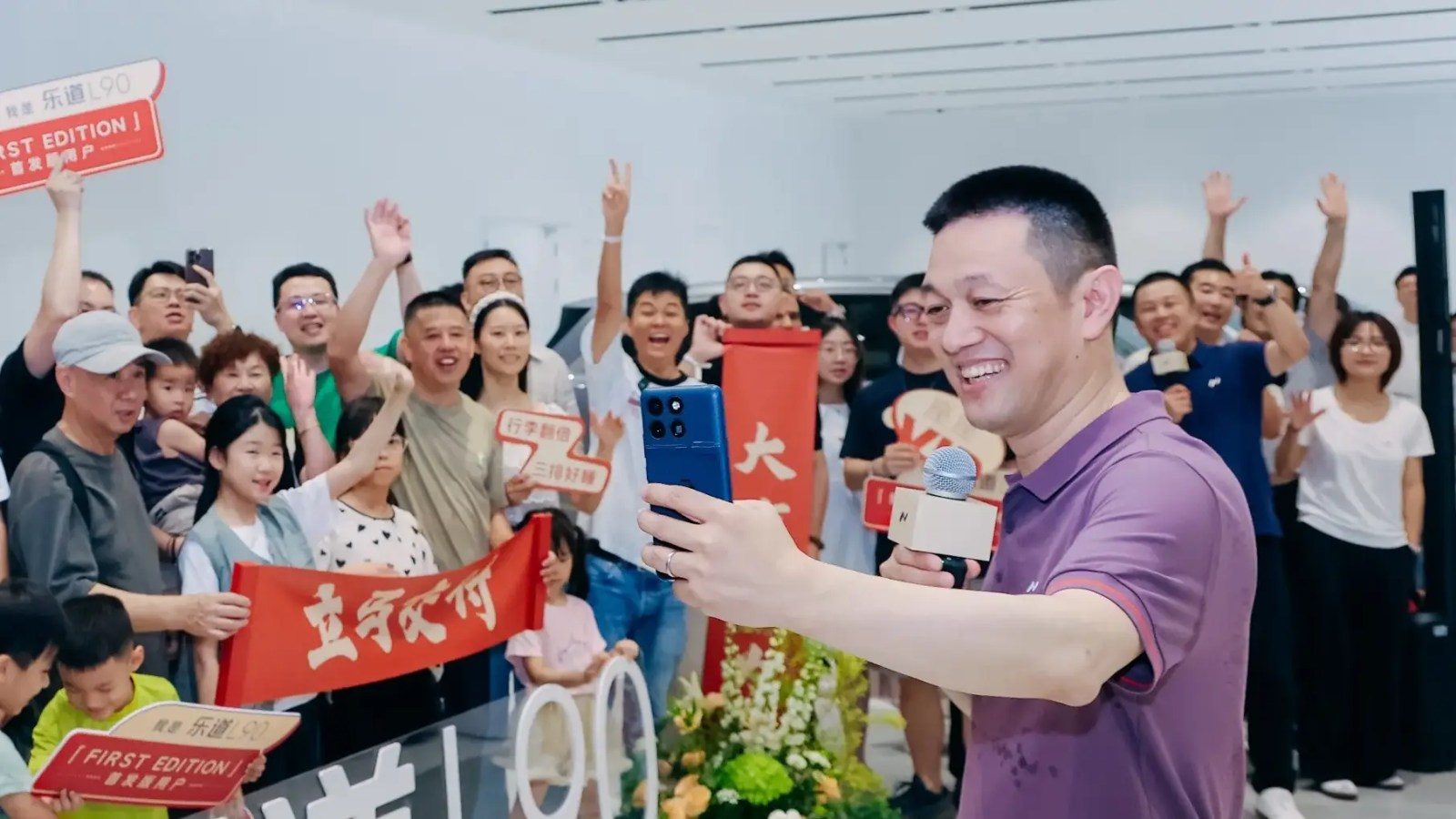

Nio‘s founder and CEO William Li said sub-brand Onvo‘s biggest challenge remains low brand awareness — calling for patience as the family-oriented sub-brand works to build its sales organization and market presence.
Speaking at a media event following the 2026 Onvo L90 launch on Wednesday, Li said initial orders for the refreshed SUV are meeting expectations.
He acknowledged, however, that visibility remains the core bottleneck.
“In terms of orders, they are basically in line with our expectations. Right now, the biggest issue for Onvo is still low awareness — many people simply don’t know about it yet,” he stated.
The admission is consistent with data shared earlier this month by Onvo‘s brand chief Fei Shen — one of the longest-serving executives at Nio, who replaced Alan Ai as the chief of Onvo last year after the brand consecutively missed delivery targets.
He referenced a recent awareness survey in which the brand ranked last among competitors.
The same study showed that, among consumers who do become aware of the brand, Onvo‘s conversion to purchase ranked in the top two.
Li’s own remarks at the launch event aligned with that finding.
“At the same time, the data shows something encouraging: our conversion rate is actually very strong—among the best in the industry. Maybe not strictly number one, but definitely top-tier, just slightly behind first place,” the CEO said.
The pattern — low visibility but strong purchase intent — has been a recurring theme since early 2025, when Li first acknowledged that Onvo‘s brand recognition was only one-third of Nio‘s.
The company has been expanding its marketing push with offline advertisements in train stations and apartment elevators, social media campaigns, and a sports sponsorship deal with Shanghai Shenhua FC for the 2026 Chinese Super League season.
Awareness at 2019 Nio Levels
Li put Onvo‘s recognition gap in stark historical terms, comparing it to the earliest days of the Nio brand.
“Every year we conduct brand research, and currently Onvo‘s awareness among general consumers is roughly at the level that Nio had back in 2019,” Li said. “And how many cars was Nio selling back then? Not that many.”
In 2019, Nio delivered 20,565 vehicles for the full year — less than a quarter of the roughly 83,000 units the wider Nio Group registered in the first quarter of 2026 alone.
The year nearly marked the end of the company.
With subsidy cuts hammering China’s EV market, ES8 deliveries plunged as much as 80% in some months, and Nio burned through cash at a rate that left it weeks from insolvency.
Li secured a roughly $1 billion investment from a consortium led by the Hefei municipal government in April 2020.
The deal transferred core Chinese assets into a new subsidiary called Nio China, with the investors collectively holding 24.1%.
Li addressed the rising profile of both sub-brands during an internal employee meeting in January.
“Our brand recognition, particularly for Onvo and Firefly, continues to rise. I am confident our sales and service systems, along with our network coverage capabilities, will only strengthen,” he said at the time.
Multi-Brand Stores
Li spent a significant portion of his remarks at the launch event addressing the operational maturity of Onvo‘s sales network, framing the challenge as one of organizational development rather than product shortcomings.
“I think we need to be patient,” he said.
The founder noted that across both Nio and Onvo, the company is “really focused on building what we’ve been talking about over the past two years: embedding everything into the front lines, making sure that every single week we’re actively engaging and serving users well.”
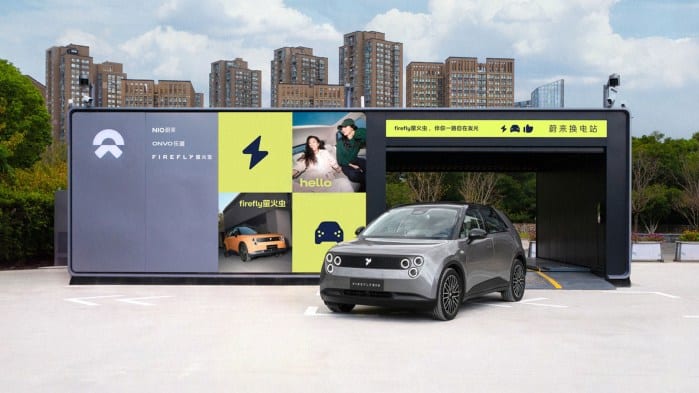
Earlier this year, Nio opened its first multi-brand “Sky Store” in Jiangmen, Guangdong — bringing Nio, Onvo, and Firefly under a single roof to lower fixed costs while boosting exposure for its sub-brands.
The format is being expanded to lower-tier cities across roughly 210 prefecture-level markets.
The shared showroom model also allows consumers considering an entry-level Nio model to discover Onvo vehicles with comparable or better specifications at a considerably lower price point.
Shen Fei said both sub-brands under the same roof would help “make more people aware of Onvo and choose it.”
‘Battle Units’
Nio Inc. has been operating under a Cell Business Unit (CBU) framework, a performance-oriented structure introduced in early 2025 that requires each department to manage its own budget and return on investment.
Li said the system must extend down to every individual team and region.
“From the company’s capability perspective, we need to empower every ‘battle unit’ (team), every store, and every region to operate effectively in a coordinated way. This is something we must keep doing consistently. There are no miracles here,” he said.
He drew a direct contrast between Nio‘s established frontline teams and Onvo‘s nascent operations.
“For example, Nio‘s battle units are relatively mature now, but on the Onvo side, only about 30% of the battle units have started delivering results. What does that mean? It means many of them are still in the process of being built and refined,” Li said.
Nio was founded in November 2014 and underwent a major restructuring in 2025 that saw the company close the year with 10,600 fewer workers.
Onvo‘s sales and service organization was built from scratch, the executive said.
He acknowledged that “Onvo‘s sales and service team is also very young and entirely new — from headquarters to regional teams, it’s a fresh organization. And with a new team, we need time to build experience and maturity.”
Competitive Pressures
At the same time, the Li highlighted how intense competition is in China’s EV market, along with how quickly new models are being developed and updated.
“The reality is that products are becoming more and more commoditized, and competitors are moving very fast,” Nio‘s founder and CEO said.
The 2026 L90 reflects that urgency.
Launched just nine months after the original version, the refreshed SUV replaces the Nvidia Orin-X chip with Nio‘s in-house Shenji NX9031 processor.
The model also introduces LiDAR on an Onvo vehicle for the first time — ending the pure-vision approach the sub-brand had promoted since its 2024 debut.
Starting prices remain unchanged at 265,800 yuan ($36,940), or 179,800 yuan under the Battery-as-a-Service plan.
Deliveries are scheduled to begin on May 9.
Onvo has surpassed 140,000 cumulative deliveries across the L60 and L90 since it launched in September 2024.
The brand is also preparing to debut the L80 — a five-seat variant of the L90 — at the Beijing Auto Show this week, with deliveries expected in mid-May.
The company’s executives have stated during the media event that the upcoming SUV will address ‘unmet needs’ in the five-seat SUV segment.