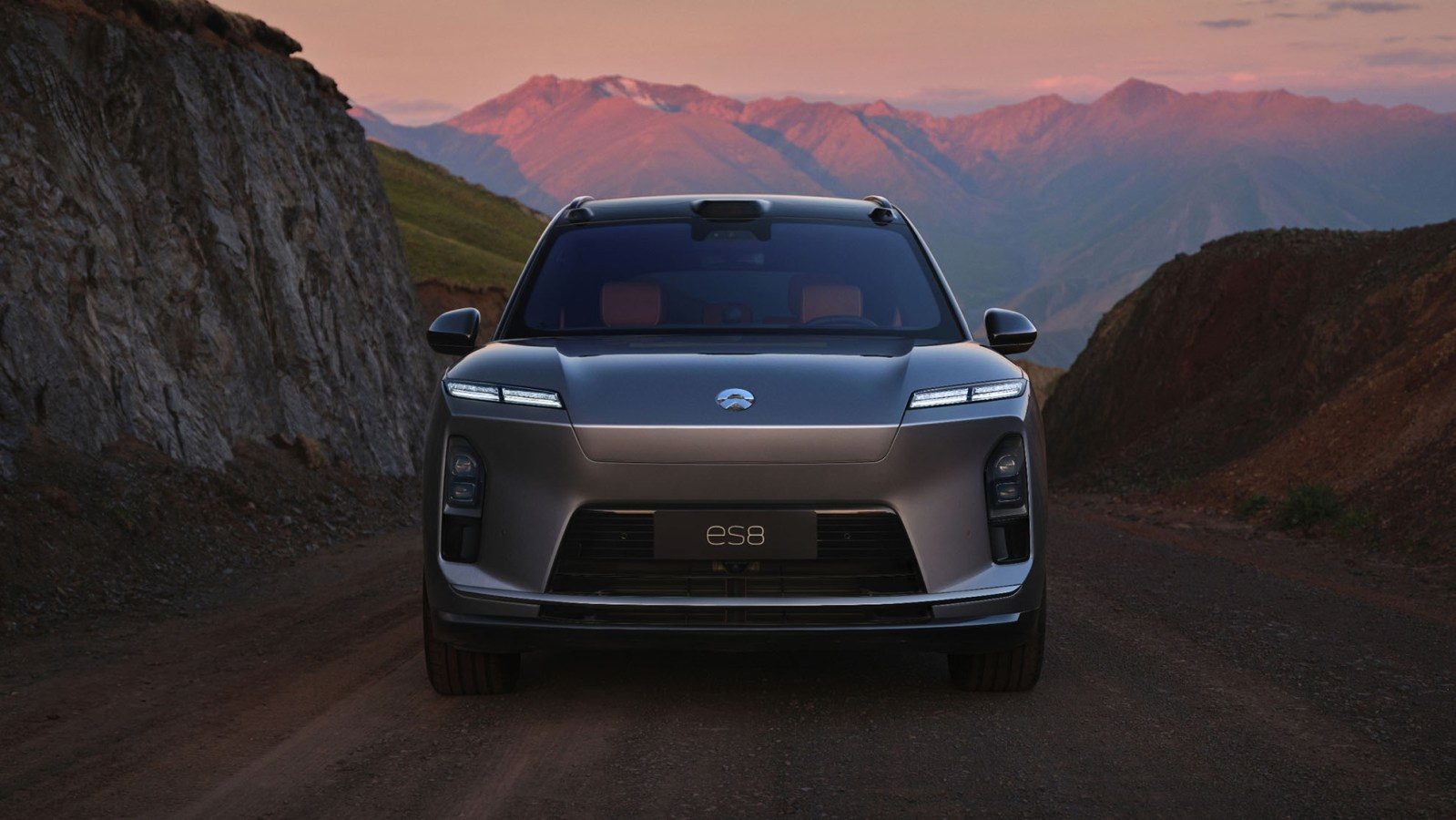

The premium Nio brand delivered 20,008 vehicles in July, a 57.9% increase from a year earlier and an 8.7% decline from June, according to the brand-level split published by Nio Inc. on Saturday.
The main marque accounted for 55.7% of the group’s 35,934 July deliveries, down from 54.0% in June once the sub-brands’ steeper sequential falls are taken into account.
Deliveries under the Nio badge now total 139,496 for the first seven months of 2026, a 60.1% increase on the 87,120 units handed over in the same period of 2025.
The company does not publish a brand-level year-to-date figure. That total is calculated by EV from the monthly splits Nio Inc. discloses each month.
A model-level breakdown of the July figure is not included in the release. The China Passenger Car Association is expected to publish its model-by-model data next week, which will carry the ES8, ES9, ET5, ES6 and EC6 splits.
The ES8 Recovers Its Footing
Nio said the ES8 delivered 10,286 units in July, a 14.7% rise on the 8,969 vehicles the model recorded in June.
June had broken a seven-month run above 10,000 units for the flagship, a 21.9% sequential fall that arrived as the newly launched ES9 pulled buyers toward the top of the range.
The July figure puts the ES8 back above that threshold and gives the model 51.4% of the entire Nio brand volume for the month.
Measured against the group, the ES8 alone accounted for 28.6% of all 35,934 vehicles the company delivered in July.
The model reached 130,000 cumulative deliveries on July 22, 305 days after the third-generation car went on sale in late September 2025.
Nio also said the ES8 led China’s large SUV segment on sales in the first half of 2026 and topped the 400,000-yuan price class over the same period.
The Five-Seat Variant Enters the Mix
Deliveries of the ES8 Five-Seat Version began on July 10, making July the first full month in which the flagship has been available in five-, six- and seven-seat configurations.
The variant opened pre-orders on June 28, the ES8 nameplate’s eighth delivery anniversary, priced from 382,800 yuan for the Executive Premium trim and 274,800 yuan under Battery-as-a-Service.
The car began life inside Nio as a separate model. On the second-quarter 2025 earnings call, founder and chief executive William Li told investors the company would launch a large five-seat SUV called the ES7 alongside the ES9 and the Onvo L80.
Co-founder and President Qin Lihong later described the same vehicle as a five-seat ES8, folding it into the existing nameplate rather than opening a new one.
The launch incentive attached to it — five years of complimentary NOP+ subscription and a cabin accessory package — expired on July 31, which concentrated order intake inside the month and makes August the first clean read on underlying demand.
The Flagship Crossover Continues
June was the month the ES9 came within 374 units of the ES8.
The ES9 delivered 8,595 vehicles in its first full month on sale, a 176.5% increase on the 3,108 units handed over across the final four days of May, and contributed 21.2% of group volume.
In April, before the ES9 reached customers, the ES8 had taken 13,028 units and 44.4% of the group total, which measures how quickly the premium mix has moved inside a single quarter.
Deutsche Bank has argued the two do not cannibalise each other given the price gap, positioning the ES8 as a family vehicle against the Li L8 and the Aito M8, and the ES9 as an executive car against the Aito M9 and the Zeekr 9X.
The bank put the ES9’s non-cancellable order backlog above 40,000 units.
Whether that thesis holds through July will only be testable once the CPCA figures land next week.
Target Progress
Nio sets no separate delivery target for the main brand, guiding instead at group level to 40% to 50% growth on 2025’s 326,028 units, implying a full-year range of roughly 456,000 to 489,000 vehicles.
Group deliveries of 227,057 through July represent 49.8% of the lower bound of that range and 46.4% of the upper bound.
The second quarter closed at 107,658 units, 2,342 short of the company’s own 110,000-to-115,000 guide, which sets the bar the main brand has to clear in the third.
The Nio brand’s own 139,496 units equal 61.4% of the group’s year-to-date volume, against a long-term mix in which management has said the main brand should settle at roughly 35% as Onvo scales to 55% and Firefly to 10%.
The gap between those two figures is the clearest single measure of how far the group is from the structure it has described.
Chinese automakers broadly reached the half-year mark behind their annual goals, and Nio has missed its own delivery target in each of the past three years.
Infrastructure Behind the Premium Push
Nio is approaching 4,000 battery swap stations in China, the network the brand has used since 2018 to differentiate its premium cars from range-extended rivals.
Large-scale deployment of the fifth-generation station began in July, cutting the fastest swap to one minute and 48 seconds and raising per-station battery storage to between 21 and 28 packs.
Brand and communications executive Ma Lin said on Weibo late Friday US Eastern time that the 4,000th station will be the first fifth-generation site to open for service, and pointed to Quanzhou, Fujian province, in early August.
Li has guided to 4,500 to 4,600 stations in China by year-end, with about 450 openings loaded into the fourth quarter.