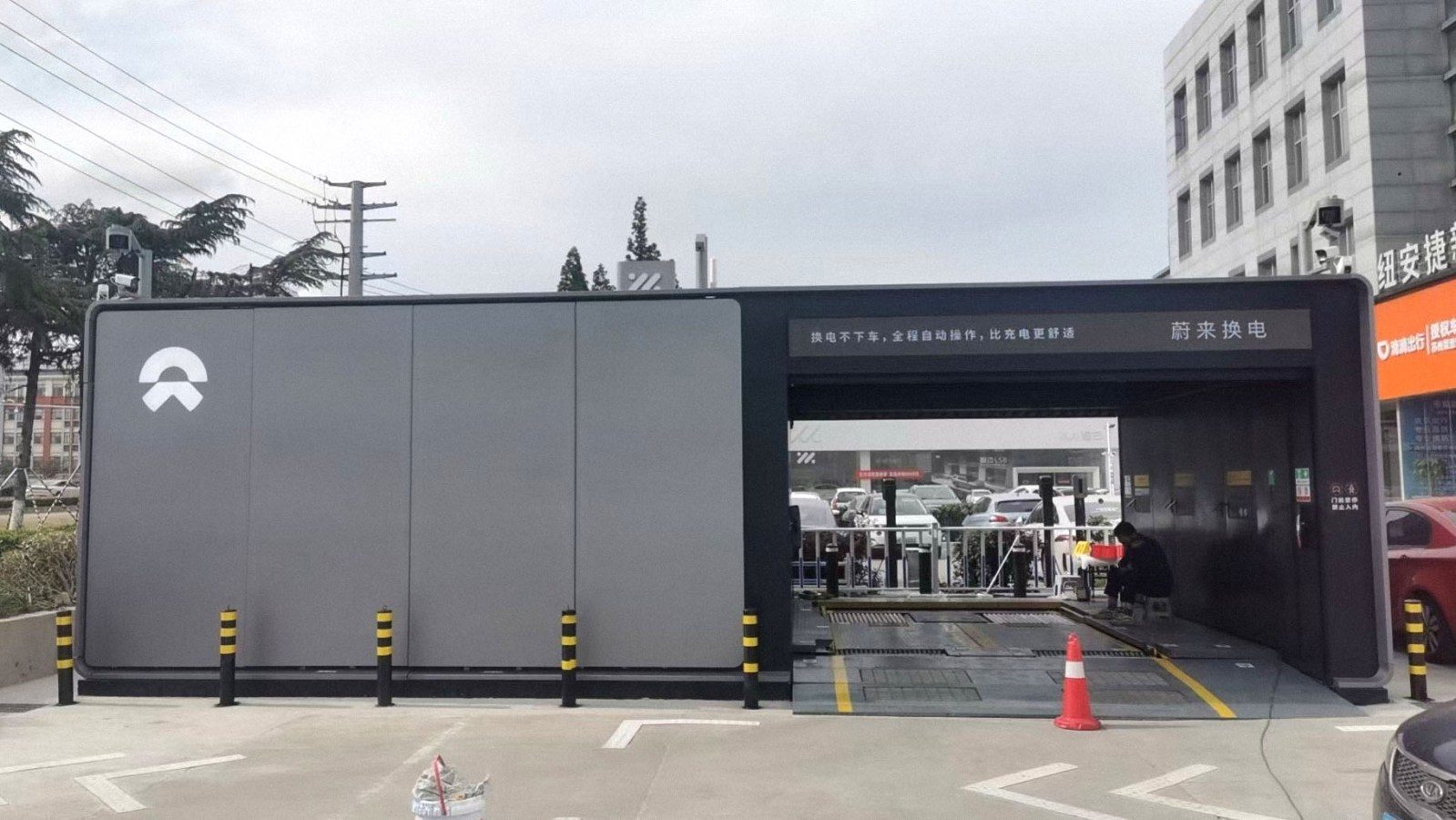

Nio Inc. has officially begun the large-scale deployment of its fifth-generation battery swap stations in China, marking the start of the most ambitious phase of a rollout that has been repeatedly delayed since last year.
Founder and CEO William Li made the announcement this week while reaffirming the EV maker’s target of over 1,000 new stations added in 2u026 — which would bring the nationwide total to more than 4,600.
Nio currently operates 3,989 stations in China for its battery swap network, according to its website — just 11 away from reaching the 4,000 milestone.
More than 1,000 of those stations are positioned along highways.
The fifth-generation stations are the first in the network to support vehicles from all three of Nio‘s brands — Nio, Onvo, and Firefly — regardless of wheelbase or battery pack size.
Reserved interfaces have also been designed to eventually accommodate models from battery swap alliance partners, including Changan and Geely, though the company has deprioritized that initiative in favor of expanding for its own brands.
Fifth-Generation Specs
The fifth-generation station represents a substantial hardware upgrade over its predecessor.
The fastest battery swap has been cut to one minute and 48 seconds, a 25% reduction from the fourth-generation station’s two minutes and 24 seconds.
Daily service capacity has risen to 500 swaps from approximately 417, a 20% increase.
Battery storage capacity has expanded to between 21 and 28 packs per station, up from a range of 13 to 20 in the previous generation.
The larger buffer allows a single station to carry packs for compact Firefly city cars, mid-size Onvo models, and full-size Nio SUVs simultaneously — a prerequisite for the multi-brand strategy that Nio has been building toward since introducing its second and third sub-brands.
A retractable VGA vision-guided robotic arm handles automatic vehicle positioning, eliminating the need for drivers to exit the vehicle or perform any manual steps.
Each fifth-generation station also functions as distributed energy storage, since the packs held on site can be discharged back to the grid rather than only into vehicles.
Nio has framed the storage capability as a future revenue stream, with stations potentially participating in grid load-balancing programs.
Several Nio stations have already been included in grid regulation programs in China since 2022, primarily to reduce electricity demand during peak summer periods.
Rollout Timeline
The path to large-scale deployment has been uneven.
Nio originally targeted a pilot run before Christmas 2025, then revised to the first quarter of 2026, then the second quarter, and most recently to July or August for mass deployment.
Internal testing stations became operational in late March, validating the new platform architecture.
Between five and 10 pilot stations entered public trial operation in May and June, collecting performance data on multi-brand battery compatibility, automated swap efficiency, and reliability in extreme weather.
Firefly vehicles were spotted testing at one of the new stations earlier this year, and the sub-brand rolled out software enabling battery swap support through a system update in May.
Full-scale deployment officially began in July, with Nio targeting more than 100 new openings per month from September.
Q4 Push
Deployment plans reported in April indicated the company intends to open more than 150 stations per month from October through December — a fourth-quarter push of approximately 450 stations that would account for nearly half the full-year target.
Li has repeatedly stated that Nio now has the capacity to build between 1,000 and 1,500 battery swap stations annually.
At the current pace, approximately one new station is entering service every 3.5 hours.
The back-loaded schedule mirrors the pattern from 2025, when Nio fell well short of its station target after slowing construction of fourth-generation stations that could not be upgraded to support new battery sizes.
Only 681 stations were added last year, representing 34.1% of the original 2,000-unit guidance.
China Network
Nio opened its first battery swap station in Shenzhen in 2018.
The company has since invested more than 20 billion yuan ($2.9 billion) specifically in charging and battery swap infrastructure, as part of a broader research and development spend exceeding 68.8 billion yuan over the past 11 years.
The battery swap business itself has not yet become independently profitable, according to management.
Nio has, however, said its broader service and community business — which includes swap infrastructure — has reached profitability, providing financial support for continued expansion.
Nine provincial-level regions in China have achieved full county-level swap coverage, with Li indicating that full nationwide county coverage is approximately two years away, with exceptions for remote areas of Xinjiang and Tibet.
Nio‘s founder and CEO has stated that, by the end of China’s 15th Five-Year Plan period (around 2030), the company aims to operate more than 10,000 battery swap stations — while maintaining an annual construction pace of approximately 1,000 units over the next several years.
Rest of the World
Outside China, however, Nio‘s battery swap expansion has stalled.
Nio‘s global station count at year-end 2025 stood at 3,737, reflecting 60 stations in Europe and one in the UAE, per its annual report filed with the US Securities and Exchange Commission.
The company operates 60 stations across six European markets, most of them in Norway and Germany, according to the most recent figures.
Growth in the European network slowed sharply following investment cuts to the continent’s operations.
As exclusively reported by EV, Nio closed one of its European stations — located in Denmark — late last year, marking the first time the company had shut a swap facility anywhere on the continent since arriving in 2021.
The European network crossed 300,000 cumulative battery swaps in June. Nio said 74% of its European users now choose battery swapping over plug-in charging.