
An investment firm co-founded by Nio Inc.‘s founder and chief executive William Li is the third-largest shareholder in a battery-swap operator that has now refiled for a Hong Kong listing.
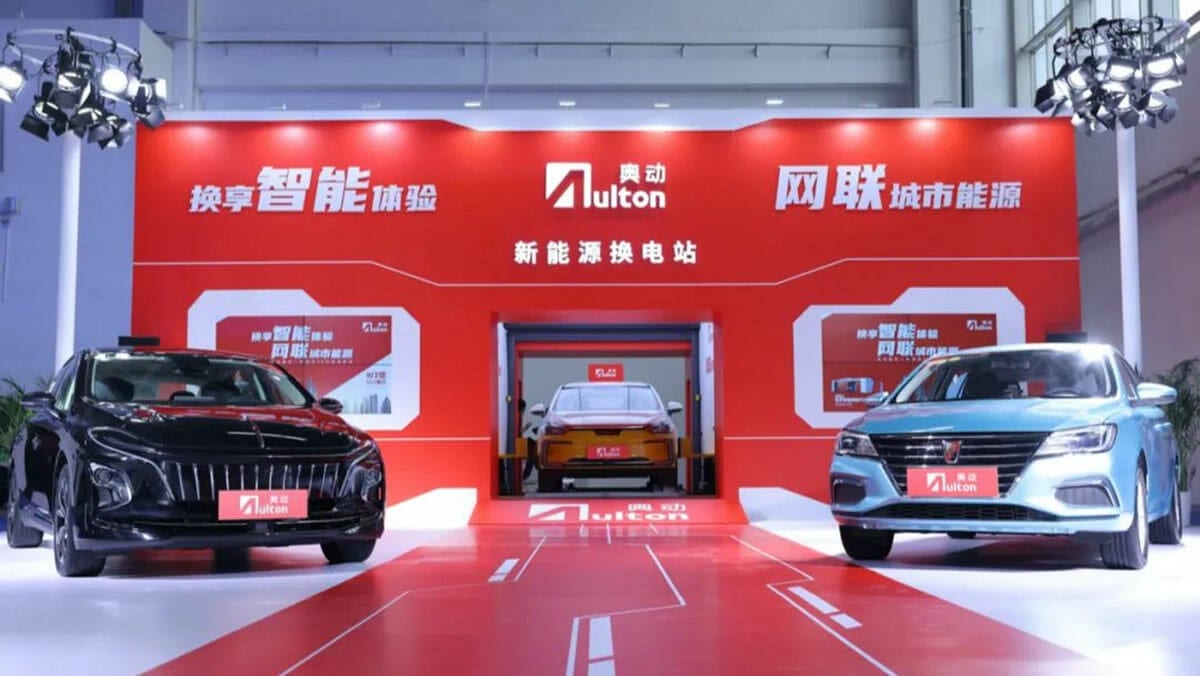
Named Aulton New Energy, the firm is set to become the first pure swap business to trade publicly.
The stake sits at 5.53%, or 52,556,128 of Aulton‘s 951,207,879 registered shares, held through Hubei Jiahu Equity Investment Partnership, a vehicle affiliated with the Hubei Yangtze Nio New Energy Industry Development Fund.
Only Aulton‘s two co-founders hold larger stakes.
The Shareholding
Chairman and general manager Cai Dongqing holds 39.11% directly, on 372,035,637 shares. Co-founder Zhang Jianping, a battery-swap engineer, holds 13.24%.
Nio Capital’s 5.53% places it ahead of Guangjin Kaide, linked to Guangzhou state-related capital, at 5.20%.
Below that sit Fujian Aoying at 4.82%, Zhuhai Aoning at 4.27%, individual holder Chen Shaoxiong at 4.25%, Guangzhou Jinxian at 4.07% and the employee platform Zhuhai Aoli at 3.09%.
The nine largest holders account for 83.6% of the register, with more than twenty smaller shareholders holding the rest. Among them, according to filings, are a Sinopec-linked fund at about 2.16%, a vehicle described as Toyota-related, and a Samsung Ventures partnership.
Nio Capital was founded in 2016 by Li and Zhu Yan, and operates as an independent private equity firm raising from third-party limited partners. Li is listed as a managing partner.
How the Stake Was Built
Nio Capital invested 250 million yuan alone in Aulton‘s Pre-A round in April 2018, taking an initial holding of roughly 5.56%, then added about 150 million yuan in the Series A.
The 400 million yuan total has been diluted only marginally across subsequent rounds, from 5.56% to 5.53%.
Aulton has raised roughly 3.5 billion yuan since its founding and was valued near 11.9 billion yuan after its final round in early 2022. No fresh capital has entered the company in the four years since.
Nio’s Own Supply Chain
Aulton is one position among roughly seventy, and the portfolio Nio Capital publishes runs directly through the businesses Nio depends on.
The clearest case is Seyond, formerly Innovusion, which supplies the LiDAR fitted to Nio’s vehicles. The fund co-founded by Nio’s chief executive holds a stake in the carmaker’s principal LiDAR supplier.
CATL appears in the same portfolio.
The world’s largest battery maker is both Nio’s cell supplier and, increasingly, its competitor in swapping — CATL had reached 700 swap stations in China by late 2025 and targets more than 2,500 by the end of 2026.
Two further cell makers, CALB and Sunwoda, are also listed, alongside cathode producer Ronbay Technology.
XPT, Nio‘s own powertrain and electric drive subsidiary, appears on the page as well.
The mobility section carries two autonomy developers that compete with Nio’s in-house stack: Momenta, one of China’s largest autonomous driving software companies, and Pony.ai.
The list also includes Lotus, the Geely-owned electric brand, and Hycan, the former GAC-Nio joint venture that was wound up in 2025.
Elsewhere the fund holds Black Sesame Technologies, which makes automotive computing chips of the kind Nio now designs in-house, and EACON, the autonomous mining haulage developer.
The portfolio places Nio Capital simultaneously among Nio‘s suppliers, its subsidiaries, its swap competitors and its autonomy rivals.
Recent Deals
On July 13, two portfolio companies listed on the Hong Kong exchange on the same day — Momenta and EACON. Aulton filed six days later.
Beyond automotive, the firm backed Silicon Flow in a Series B of more than 2 billion yuan in June, co-led a Series C+ of nearly 1 billion yuan in the eVTOL developer VOLANT Aerotech in May.
Additionally, it also led a Series A in green hydrogen materials company Shenghui Technology in March and made a follow-on investment in the $200 million Series B of humanoid robotics developer LimX Dynamics in February.
A Batter Swap Competitor?
Aulton describes itself as China’s largest independent third-party swap provider, building and operating stations for taxi and ride-hailing fleets and selling equipment to municipal investment companies, energy firms and manufacturers.
Penetration of the private passenger car market, where Nio focuses, remains minimal.
Nio runs a proprietary network built around its own vehicles and its battery-as-a-service model, and has since begun opening it to other manufacturers — which moves it toward the third-party business Aulton occupies.
Aulton’s platform connected 531 stations as of April 30, comprising 214 proprietary sites, 79 under managed operation and 238 reached through platform services.
Nio operates close to 3,990 stations in China.
Aulton ranks third in China by swap station operation service revenue, according to CIC data cited in the prospectus.
The Company Going Public
The financial picture is the reason the listing matters beyond the shareholder curiosity.
Revenue fell from 1.155 billion yuan in 2023 to 926 million in 2024, a decline of 19.8%, then to 677 million in 2025, down a further 26.9%.
Cumulative net losses from 2023 through the first four months of 2026 reached about 1.47 billion yuan. Annual losses ran at 656 million yuan in 2023 and 419 million in 2024.
Equipment sales, once the core of the business at 731 million yuan in 2022 and 66.9% of revenue, fell to 519 million in 2023 and about 150 million in 2025 — a collapse of roughly 70% that the prospectus attributes to third-party station investors and automakers tightening capital spending from 2024.
Utilisation tells the same story. Swap station production line utilisation fell from 57.9% in 2023 to 9.2% in the first four months of 2026, and module line utilisation from 77.4% to 17.5%.
The Pressure From Both Sides
Nio and CATL are both building swap networks at scale, CATL having reached 700 stations in China with a target above 2,500 by the end of 2026.
At the same time, the spread of 800-volt architectures and high-power charging is eroding the speed advantage that swapping was built on, particularly among private buyers.
Aulton‘s own technology remains competitive on that measure — a chassis-locking system it says completes a passenger car swap in 20 seconds, supported by 2,453 authorised patents as of April.a