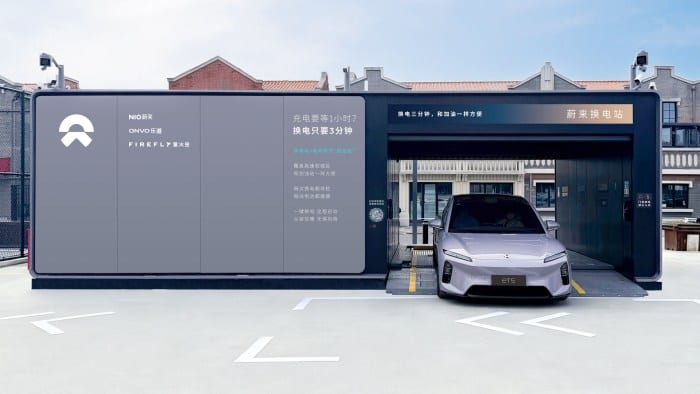
Nio is approaching the 4,000-station milestone for its battery swap network in China, with 3,989 stations in operation as of press time — just eleven short of the threshold.
The Chinese EV maker ended 2025 with 3,676 battery swap stations in China, which implies that 313 new stations have been built in the first seven months of 2026.
Nio has targeted more than 1,000 new stations this year, which would bring the domestic total to above 4,600 by December.
As of July 30, the company has completed only 31.3% of its yearly target.
Founder and CEO William Li has repeatedly reaffirmed the target, most recently while announcing the large-scale rollout of fifth-generation battery swap stations this week.
Li said Nio now has the capacity to build between 1,000 and 1,500 stations annually.
Year-to-Date Pace
At 313 stations added across roughly 30 weeks, Nio has been building at an average pace of about 45 per month in 2026 — well below the run rate needed to meet its full-year target.
Reaching 1,000 net additions by year-end requires approximately 687 more stations across the final five months, or roughly 137 per month from August through December.
The back-loaded schedule mirrors the pattern from 2025, when Nio fell well short of its station target after slowing construction of fourth-generation stations that could not be upgraded to support new battery sizes.
Only 681 stations were added last year, representing 34.1% of the original 2,000-unit guidance.
Management has attributed this year’s front-half slowdown to the same dynamic — holding back fourth-generation builds while waiting for fifth-generation hardware to reach production readiness.
Gen-5 Rollout Underway
The company officially began large-scale deployment of its Gen 5 stations this week, after a path to volume deployment that slipped repeatedly.
Nio originally targeted a pilot run before Christmas 2025, then revised it to the first quarter 2026, then the second, and most recently to July or August for mass rollout.
Between five and 10 pilot stations entered public trial operation in May and June.
Full-scale deployment began in July, with Nio targeting more than 100 new openings per month from September.
The fifth-generation stations are the first in the network to support vehicles from all three of Nio‘s brands — Nio, Onvo, and Firefly — regardless of wheelbase or battery pack size.
With the new generation, the fastest swap time has been cut to one minute and 48 seconds, a 25% reduction from the fourth-generation station’s two minutes and 24 seconds.
The fifth generation cuts the fastest swap to one minute and 48 seconds from two minutes and 24 seconds, a 25% reduction, and raises daily capacity to about 500 swaps from 480.
Nio has guided to a roughly 20% increase in battery storage over the fourth generation, which holds 23 packs — up from 21 in the third — though the company has not published a bay count for the new stations.
Deployment plans reported in April indicated the company intends to open more than 150 stations per month from October through December — a fourth-quarter push of approximately 450 stations that would account for nearly half the full-year target.
CATL Is Building Faster
CATL‘s Choco Swap network did not exist at the start of 2025.
The battery maker’s subsidiary CAES set a target in October 2025 of 1,000 stations by year-end, alongside more than 2,500 across at least 120 Chinese cities during 2026. CATL announced in late November that it would clear the first of those a month early.
On December 30 the company confirmed 1,020 stations across 45 cities, and raised its end-2026 goal from 2,500 to more than 3,000, then covering 140 cities. That figure has since moved again: CATL now guides to more than 190 cities by December.
The 2,000th Choco station was deployed on June 30, taking coverage to 180 cities across 31 provinces, with more than 80% penetration of small and medium-sized cities. The company said it averaged more than 200 new stations a month during the second quarter.
The Rates Are Not Comparable
Set against Nio‘s network, the contrast is in the build rate rather than the totals.
CATL added 980 stations in the six months to June 30, an average of 163 a month. Nio added 313 in the seven months to July 30, an average of 45. The battery maker is building at roughly 3.7 times the carmaker’s rate.
The gap matters more for what each still has to do than for where each stands.
CATL needs 1,000 more stations across the final six months to reach 3,000, or about 167 a month — marginally above the 163 it has just been running.
Nio needs 687 across five months to reach its own target, or about 137 a month, against the 45 it has achieved.
One is on pace. The other would need to roughly triple.
Carried forward at current rates, CATL finishes the year at close to 3,000 Choco stations and Nio at around 4,200, short of the 4,676 its guidance implies.
Counting both networks changes the picture again.
CATL has said its combined Choco and Qiji Energy heavy-truck stations will exceed 4,000 in China by the end of 2026 — from a standing start eighteen months earlier, and within reach of a network Nio has spent since 2018 building.
Nio’s Investment and Scale
Nio opened its first battery swap station in Shenzhen in 2018.
The company has since invested more than 20 billion yuan ($2.9 billion) in charging and battery swap infrastructure, as part of a broader research and development spend exceeding 68.8 billion yuan over the past 11 years.
The battery swap business itself has not yet become independently profitable, according to management.
Nio has, however, said its broader service and community business — which includes swap infrastructure — has reached profitability.
Nine provincial-level regions in China have achieved full county-level swap coverage.
According to William Li, full nationwide county coverage is approximately two years away, with exceptions for remote areas of Xinjiang and Tibet.
By the end of China’s 15th Five-Year Plan period, around 2030, the company aims to operate more than 10,000 stations while maintaining an annual construction pace of roughly 1,000 units.
Europe
Outside China, Nio‘s swap network expansion has stalled.
The company operates approximately 60 stations across six European markets, most of them in Norway and Germany.
Management has reportedly told owners that no new swap stations will be added in Europe in 2026, leaving all of this year’s deployments to China.
However, in mid June, the Norwegian subsidiary announced that it will open a new battery swap station in the Oslo West/Bærum area.
The European network crossed 300,000 cumulative battery swaps on June 21.
Nio said 74% of its European users now choose battery swapping over plug-in charging.
Reaching the third 100,000 swaps took 307 days — 38 days longer than the second 100,000, despite a larger base of vehicles and drivers on the continent.
As exclusively reported by EV, Nio closed one of its European stations — located in Denmark — late last year, marking the first time the company had shut a swap facility anywhere on the continent since arriving in 2021.
Nio has shifted its European sales operations toward a dealer-and-distributor model, entering seven new markets through local partners.
Management has said the decision to deploy swap stations in those new markets rests with each distributor.
No distributor has announced the opening of a battery swap station as of Thursday.
Middle East
Nio operates one battery swap station in the Middle East, located at the Yas Marina F1 Circuit on Yas Island near Abu Dhabi.
The station opened in February 2025 and remains the company’s only swap facility in the region.
Nio‘s country chief for the UAE, Roberto Lopes da Silva, said in September 2025 the company was “proactively looking” for a location in Dubai for a second station, citing heavy power requirements — a minimum of 250 kW — as the main challenge in securing new sites.
No second station has materialized since.
The MENA operation is managed through Nio MENA, a joint venture with Abu Dhabi-based investor CYVN Holdings, which holds a roughly 20% stake in Nio.
As EV reported in April, several founding commitments of the venture — including a bespoke vehicle, a regional R&D center, and sub-brand expansion — remain without disclosed timelines.