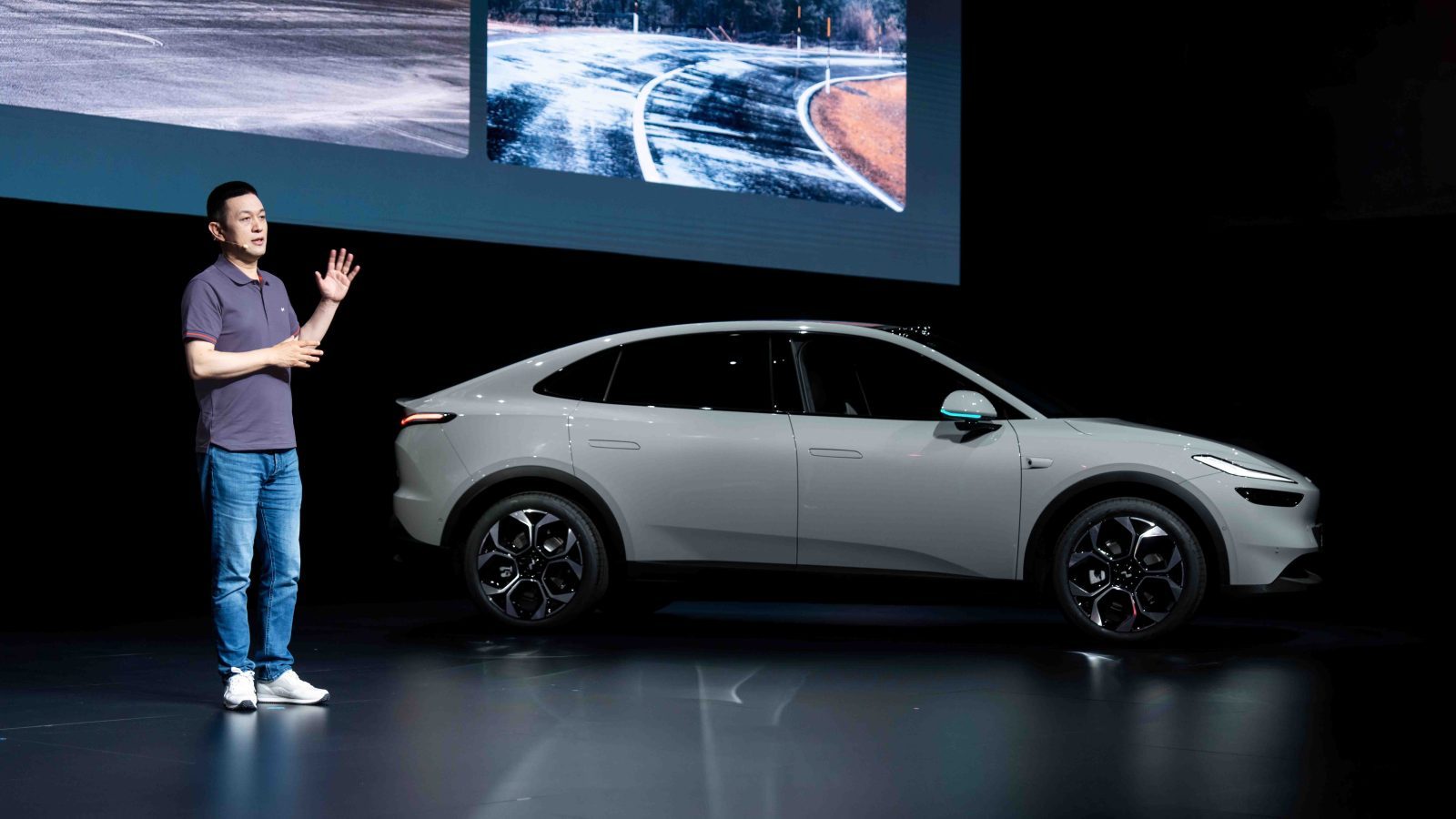

Onvo cut the starting price of its overhauled L60 SUV to 192,800 yuan ($28,300) at a relaunch last week, 14,100 yuan below the outgoing model even as it added costlier hardware and absorbed rising supply-chain costs.
The new iteration tops out at 222,800 yuan ($33,000) for full-purchase buyers, down from the previous generation’s 206,900 to 255,900 yuan bracket.
Under Nio Inc.‘s Battery as a Service subscription, the entry price falls to 135,800 yuan ($20,000).
The reduction was unexpected. In the weeks before the June 11 launch, both senior Onvo executives had signaled that prices would rise.
Brand chief Shen Fei cited upgrades and rising costs at the model’s pre-sale unveiling on May 29 without specifying a figure.
Days later, Onvo‘s Head of Marketing Ma Lei put a number on the expected increase, writing on Weibo that the new L60 would sell for nearly 20,000 yuan more than the outgoing model and that the LiDAR-equipped trim would cost more than 10,000 yuan above the pure-vision variant.
Clearance of old-generation inventory was nearing its end, Ma added, reinforcing the expectation of a step-up.
Instead, Nio moved in the opposite direction — trimming the sticker even as it loaded the vehicle with hardware previously reserved for premium Nio models.
In an interview with the Economic Observer published around the launch, Nio‘s founder and CEO William Li put a figure on what the decision is costing the company.
“Supply-chain prices really have risen too much now. The Onvo L60 still has gross margin, but it’s pretty dire,” Li said.
He disclosed that the all-in expense of building a single Onvo vehicle has climbed by more than 10,000 yuan ($1,500), reaching approximately 15,000 yuan ($2,200) once taxes and related charges are factored in.
Memory chips, battery raw materials, and other supply-chain inputs are the main drivers, he said.
More Hardware for Lower Price
The margin pressure is all the more notable given the scope of the upgrade.
Mid- and high-specification trims carry, for the first time, Nio‘s in-house Shenji NX9031 chip — billed as the world’s first 5-nanometer automotive-grade smart-driving processor — paired with a high-precision LiDAR sensor and Nio‘s SkyOS Tianshu world-model operating system.
The entry variant retains a vision-based solution running on Nvidia‘s Orin-X chip.
The addition of LiDAR in the two top trims represents a clean break from Onvo’s founding strategy, which deliberately omitted the sensor to keep the price point low when the L60 debuted in September 2024.
Additionally, the full lineup moved to Nio‘s NT3.0 platform with a standard 900-volt silicon-carbide architecture.
‘Pretty Dire’ Margins
Li’s admission marks a rare instance of a Nio executive publicly describing Onvo‘s unit economics in negative terms.
It also represents a step backward from targets the company has laid out over the past year.
When Onvo‘s second model — the six-seat SUV L90 — opened pre-orders in July 2025, brand president Shen Fei said the SUV’s pricing had been initially set at a zero-margin baseline and was later revised upward.
By September 2025, Li outlined explicit brand-level margin targets during the second-quarter earnings cycle: approximately 15% for Onvo, 20% to 25% for the premium Nio brand, and around 10% for Firefly.
He singled out the Onvo L90 and the new ES8 as models targeted at approximately 20% gross margin.
CFO Stanley Qu reiterated the 15% Onvo target during Nio‘s fourth-quarter 2025 earnings call in March.
Li’s description of the L60’s margin as “pretty dire” suggests the refreshed model is falling well short of even the 15% floor, at least in the early phase of production — given the simultaneous headwinds of a lower selling price and per-unit cost inflation running at 15,000 yuan.
Nio does not break out margins by brand or model in its financial filings.
The only model-level disclosure to date concerns the flagship ES8 SUV, which co-founder and President Qin Lihong said in January carries a gross margin of roughly 20% and generates approximately 80,000 yuan ($11,800) in gross profit per unit.
At the group level, vehicle margin reached 18.8% in the first quarter of 2026 — a fourth consecutive quarterly improvement — but that reading was driven overwhelmingly by the Nio brand, which contributed 58,543 of the quarter’s 83,465 deliveries.
Onvo accounted for 13,339 units and Firefly 11,583.
Management warned on the May earnings call that the full-year vehicle margin target stands at 17% to 18% — below the first-quarter figure — because a rising share of lower-priced Onvo and Firefly vehicles will dilute the group average in coming quarters.
Li told staff in an internal meeting in April that the second-quarter launches — including the ES9 and the Onvo L80 — were “all high-margin large vehicles” and that executing them well was the quarter’s most important objective.
Brand Awareness Issues
Beyond margins, Li pointed to a deeper structural issue.
Onvo‘s name recognition among Chinese consumers remains far lower than Nio had anticipated — a problem for a brand competing in the 200,000-yuan all-electric SUV segment, where showroom traffic depends on buyer familiarity.
“We originally thought Onvo‘s recognition would be built up quickly. But according to our research data, many people may not know the Onvo brand at all,” Li stated last week.
He estimated that brand awareness sits roughly where Nio‘s was six to seven years ago, a comment he had also made during the first quarter’s earnings briefing in May, when he conceded that the biggest issue at Onvo “is still low awareness.”
Demand for Onvo
Nio accumulated nearly 100,000 L60 deliveries since its September 2024 debut, but monthly volumes peaked above 10,000 in December 2024 and then declined steadily throughout 2025, averaging between 4,000 and 6,000 units a month.
By January 2026, the L60 moved 1,978 units, and February brought just 1,664.
Sales recovered from March but stayed below earlier highs — the trajectory that prompted the lineup-wide refresh culminating in last week’s L60 relaunch.
The L90 — which consecutively surpassed 10,000 monthly deliveries in its first three months of sales — also saw volumes decline sharply in the beginning of 2026.
Li said he has not set a standalone sales target for Onvo, preferring to track the group’s consolidated growth rate.
Nio Inc. is targeting 40% to 50% year-on-year delivery growth across all three brands in 2026.
The founder noted that growth from January through May reached 68%.
“Growth from January to May this year was certainly a bit above that figure, reaching 68%,” he said, calling it “still pretty good.”
Late last month, William Li outlined a long-term brand-mix target of 35% Nio, 55% Onvo, and 10% Firefly by volume.
Through the first five months, the sub-brand contributed 30,720 of Nio Inc.‘s 150,526 global deliveries, a 20.4% share.