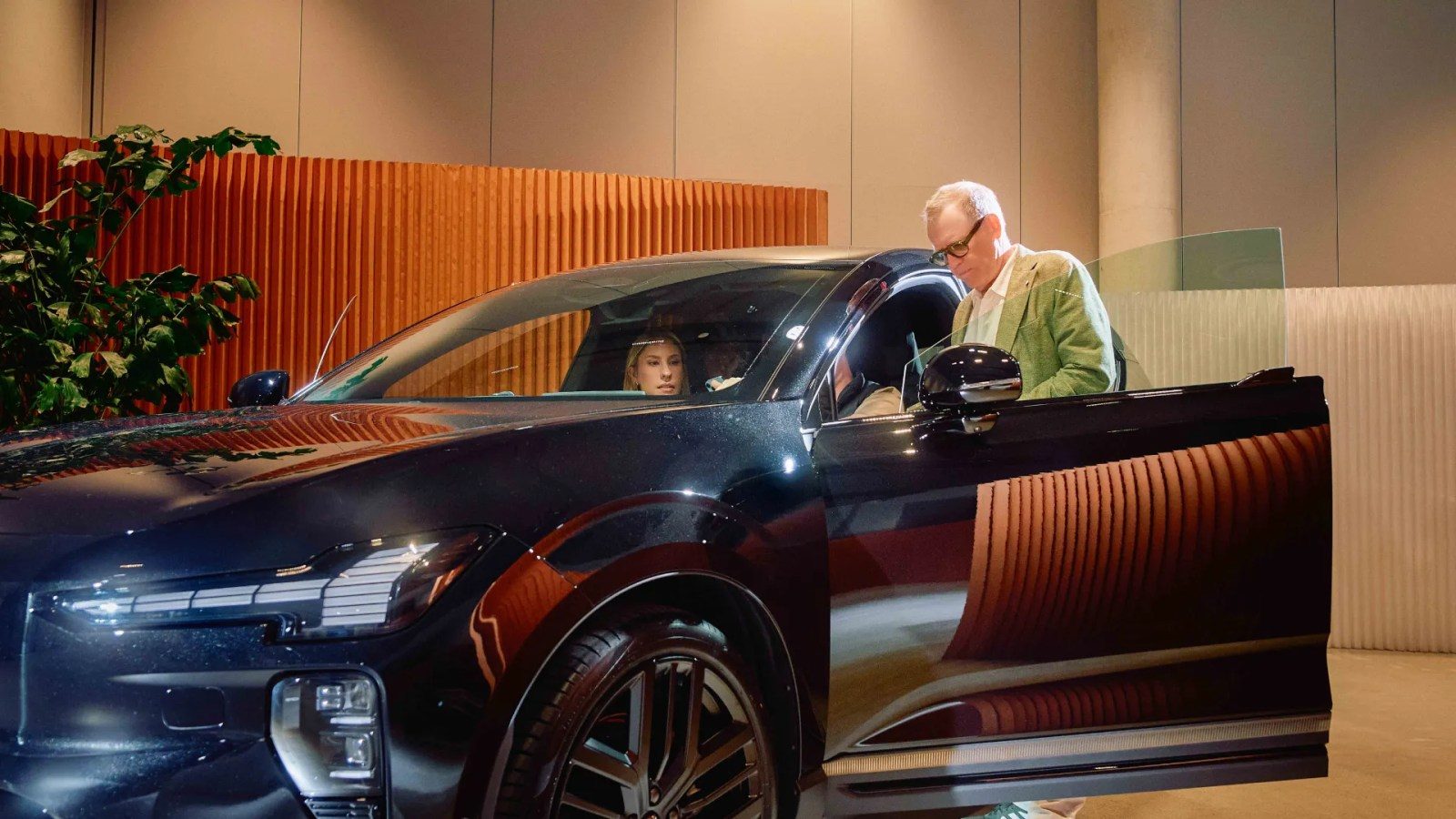

Volvo Cars began delivering the fully electric EX60 to customers in Europe on Thursday, marking a pivotal step for the Geely-backed automaker as it attempts to reverse declining global sales through its most important model launch in years.
Sweden — where it is headquartered — was the first market to receive customer vehicles, with broader European deliveries set to follow in the coming weeks.
The mid-size SUV, launched in January, enters what is now the most contested electric segment in Europe.
BMW, Mercedes-Benz and Audi are all bringing fully electric mid-size SUVs to market this year — the iX3, the electric GLC, and the Q6 e-tron — creating what CEO Håkan Samuelsson has described as a three-way race that will push the continent toward electrification.
“This is a huge moment for us and our customers,” Volvo‘s Chief Commercial Officer Erik Severinson stated on Thursday. “After many thousands of hours and miles developing one of the most advanced cars on the market, seeing the first customers take delivery of their own EX60 feels especially momentous.”
Production and customer deliveries will ramp up through the second half of 2026.
Order books are open across Europe, and have recently opened in the United States as well, where the model starts from $58,400 — just $410 above the Rivian R2 Performance.
Specs
Volvo claims the EX60 delivers class-leading range for its segment.
The top-specification P12 AWD variant offers up to 810 km (503 miles) on the WLTP cycle, which the company says exceeds its recently revealed competitors.
The P10 AWD reaches up to 660 km (410 miles), while the rear-wheel-drive P6 variant delivers up to 611 km.
Charging speed is similarly positioned as a differentiator. At a 400 kW fast charger, the EX60 can add up to 340 km of range in ten minutes, according to Volvo.
The P10 AWD and P6 RWD variants can charge from 10% to 80% in 16 minutes.
The P12 AWD — which carries the largest battery — charges from 10% to 80% in approximately 18 to 19 minutes, based on previously disclosed specifications.
All variants use an 800-volt electrical architecture, a feature shared with its German competitors this year.
The EX60 is available in seven configurations across the three powertrains, covering Plus and Ultra trim levels.
Designed and Built in Sweden
The EX60 is the first fully electric Volvo to be designed, developed, and manufactured entirely in Sweden.
Production began in April at the Torslanda plant near Gothenburg, which received approximately SEK 10 billion ($1 billion) in upgrades to accommodate the new model.
Volvo introduced mega casting capabilities, a new battery assembly plant, a refurbished paint shop, and an updated final assembly line at the facility.
The model is underpinned by SPA3, Volvo‘s new scalable product architecture — described internally as “100% electric and 100% Volvo Cars.”
SPA3 marks a departure from the SPA2 platform, which was co-developed with parent company Geely and underpins the larger EX90 and the Geely-backed Polestar 3.
Key manufacturing technologies on the new platform include mega casting — where an 8,400-tonne Bühler press produces a single rear underbody component replacing more than 100 stamped parts — and cell-to-body battery construction, which integrates batteries directly into the vehicle structure.
Demand Exceeds Expectations
The start of deliveries follows months of stronger-than-expected order intake.
Within the first month after the January reveal, Volvo said nearly all major European markets reported retail orders considerably higher than internal forecasts.
Sweden alone accounted for more than 3,000 orders in that initial period — a pace Volvo said significantly exceeded the order intake for the EX30 small SUV after its 2023 debut, despite the EX30 sitting in a higher-volume, lower-price segment.
Samuelsson told Reuters in April that the company expects to build up to 40,000 EX60 units this year.
To meet incoming orders, Volvo negotiated with local trade unions to keep the Torslanda plant open for an additional week during the summer shutdown period — which would be a first in the facility’s history.
“Interest has been above our planned order intake, higher than planned, so at least we know we have the customers; the challenge is now on delivering, not selling,” Samuelsson said at the time.
Pricing Aligned with Best-Seller
Volvo has priced the EX60 in line with its best-selling XC60 plug-in hybrid, which starts from €67,990 in Germany.
European pricing for the EX60 starts from roughly €63,000 to €67,000 depending on the market and variant, according to publicly available configurator data. Severinson said late last year that the EX60 would be “priced like a plug-in hybrid but with a better profit margin.”
The pricing strategy places Volvo at a slight advantage against its German rivals.
The BMW iX3 starts at $62,850 in the United States including destination, while the Audi Q6 e-tron begins at approximately $64,500. In France, the EX60 starts from €66,500.
The model arrives with a 10-year battery warranty.
In Sweden, Volvo is also offering three years of free home charging — an incentive the company has said it plans to roll out to other markets.
Broader Volvo Context
The EX60 launch arrives at a critical juncture for the Swedish automaker.
Global sales fell 5.6% year-over-year in the second quarter to 171,501 vehicles, an improvement from the 11% decline recorded in the first quarter.
Fully electric deliveries rose 14% globally during the period, marking the company’s ninth consecutive month of BEV growth.
Europe and the rest of the world remained the strongest region, with sales rising 2% to 104,259 vehicles and fully electric deliveries jumping 25%.
Severinson said the EX60 “continues to surpass expectations with robust customer orders” and that it will further strengthen Volvo‘s share in the growing fully electric segment.
The company has guided for full-year volume growth in 2026, supported by the EX60 ramp and continued BEV momentum in Europe.
Volvo is also pursuing additional cost reductions beyond the SEK 18 billion turnaround plan launched in 2025, and recently secured up to €119 million in Belgian government support for its Ghent plant.
On the charging front, Volvo announced in May that EX60 owners in Europe will gain access to more than 20,000 Tesla Supercharger stations across 29 countries starting in the fourth quarter, using the vehicle’s native CCS2 connector through the Volvo Cars app.
The EX60 is the electric successor to the XC60, Volvo‘s all-time best-selling model worldwide with over 2.7 million units sold since 2008.
Samuelsson has described the model as one that will generate high volumes and deliver improved margins from electric vehicles — a benchmark the company has struggled to meet with earlier EV launches including the EX30 and EX90.