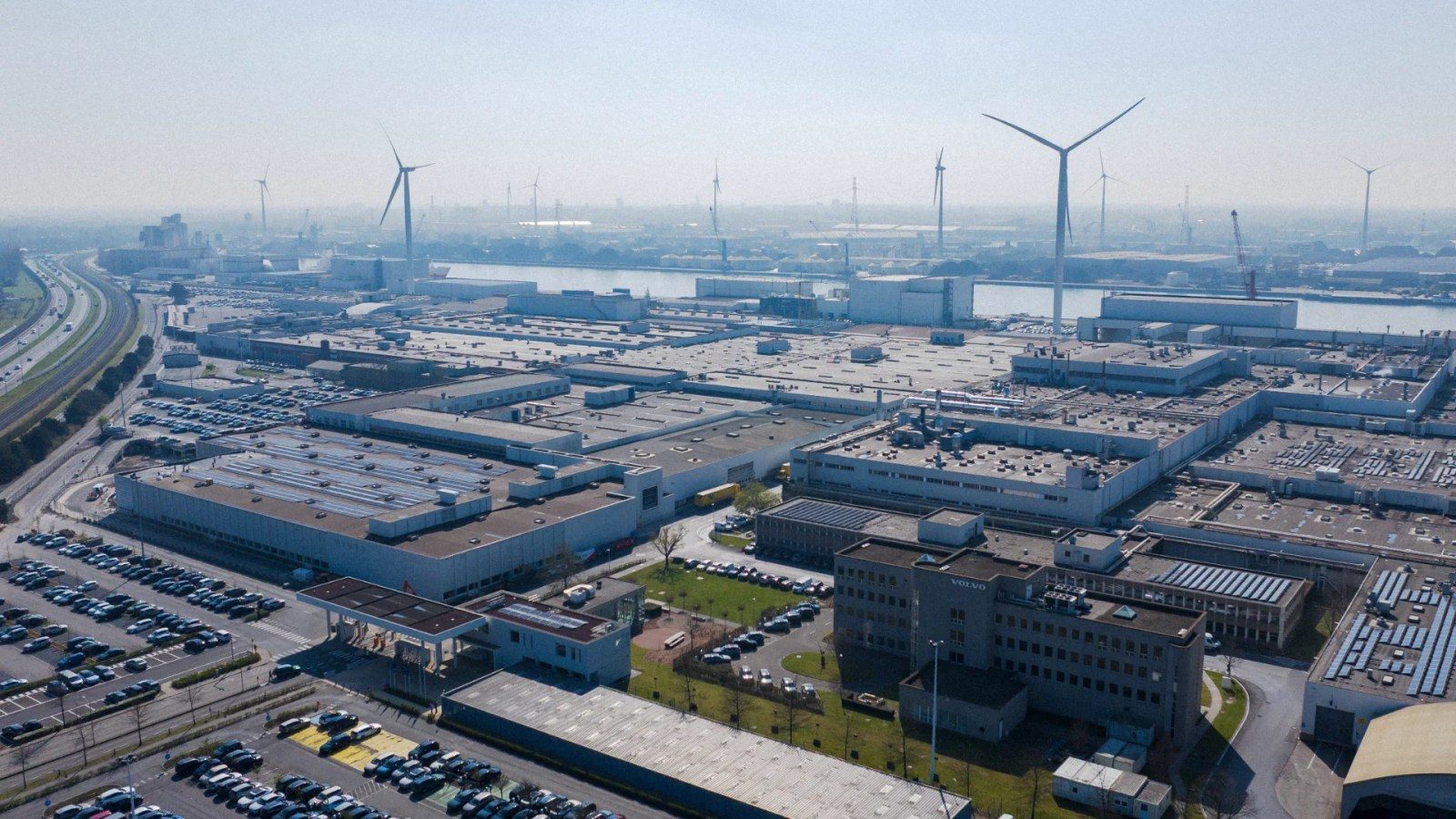

Volvo Cars signed a memorandum of understanding with Belgium for a support package of up to €119 million ($136 million) aimed at strengthening the long-term competitiveness of its manufacturing plant in Ghent — the country’s last remaining car factory.
The agreement, signed between the Swedish automaker, the Belgian federal government and the regional government of Flanders on Wednesday, covers industrial, innovation, and ecological initiatives, as well as financing programs.
Volvo said the measures, combined with its own internal efficiency actions, are expected to help secure future utilization of the plant and support continued manufacturing activity.
The MoU arrives at a precarious moment for Volvo Car Gent.
Located in the Port of Ghent, the 61-year-old facility employs nearly 6,600 people and produced 212,177 vehicles in 2025 — a 14% increase over the previous year.
The plant currently builds the EX30, EX40, EC40, XC40, and V60, with the XC40 and EX40 family accounting for 156,977 units last year.
Several developments over the past year have eroded Ghent’s position within Volvo‘s global production network, however.
EX30 US Exit
In March, Volvo pulled the EX30 and EX30 Cross Country from the US market after the 2026 model year, citing shifting market conditions and financial factors.
The United States had been one of Ghent’s key export markets — roughly one in five vehicles produced at the plant was shipped across the Atlantic.
About 4,500 EX30 units had been built there for the American market since Belgian production of the model began in April 2025.
The decision to halt sales followed the removal of the US $7,500 EV tax credit and a jump in import tariffs on European-built vehicles from 2.5% to 15%.
Supplier Strike
Last month, a strike at Plasman — a key supplier to the Ghent plant — forced Volvo to halt final assembly and placed approximately 4,000 workers on temporary unemployment.
The dispute highlighted the fragility of the local supplier ecosystem and added to employee anxiety about the factory’s future.
Ghent became the only car manufacturing plant in Belgium after Audi Brussels closed in February 2025 — and the only car plant in Flanders since Ford Genk shut down a decade ago.
The Belgian federal government established a task force earlier this year specifically to safeguard the future of the country’s automotive industry.
The Slovakia Question
The support package cannot be separated from Volvo‘s €1.2 billion investment in a new electric vehicle plant near Košice in eastern Slovakia.
Construction began in February 2023, with pre-series test production planned for mid-2026 and mass production in early 2027.
The facility is designed to produce up to 250,000 vehicles per year — more than Ghent’s current annual output — and will build a next-generation Volvo model followed by the Polestar 7 SUV from 2028.
The Slovak government secured EU Commission approval for €267 million in subsidies to support the project.
Reports earlier this year indicated Volvo intended to eventually relocate part of its electric vehicle production to Slovakia, triggering concern among Ghent employees and suppliers.
CEO Håkan Samuelsson — who returned as CEO on April 1, 2025, after Jim Rowan stepped down — has been clear about wanting Volvo to become closer to other Geely brands and to share supply chains to cut costs.
Other Brands’ Assembly
The most notable element in Wednesday’s announcement is the reference to “possible opportunities to use Volvo Car Gent for contract assembly of cars of other brands.”
Volvo said contract manufacturing would increase plant utilization and contribute to industrial activity in the region.
The language aligns with a strategy Geely founder and President Li Shufu laid out in March, when he told the Financial Times the group would build more vehicles in Europe using existing Volvo plants.
Producing locally allows Geely-linked brands to avoid the steep tariffs the European Union imposed on imported Chinese electric vehicles in late 2024.
Li, who is also Chair of Volvo Cars, has warned of overcapacity across the global auto industry — particularly in China, where experts estimate annual demand of about 25 million cars against factory capacity of 45 to 50 million.
The most immediate candidate for contract assembly is Lynk & Co.
Volvo signed a separate MoU in March to become the exclusive importer and commercial operator for Lynk & Co vehicles across Europe, taking over the brand’s entire continental sales, servicing, and brand operations.
Lynk & Co, now a subsidiary of Zeekr after Geely‘s November 2024 restructuring, currently ships its European models from China.
Building Lynk & Co vehicles at Ghent would eliminate EU tariff exposure and give the brand a European production base — while filling capacity at the Belgian plant.
Other potential candidates within the Geely ecosystem include Zeekr and Smart, both of which currently export to Europe from Chinese factories.
Reuters reported earlier this year that Ford Motor Co. and Geely had held discussions about potentially sharing European production facilities.
Broader Volvo Context
The Ghent deal comes as Volvo navigates a company-wide restructuring.
The automaker posted its first operating loss since going public in the second quarter of 2025 — a SEK 10 billion ($1.04 billion) loss driven by an impairment charge and restructuring costs.
Samuelsson launched a SEK 18 billion ($1.8 billion) cost and cash turnaround plan that included cutting 3,000 office-based positions globally, or about 15% of its white-collar workforce.
The company’s forward strategy rests heavily on the EX60, the fully electric successor to the XC60 — Volvo‘s all-time best-selling model.
Production began at Torslanda in April on Volvo‘s new SPA3 platform, backed by approximately SEK 10 billion ($1 billion) in factory upgrades.
Samuelsson said order intake exceeded expectations, and the company was considering keeping Torslanda open an extra week during the summer to meet demand.
The EX60 does not directly benefit Ghent — Torslanda handles all production — but its early commercial traction signals that Volvo‘s electrification push is gaining ground despite the broader sales decline.
Volvo also secured a special authorization from the US Department of Commerce in May to continue selling connected vehicles in the United States under the Connected Vehicle Rule — a clearance its sibling Polestar was denied, effectively barring Polestar from US sales starting with the 2027 model year.
Political Framing
Flemish Prime Minister Matthias Diependaele framed the agreement as protecting the region’s industrial base.
“Volvo Cars has been part of Flanders’ industrial fabric for decades,” Diependaele said. “By creating the conditions for new investments, we are securing a strong industrial future for the Ghent site and the wider automotive ecosystem around it.”
Belgian Prime Minister Bart De Wever emphasized the country’s positioning as a manufacturing location.
“Creating the right framework conditions, including fostering a competitive investment climate, strengthens our country’s position as an attractive location for high-quality industrial employment in Europe,” De Wever stated.
CEO Samuelsson described Ghent as “a highly capable plant with an experienced team” and said the improvements in competitiveness would strengthen its future as a car plant in Belgium.
Volvo did not disclose what its own “efficiency actions” entail, nor did the company specify a timeline for finalizing the measures outlined in the MoU.