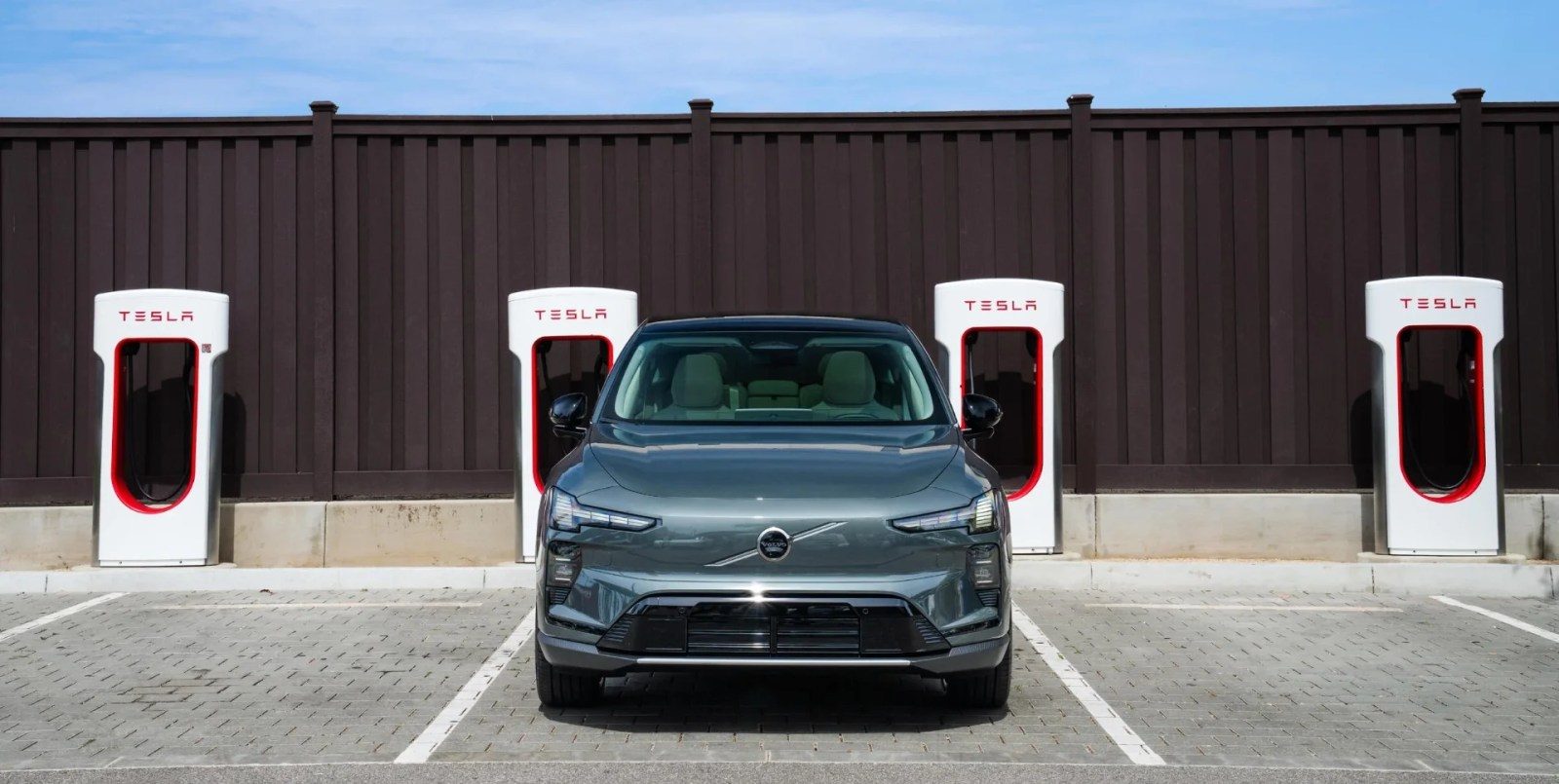

Volvo Cars announced on Tuesday that it will expand access to Tesla‘s Supercharger network for its drivers in Europe and the Asia-Pacific region, as the Geely-backed brand seeks to improve the charging experience.
Starting in the fourth quarter of this year, drivers will be able to use the Volvo Cars app to initiate sessions at more than 20,000 Tesla Supercharger stations across Europe.
The integration will cover 29 European countries, with the bulk of the network located in major markets including Germany, France, Norway, the UK, Sweden, Italy and Spain.
The carmaker’s Head of Energy Solutions Alejandro Castro Pérez said the addition gives the brand’s customers “easier access to one of the most recognised fast charging networks.”
“Volvo drivers already have access to over three million charging points globally through the Volvo app,” he added.
All current Volvo EVs sold in Europe — the EX30, EX40, EC40, EX60, EX90, and ES90 — are compatible with Tesla Superchargers through their native CCS2 connector.
Plug-in hybrid models, which use Type 2 connectors for AC charging only, are excluded from the program.
Asia-Pacific Plans
Beyond Europe, the Swedish automaker also said it intends to transition selected models in Japan and South Korea to the North American Charging System (NACS) by 2029.
The switch will give Volvo drivers in those Asia-Pacific markets future access to Tesla‘s Supercharger network, though no specific timeline was provided for when individual stations would open to non-Tesla vehicles in either country.
The move mirrors Volvo‘s approach in North America — where the company became the first European car maker to sign an agreement with Tesla, giving current and future electric Volvo car drivers access to Tesla‘s vast Supercharger network across the United States, Canada, and Mexico since 2023.
Volvo‘s current US lineup uses NACS adapters to access Superchargers, with the recently launched EX60 becoming the first Volvo model equipped with a native NACS port from the factory.
In total, electric Volvo drivers in North America already use the app at approximately 120,000 charging points, including the Tesla network.
Following Polestar
Volvo‘s announcement closely tracks the integration that sister brand Polestar rolled out earlier this year.
In February, the Geely-backed premium brand became one of the first OEMs to fully integrate Tesla Superchargers into its own Polestar Charge app.
Polestar‘s implementation also includes real-time Supercharger availability inside the in-car Google Maps navigation and complimentary Plug & Charge support at more than 28,000 stations across the region.
Volvo did not specify on Tuesday whether its own integration would include the same level of in-vehicle navigation depth or whether Plug & Charge would be enabled across the Tesla network from launch.
The two brands share a parent company and overlap on charging infrastructure strategy, but operate distinct apps and customer ecosystems.
Speaking at the Financial Times’ Future of the Car conference earlier this month, Polestar‘s CEO Michael Lohscheller said that Scandinavian minimalist design and the brand’s sustainability framing remain the core differentiators between Polestar and Volvo.
Sales Backdrop
The expanded charging access lands as Volvo navigates a difficult sales environment.
The company reported global first-quarter sales of 153,316 units, down 11% from 172,219 in the same period last year — despite March’s positive result.
Sales also fell by 12% year over year in April.
Europe remains Volvo‘s largest market and the strongest part of the business.
There, battery electric vehicle (BEV) sales increased by 21% in the first quarter, with electrified vehicles (including hybrids) accounting for 57% of regional volume.
Globally, fully electric Volvo deliveries rose 12% to 36,348 units in the quarter, lifting BEVs to 23.7% of total sales. April also saw a 10% increase from the previous year.
Combined with plug-in hybrids, electrified models made up 47.3% of all cars sold — a share the company has described as the highest among legacy premium automakers.
The Americas region remains the weak point, with first-quarter sales falling 28% to 29,651 vehicles on weak consumer sentiment and the phaseout of EV and plug-in hybrid incentives.
Volvo confirmed earlier this year that it would remove the China-built EX30 from its US lineup after the 2026 model year, leaving the Sweden-built EX60 as the focal point of its American electric strategy.
Tesla’s Open Network
Tesla‘s Supercharger network in Europe spans roughly 1,500 stations, the vast majority of which use CCS2 connectors rather than the NACS standard used in North America.
That hardware reality has made integration relatively straightforward for European OEMs: any EV with a CCS2 port can physically plug into a CCS2-equipped Supercharger, with software integration handled through the OEM’s own app.
Tesla began opening selected European Superchargers to non-Tesla EVs in 2022, starting with a pilot in the Netherlands.
Since then, the program has expanded across the continent, with rival OEMs increasingly building direct integrations into their own apps rather than requiring customers to use Tesla‘s app.
For Volvo, the upcoming launch will bring its European customer charging experience closer in line with what Polestar drivers already have access to and what Volvo customers in North America have used since late 2024.