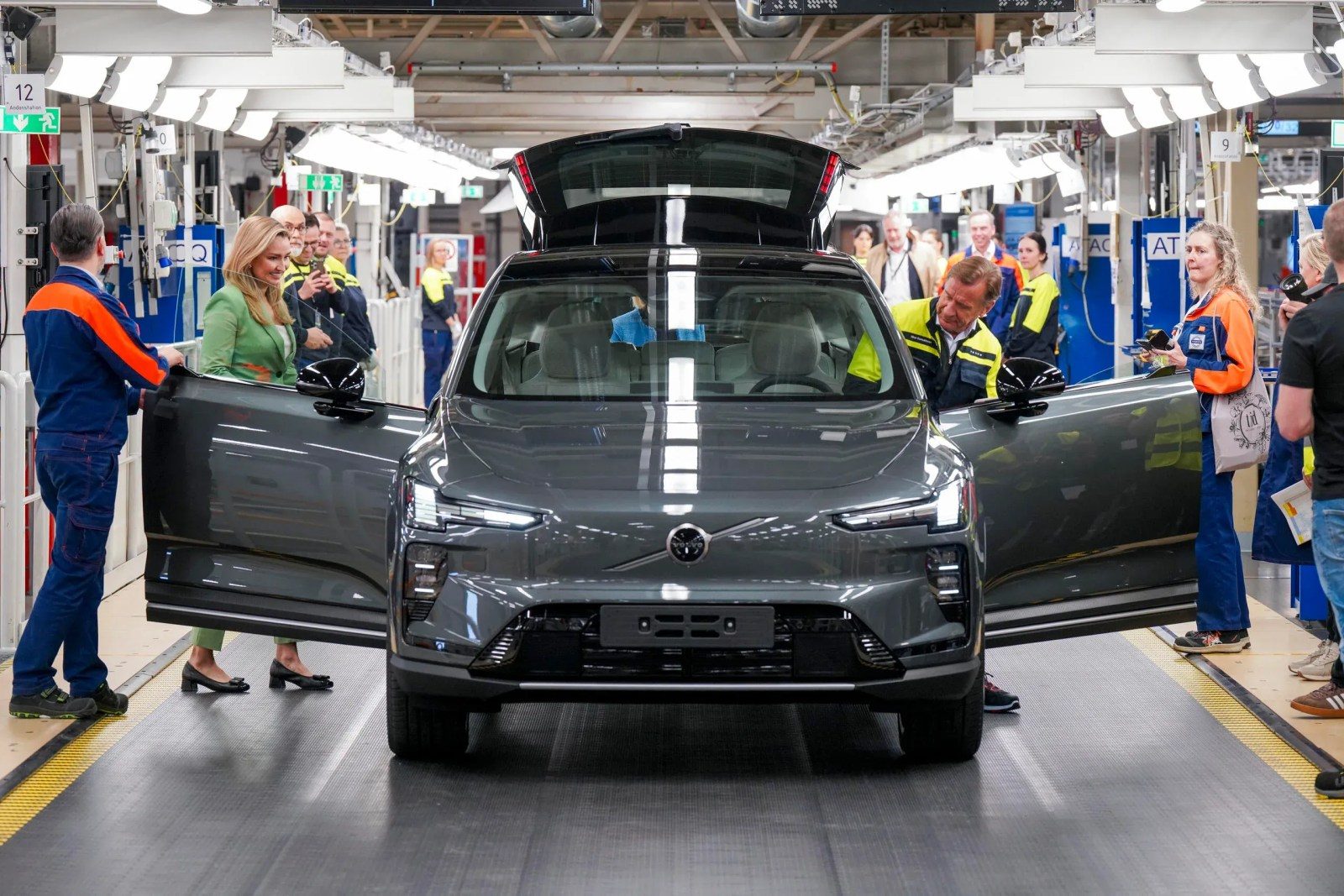

Volvo Cars announced on Wednesday that it has started production of the fully electric EX60 SUV at its Torslanda plant in Sweden.
Customer deliveries are planned to begin in early summer.
Speaking at the Swedish facility on Wednesday, CEO Håkan Samuelsson told Reuters that demand for the model has surpassed the company’s initial expectations.
“Interest has been above our planned order intake, higher than planned… so at least we know we have the customers,” Samuelsson said.
The Geely-controlled automaker expects to build up to 40,000 units of the mid-size electric SUV this year.
Additionally, Volvo is considering keeping the Torslanda factory open for an extra week during the upcoming summer period to handle incoming orders — which would be the first time in the plant’s history.
“The challenge is now on delivering, not selling,” the CEO added.
New Platform
The EX60 is the first vehicle built on Volvo Cars‘ new production platform, which required extensive changes to the Torslanda factory.
The company invested approximately SEK 10 billion ($1 billion) in upgrades, introducing mega casting capabilities, a new battery assembly plant, and a fully refurbished paint shop and final assembly line.
“This is an all-new car introducing new technology… Now that has to be ramped up to a very high pace from zero,” Samuelsson said.
First unveiled in January, the EX60 is the electric version of the XC60 — Volvo‘s all-time best-selling model worldwide.
The company has positioned the mid-size SUV as a direct competitor to the Tesla Model Y, the BMW iX3, and the electric Mercedes-Benz GLC, while pricing it in line with the XC60 plug-in hybrid.
The model claims a class-leading WLTP range of up to 810 kilometers (503 miles) and features an 800-volt electrical architecture with 400-kilowatt charging capability.
In an official statement, Samuelsson said the company is “now focused on a steady ramp-up of high-quality EX60 production, making sure this game-changing car will be a profitable growth driver in the coming years.”
Volvo described the EX60 as the first fully electric car designed, developed, and built entirely in Sweden, and said the model’s projected production volumes position it to become one of Sweden’s largest export products by value.
EV Adoption Driver
The EX60 start comes at a pivotal time for the Swedish automaker.
Samuelsson has repeatedly framed it as a vehicle that will drive broader EV adoption across Europe.
Earlier this year, the CEO said he expects Volvo, alongside BMW and Mercedes-Benz, to lead the continent “toward electrification” through the premium mid-size SUV segment.
All three brands are launching electric successors to their best-selling combustion models this year — the EX60, the iX3, and the electric GLC.
Samuelsson said in January that the concentrated competition “might trigger a lot of customers who maybe are not thinking about buying an electric car to really have a closer look.”
Demand Struggles
That confidence contrasts with Volvo‘s recent global trajectory.
Battery-electric vehicle sales fell 13% in 2025 to 151,830 units, while total global deliveries declined 7% to 710,042 vehicles.
Volvo reported an 11% decline in global first-quarter sales earlier this month, delivering 153,316 vehicles in the first three months of the year.
The company cited persistent challenges including pricing pressure, uncertain geopolitics, tariffs, and adverse regulatory changes.
The results highlighted a growing gap between Volvo‘s European and American performance.
In Europe, fully electric vehicle deliveries rose 21%, with electrified models accounting for 57% of all vehicles sold in the region.
Chief Commercial Officer Erik Severinson said at the time that March marked the company’s sixth consecutive month of growth in fully electric deliveries, “even without the EX60.”
The American market, however, fell 28% to 29,651 vehicles.
Volvo attributed the decline to weak consumer sentiment and the phaseout of EV and plug-in hybrid incentives.
The quarter followed a series of setbacks in the region, including the company’s decision to remove the EX30 and EX30 Cross Country from its US lineup after the 2026 model year.
A spokesperson said the move was “a direct response to shifting market conditions and financial factors.”
With the EX30 exiting the American market, the Sweden-built EX60 becomes even more critical to Volvo‘s US strategy — once orders open there this spring.
The company’s South Carolina plant currently produces the larger EX90.
Geely Production Strategy
The strong early demand for the EX60 also carries implications for Volvo‘s parent company.
Geely founder and President Li Shufu said in late March that the group would build more vehicles in Europe using Volvo’s existing plants, warning of “very serious” overcapacity in the global auto industry.
The factory’s output rate is closely tied to Volvo‘s European profitability, and running at or near full capacity with a premium-priced model would help the company offset the fixed costs that weigh on margins when production volumes fall short.
The EX60 ramp-up will test the company’s ability to translate strong order books into consistent production output as it scales up an entirely new platform from scratch.