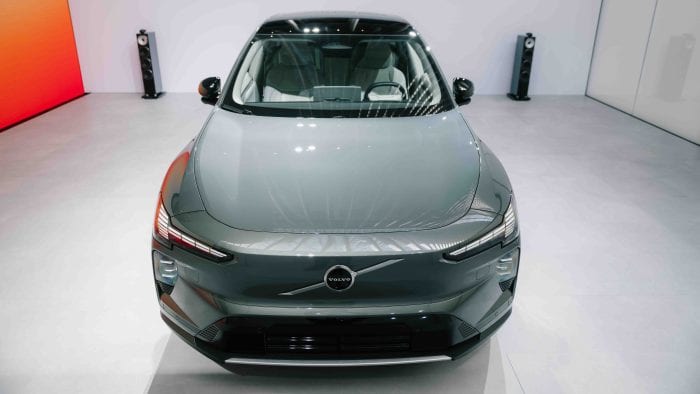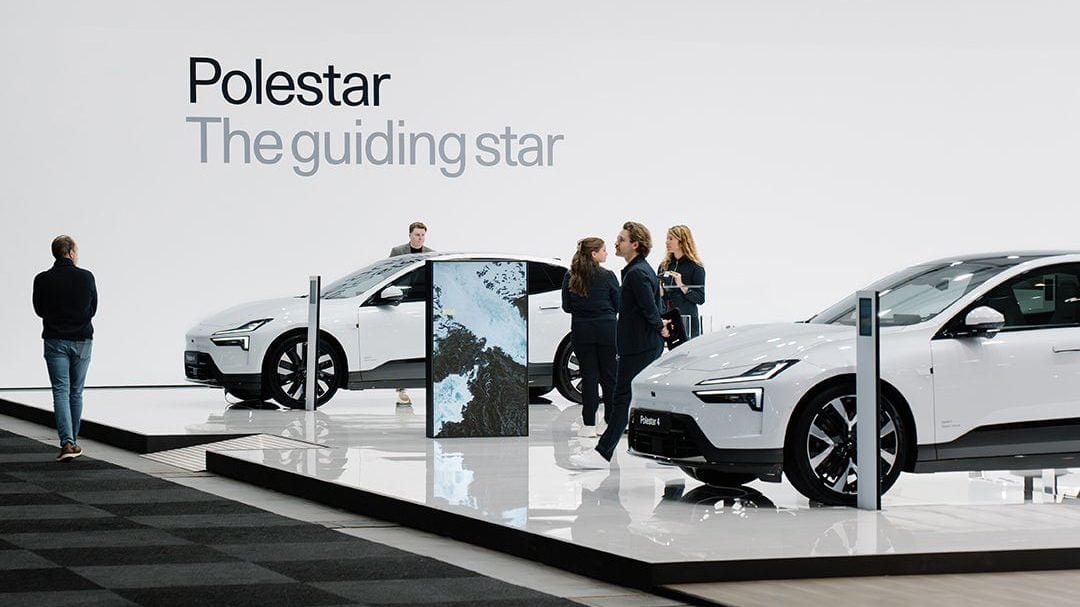

Polestar and Volvo share a Chinese owner, a Swedish badge and a South Carolina assembly line.
However, only Volvo will be selling new cars in the United States from the 2027 model year.
Commerce does not publish its authorization decisions, and Volvo‘s own account describes a private, case-by-case negotiation.
Volvo cleared the rule a month before the denial reached Polestar, yet the gap between the two siblings, not either ruling alone, is what now hangs over the brand’s US exit.
That gap is being pressed by Polestar‘s dealers and former executives, the people the company itself will not echo.
The Shared Ground
Polestar and Volvo sit under the same controlling shareholder, China’s Geely and its founder Li Shufu, who together hold about two-thirds of the EV maker.
PSD Investment, Li’s personal holding company, is the largest single owner at roughly 44%, while Volvo keeps about 16%.
Both are publicly traded, Volvo on Nasdaq Stockholm and Polestar on the Nasdaq under the ticker PSNY.
That ownership placed both brands inside the Connected Vehicle Rule’s definition of a manufacturer subject to Chinese control, the same test each had to clear.
Finalized in January 2025, the rule bars carmakers owned or controlled by China or Russia from selling connected vehicles in the US, whatever the assembly location.
Ridgeville, South Carolina, builds the Polestar 3 on the same line as the Volvo EX90, with output consolidated there earlier this year.
Volvo has put about $1.3 billion into that site, which runs a body shop, a paint shop, a battery-pack line and final assembly and employs more than 2,000 workers.
Only Volvo operates the plant, and Polestar keeps no American factory of its own, leaning on that workforce to build its single US model.
So a US-built Polestar, rolling off the same line as an authorized Volvo, is the one blocked from sale.
Where the Outcomes Diverge
Commerce has not published the criteria that separated the two, and the authorization runs case by case.
One is scale and independence, with Volvo a separately listed company and a far larger, older US business that sold about 121,600 cars in the country in 2025 and has traded there for 70 years.
By contrast Polestar is smaller and more tightly woven into Geely‘s structure, sharing vehicle platforms and connected-car software with other Geely-controlled brands.
That entanglement matters under a rule aimed at the connectivity and automated-driving layer, covering Bluetooth, cellular, Wi-Fi and satellite modules and the software behind them, where vehicle data is gathered and sent.
The software restrictions take effect with the 2027 model year and hardware limits follow later in the decade, so a brand’s technology sourcing now decides market access.
A second gap is lineup exposure, after Volvo halted imports of the China-built EX30 over tariffs and now sources its US range from Europe apart from the EX90.
Polestar leans the other way, on the South Korea-built 4, which rides a Geely platform, and the China-built 2.
Volvo Car USA also held what the company called constructive discussions with Commerce over governance, technology and data security, then agreed to measures and won its authorization in May.
Even cabin technology built around Google rather than in-house code did not change the result for Polestar, because the rule reaches a carmaker’s ownership, not the software in the car.
Polestar’s Bind
Polestar has not contested the decision, and its public response steered around the comparison.
“The automotive industry is entering a new phase, based on regional dynamics,” Chief Executive Officer Michael Lohscheller said in a statement, naming Europe the company’s main growth engine.
His statement did not mention Volvo or the gap in treatment.
Openly challenging the outcome would put Polestar in the position of disputing a ruling that favored a brand under its own controlling shareholder.
The reticence is easier to afford because the US mattered little to the brand’s volume, at about 6% of sales, with growth coming almost entirely from outside the country.
The Reaction
Sharper questions have come from Polestar‘s dealers and former staff, who owe no such restraint.
Matthew Haiken, who owns Polestar Short Hills in East Hanover, New Jersey, and ranks among the brand’s earliest and largest US retailers, said he was “absolutely devastated,” Automotive News reported.
He described a company he had treated as family and a lineup of new models that will not arrive, the outlet said.
Gabe Elsner, a former chief financial officer of Polestar North America, called the decision “hard to square” in a LinkedIn post, noting that a sibling under the same owner had won the authorization his old team was refused.
Several current and recently departed US staff posted publicly in support, voicing the comparison the company would not.
What the Split Signals
For any automaker with Chinese capital or a Chinese software stack, the divergence is the clearest read yet of how the rule works in practice.
A Swedish-branded, partly US-built EV was walled off on upstream ownership alone, while a sibling cleared the same bar.
Polestar is the first brand pushed out of the US under the rule, though likely not the last, with the criteria still unstated for those that follow.
European registrations have kept rising for the brand, which is leaning harder into the region as the US door closes.