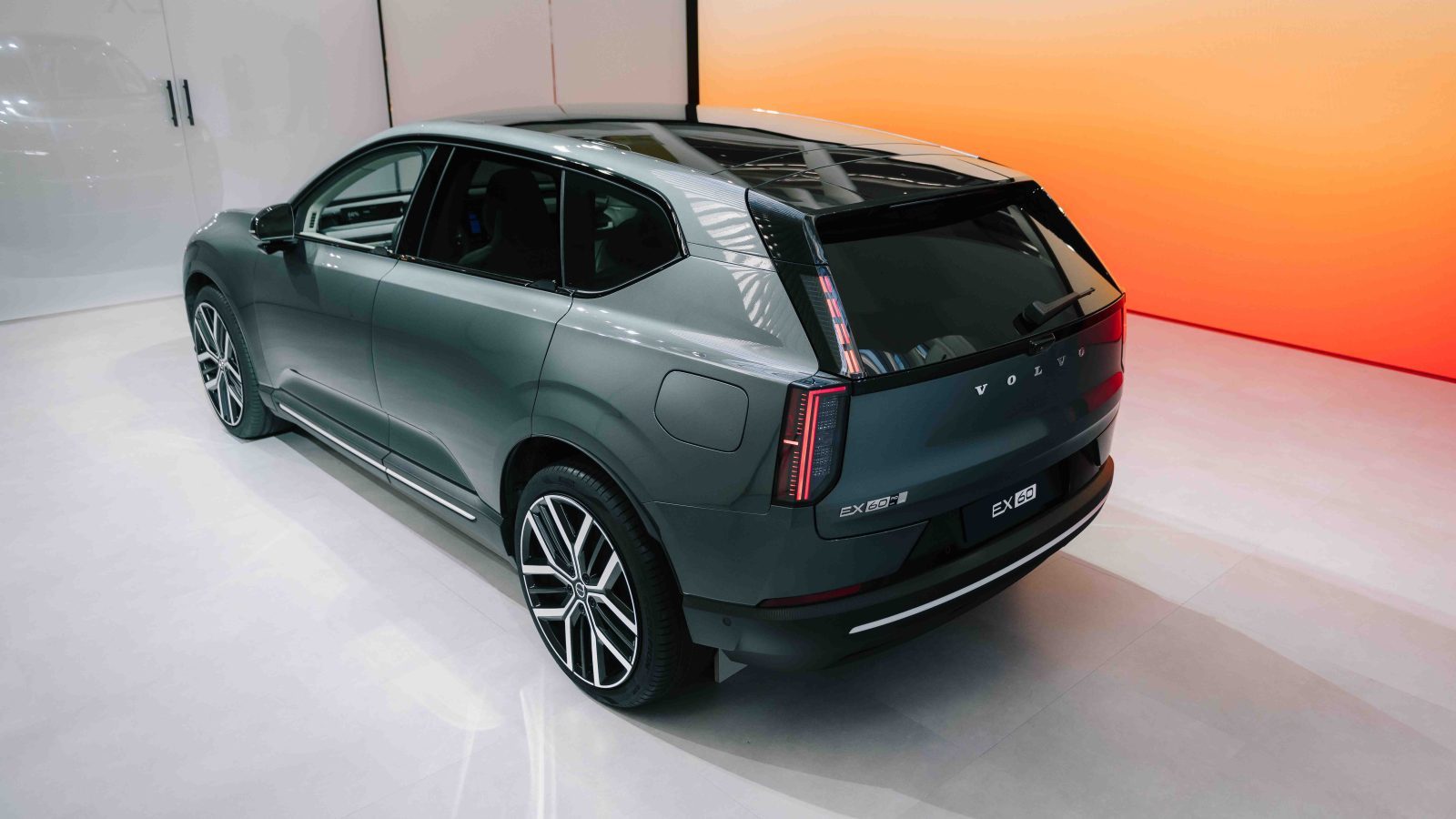

Geely-backed brand Volvo Cars has joined the growing list of automakers launching a fully electric, midsize SUV in the United States.
The Swedish-headquartered brand opened orders for the EX60 on Monday, with a starting price of $58,400 — just $410 above the Rivian R2 Performance, for which the online configurator opened last week.
The EX60’s arrival marks a critical moment for Volvo in the US, where the brand has struggled with declining sales and a shrinking EV lineup.
Volvo said it expects initial deliveries to begin later this summer. Rivian R2 deliveries are imminent.
EX60 Specs and Pricing
The Volvo EX60 is now available to configure through authorized US retailers and the company’s website.
At launch, the model is offered in two powertrains.
The entry-level EX60 P6 Plus starts at $58,400 before destination, bringing the effective starting price to roughly $59,795 with the $1,395 destination fee.
The EX60 is the first Volvo built on the company’s SPA3 platform, which features an 800-volt architecture, cell-to-body battery technology, next-generation in-house e-motors, and mega casting.
Battery capacity ranges from approximately 80 kWh to 112 kWh, depending on the variant.
Volvo‘s EX60 is also its first car equipped with a native NACS port, giving US buyers adapter-free access to more than 29,000 Tesla Supercharger stations.
Power output spans from 369 horsepower on the rear-wheel-drive P6 to 670 horsepower on the upcoming all-wheel-drive P12, while the 0-60 mph time ranges from 5.7 seconds on the P6 to an estimated 3.8 seconds on the P12.
The EX60 also offers a towing capacity of up to 4,500 lbs, making it the strongest tower in its immediate competitive set.
EPA range estimates start at up to 307 miles for the entry-level variant.
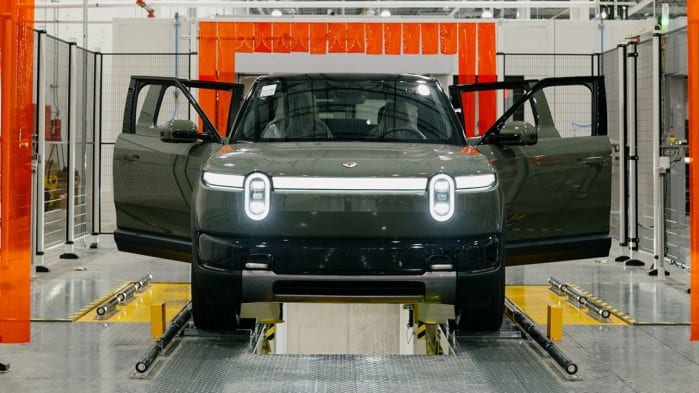
Rivian R2
The EX60’s effective starting price of roughly $59,795 with destination places it in near-direct competition with the Rivian R2 — which is priced from $59,485 including the $1,495 destination fee.
At the top of their respective lineups, the two models trade blows across different priorities.
The R2 Performance features dual electric motors producing 656 horsepower and 609 lb-ft of torque, with a 0-60 mph time of 3.6 seconds — faster than any currently available EX60 variant.
The EX60 P12 AWD — set to arrive later, with no specific timeline mentioned — is expected to match that pace with an estimated 3.8-second sprint and 670 horsepower.
Range favors the Volvo at the top end. The EX60 P12 AWD targets up to 400 miles, compared to 330 miles on the R2 Performance and up to 345 miles on the future Standard model — which is set to debut in late 2027, priced from $45,000.
The R2 uses an 87.9-kWh battery across its dual-motor variants, while the EX60’s battery ranges from roughly 80 to 112 kWh.
Charging is where the EX60 pulls ahead.
Volvo‘s 800-volt architecture enables a 10-to-80% charge in as little as 16 minutes, with up to 173 miles added in 10 minutes. The R2 charges from 10 to 80% in under 30 minutes.
The R2 is favored in cargo space, offering 28.7 cubic feet behind the rear seats and 79.4 cubic feet with seats folded, plus a large front trunk for a total of roughly 90 cubic feet of enclosed storage.
The EX60 has a space of 20.4 cubic feet and 64.3 cubic feet, respectively, with a smaller frunk.
Rivian R2’s key strengths lie in its value proposition, adventure-oriented design, off-road capability with 9.6 inches of ground clearance, and the EV maker’s software ecosystem.
The EX60 counters with its family-focused safety features, faster charging, Scandinavian design, and a broader powertrain range from entry-level RWD to a 670-hp performance flagship.
Rivian plans to follow the Performance with a Premium AWD trim at $53,990 in late 2026 and a Standard RWD Long Range at $48,490 in early 2027, with the base $45,000 Standard arriving in late 2027.
Rivian is building the R2 at its Normal, Illinois plant, with the company targeting at least 20,000 deliveries this year.
Other Rivals
The BMW iX3 rounds out the trio of midsize electric SUV launches this year.
The Neue Klasse-based model opened US reservations in early May with a starting price of roughly $61,500, and deliveries are expected to begin this fall.
It features dual electric motors producing approximately 463 horsepower, an estimated range of 383 to 434 miles from a 108.7-kWh battery, and DC fast charging at up to 400 kW with a 10-to-80% time of around 21 minutes.
The iX3 is the most expensive of the three at launch but offers the longest range ceiling and the fastest peak charge rate.
Another potential entrant to this space is the Kia EV5, which has been spotted testing in the US multiple times despite Kia officially designating the model as exclusive to Canada in North America.
The midsize electric SUV, roughly the size of the Kia Sportage and Tesla Model Y, is already on sale in Europe, South Korea, and Canada, where it starts at C$43,495.
While a US launch has not been confirmed, the repeated sightings — including a recent prototype with US-required front amber lights — suggest the automaker may be reconsidering.
EX60 Demand and European Production
The EX60 launch comes with early signs of strong demand.
Volvo CEO Håkan Samuelsson said in April that interest in the model had exceeded the company’s initial expectations, with order intake running above planned levels.
Production began at Volvo‘s Torslanda plant in Sweden in April, backed by approximately SEK 10 billion ($1 billion) in factory upgrades that introduced mega casting capabilities, a new battery assembly plant, and refurbished paint and final assembly lines.
The company expects to build up to 40,000 EX60 units this year and is considering keeping Torslanda open for an extra week during the summer to meet incoming orders — a first in the plant’s history.
The EX60 is the electric successor to the XC60, Volvo’s all-time best-selling model worldwide.
Samuelsson has positioned it as a direct competitor to the Tesla Model Y, the BMW iX3, and the electric Mercedes-Benz GLC.
He said earlier this year that Volvo, alongside BMW and Mercedes, is expected to lead Europe toward electrification through the premium mid-size SUV segment, with all three launching electric successors to their combustion best-sellers this year.
Sales Struggles in America
The optimism around the EX60 contrasts with Volvo‘s recent performance in the US.
Volvo reported an 11% decline in global first-quarter sales, delivering 153,316 vehicles in the first three months of the year.
The Americas region fell 28% to 29,651 units, which the company attributed to weak consumer sentiment and the phaseout of EV and plug-in hybrid incentives.
The struggles continued in April, with global sales falling 11.5% as weakness in both the US and China persisted.
Adding to the challenges, the company cut the smaller EX30 from its US lineup after the 2026 model year, citing shifting market conditions and financial factors.
The China-built compact EV had been Volvo‘s most affordable electric model in the region.
With the EX30 exiting, the Sweden-built EX60 becomes the focal point of Volvo‘s US electric strategy.
The company’s South Carolina plant currently produces the larger EX90 and recently became the exclusive global production site for the Polestar 3 electric SUV.
Q1 EV Sales Data
According to Cox Automotive estimates published last month, the first quarter of 2026 underscored the challenge facing European legacy automakers in the US electric vehicle market.
Rivian sold 10,365 battery-electric vehicles in the first three months of the year, a 21.2% increase from 8,553 units a year earlier.
BMW, on the other hand, delivered 4,963 electric vehicles, down 63.3% from 13,538 in the same period last year.
Mercedes sold 1,112 units, a 68.9% decline from 3,570, while Volkswagen recorded 1,177 EV sales, a steep 87.7% drop from 9,564 a year earlier.
Volvo delivered 2,343 electric vehicles — 22.6% below the 3,026 units registered a year ago.
The total US EV market contracted 27% in the first quarter of 2026, falling to an estimated 216,399 units from 296,589 the year before — as brands continue to feel the effects of the termination of incentives for EV purchases.
Within that declining market, Rivian was one of a handful of brands to post year-over-year growth, alongside Cadillac (up 19.8%), Lexus (up 206.7%), and Toyota (up 79%).