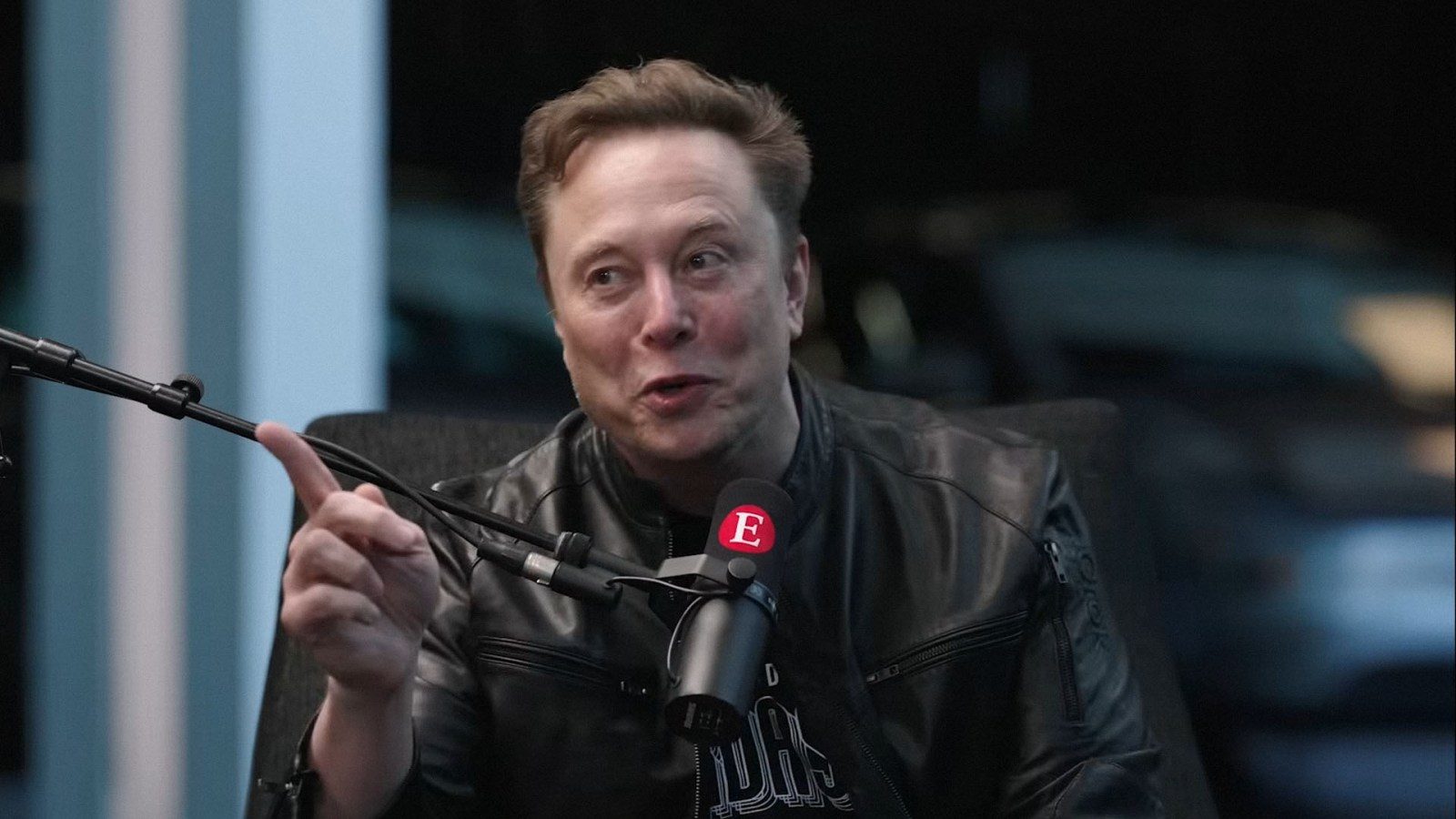

Tesla‘s CEO Elon Musk weighed in on Volvo Cars‘ decision to permanently discontinue LiDAR sensors from its vehicles, posting on X early Wednesday that he had “tried to warn” the industry.
The Chief Executive was replying to an X post by user ‘RoamingNorway’, who wrote that “customers with a LiDAR-equipped Volvo EX90 or ES90 in Norway will get a €1800 compensation for features that won’t arrive.”
Musk wrote: “I did try to warn them. Humans drive using neural nets and optical sensors. Same is true for robot cars.”
His reply came after X user and tech commentator ‘DHH’ reshared the original post, writing that “He can’t keep getting away with being right!!,” referring to Musk.
Volvo x Luminar
As reported by EV on Tuesday, Volvo Cars is compensating owners of the EX90 and ES90 models after the automaker ended its partnership with its LiDAR supplier Luminar, following the company’s Chapter 11 bankruptcy filing late last year.
The Swedish-based, Geely-owned company discontinued all plans to develop LiDAR-based functions for the two models.
Norway joins Sweden, the Netherlands, the United States, and Canada.
Volvo attributed the price adjustments to the value previously assigned to the missing LiDAR functionality.
No retrofit to remove the now-dormant rooftop sensor will be offered.
Musk’s LiDAR Criticism
Musk’s dismissal of LiDAR stretches back to more than a decade, when he argued in 2015 that passive optical sensors and a forward-facing radar could solve autonomous driving without lasers.
He acknowledged the technology’s merit in other domains — Tesla‘s sister company SpaceX uses custom-developed LiDAR for Dragon capsule docking with the International Space Station — but maintained from the outset that the automotive application was misguided.
“Did my best to warn people that LiDAR isn’t optimal for cars. Roads are designed for biological neural nets & eyes, so digital neural nets & cameras will work best,” he wrote on X in August 2023. “I say this even though Dragon uses LiDAR for docking with Station, so I don’t intrinsically hate that technology.”
The Tesla CEO’s most-cited remarks came at Tesla Autonomy Day on April 22, 2019. Standing before investors and engineers, Musk called LiDAR a “fool’s errand” and declared anyone relying on the technology “doomed.”
He compared LiDAR sensors to “a whole bunch of expensive appendices” and predicted every competitor would eventually abandon the approach.
In the same presentation, Musk identified LiDAR and high-definition maps as the two primary “crutches” that would, in retrospect, prove “obviously false and foolish.”
The Tesla CEO has continued the argument across X posts, earnings calls, and interviews.
He framed the issue as one of information bandwidth, arguing that cameras deliver “several orders of magnitude more bits per second” than radar or LiDAR and that vision processing, while harder to solve, is “fundamentally superior.”
In 2024 and 2025, he escalated the claim further, arguing that LiDAR and radar not only fail to add safety but actively reduce it through sensor contention — situations where conflicting data from different sensors introduce ambiguity rather than clarity.
Commenting on an interview by Uber CEO last year, Musk pointed to Waymo’s inability to operate on highways and Tesla‘s decision to disable radar on its fleet as evidence for the camera-only thesis.
“Lidar and radar reduce safety due to sensor contention. If lidars/radars disagree with cameras, which one wins?,” he asked, adding that “this sensor ambiguity causes increased, not decreased, risk. That’s why Waymos can’t drive on highways. We turned off the radars in Teslas to increase safety. Cameras ftw.”
Waymo Doubles Down
The most prominent counterpoint to Musk’s position remains Alphabet’s Waymo, which operates a fully autonomous commercial service across eleven US cities and plans to open in at least nine more by year-end.
Waymo‘s sixth-generation Driver, validated for driverless operations in February, uses 13 cameras, four LiDAR units, and six radar units — a 42% reduction in total sensor count compared to the previous generation but still firmly committed to multi-modal sensing.
The company delivered 15 million rides in 2025 alone and said last March it was providing 500,000 paid rides per week.
Rivian
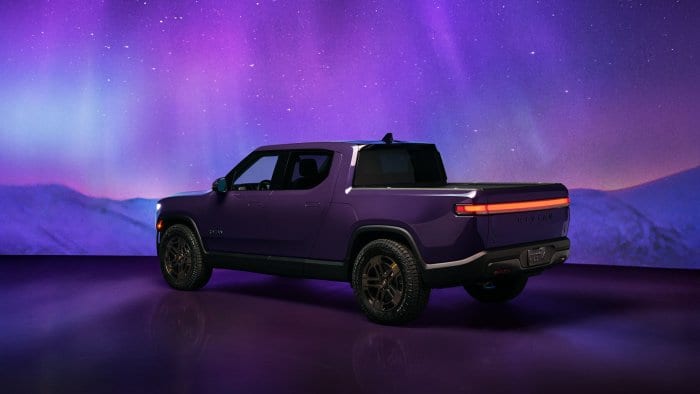
Rivian, another US EV maker, is preparing to add LiDAR to its R2 compact SUV later this year.
The R2 launched in June with Gen 2 autonomy hardware — cameras and radar only, no LiDAR, and no next-generation Rivian silicon.
Late 2026 R2 production will introduce Gen 3 hardware featuring the company’s in-house RAP1 chip, built on TSMC’s 5-nanometre process, alongside a rooftop LiDAR sensor and 11 cameras.
An R2 equipped with the LiDAR unit was spotted near Rivian’s Irvine, California headquarters in late June.
Early R2 buyers cannot retrofit to the Gen 3 hardware, creating two distinct hardware configurations under the same model name.
BYD
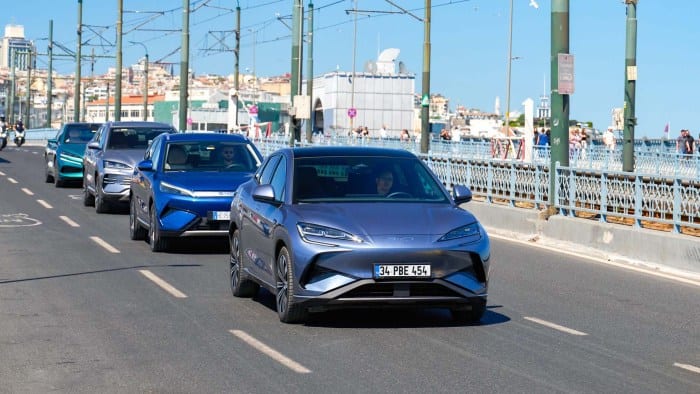
BYD, the world’s largest new energy vehicle maker, has taken the most aggressive pro-LiDAR position of any mass-market automaker.
The company’s God’s Eye B LiDAR-equipped driver-assistance package is available as a 12,000-yuan ($1,700) option across the company’s entire lineup.
The strategy extends to the bottom of the market.
BYD‘s Seagull — its cheapest model, starting at 69,900 yuan ($10,300) — became the first A00-class mini EV in China to offer a LiDAR option when the 2026 version launched in May.
With the God’s Eye B package, the hatchback climbs to 97,900 yuan ($14,400) and gains urban navigate-on-autopilot functionality — an approach that directly contradicts Musk’s cost argument.
The sensor hardware comes from RoboSense, named as BYD’s exclusive LiDAR partner across all 11 new models unveiled in March.
XPeng
He Xiaopeng has previously said that XPeng and Tesla are the only two companies capable of achieving intelligent driving without relying on high-definition maps or LiDAR, working toward a unified AI-driven solution that functions globally.
Both companies follow a pure vision-based approach after the Chinese brand’s bet on LiDAR for several years — which it ditched in July 2024.
XPeng, the Guangzhou-based automaker preparing to launch robotaxi pilot operations in the second half of 2026 and mass-produce its Iron humanoid robot by year-end, has adopted a pure-vision approach that mirrors Tesla’s thesis.
The Chinese automaker’s mass-produced robotaxi, built on the GX platform and engineered to Level 4 autonomous driving standards, operates without LiDAR or high-definition maps.
Decisions flow from the company’s VLA 2.0 end-to-end AI model, which XPeng says compresses system response latency to under 80 milliseconds.
Founder and CEO He Xiaopeng completed the first autonomous trip on the camera-only system during employee testing in Guangzhou on July 10.
XPeng has said it plans to begin fully driverless operations without on-site safety officers by early 2027.
Nio
Nio has treated rooftop LiDAR as standard safety equipment across its main brand since inception.
More notably, its mass-market sub-brand Onvo reversed course on a founding hardware commitment earlier this year.
Onvo launched the L60 SUV in September 2024 as a purely vision-based vehicle — a deliberate bet that cameras alone could deliver competitive driver assistance at a lower price point.
That position held for roughly 18 months. The refreshed model launched in June with an optional 192-line rooftop sensor and Nio‘s in-house Shenji NX9031 5-nanometre ADAS chip.
The 2026 L90, launched on April 21, was the first Onvo vehicle to adopt the Shenji chip and LiDAR sensors. Every current Onvo model — the L60, the recently launched L80, and the L90 — now offers both pure-vision and LiDAR-equipped configurations.