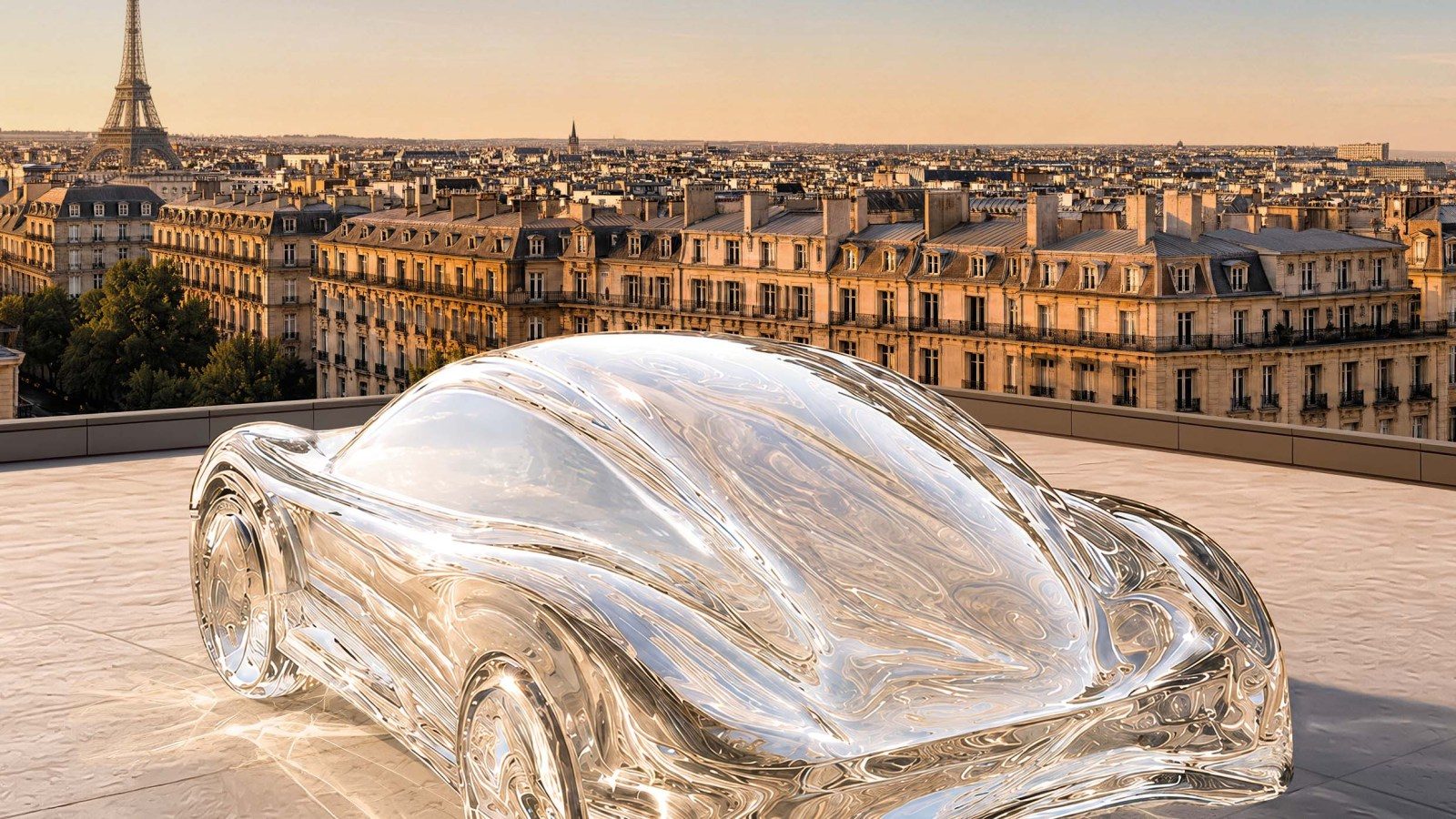

Paris Auto Show organizers unveiled the event’s official poster on Tuesday and confirmed a Chinese contingent far larger than 2024’s, less than four months before the doors open in October.
More than a dozen Chinese marques will exhibit at the 91st Mondial de l’Auto, which runs from 12 to 18 October at the Porte de Versailles, the organization told EV on Tuesday.
Organizers said the final roster would follow closer to the event.
The roster spans groups already familiar in Europe and names that few French buyers would recognise, a measure of how fast China’s carmakers are pushing into the region.
Paris runs in even years, intercalated with Germany’s Munich IAA, which holds the odd-year slots of 2023, 2025 and next 2027.
That makes this October the larger of Europe’s two flagship shows in 2026, and Chinese brands are treating it as such.
BYD Anchors a Crowded Field
BYD returns as the centre of the Chinese presence, bringing its core brand together with its premium sub-brand Denza.
Denza, pitched against European luxury marques, hands the group a higher-priced flank to show off in Paris.
Leapmotor, the Chinese brand sold in Europe through a joint venture with Stellantis, is confirmed once more after launching at the same show two years ago.
XPeng will be back as well, returning to Paris after debuting its P7+ sedan there two years ago.
The Guangzhou-headquartered brand has been expanding its lineup on the Old Continent with several new models, including the X9 MPV and the cheaper series MONA.
Each of the three has used the intervening period to widen its European range, and each arrives in October with more to sell than it did in 2024.
Changan, Geely and GAC Widen the Roster
Changan Group will land in Paris with three brands at once, fielding Deepal, Nevo and Avatr.
Avatr runs its design studio in Munich, a few miles from BMW’s headquarters, underlining how far some Chinese groups have embedded themselves in Europe’s engineering heartland.
Geely will show its main Geely Auto brand alongside group marques, including Zeekr, which recently held a media drive in Spain for its Zeekr 7 GT.
The Guangzhou-headquartered GAC Group will also exhibit, having pushed into several new European markets over recent years, Portugal among them.
AITO, the Seres brand built around Huawei technology, returns after its own 2024 debut.
Dongfeng will appear through its Forthing badge, continuing the state-owned group’s cautious European rollout.
Filling out the list are smaller and newer names, among them 212, Maxus, Pix Moving, EZI and Linktour.
Few of them are household names in Europe yet, but each is angling for an early foothold ahead of the wider group.
From Nine Brands to a Wave
The scale marks a clear step up from 2024.
Nine Chinese EV makers exhibited at that edition, a group that included BYD, GAC, Hongqi, XPeng, Leapmotor, AITO, SAIC Maxus, Dongfeng and Skyworth.
Two years on, the headcount is higher and the mix has shifted toward premium and multi-brand groups, with Changan’s three-brand stand and Geely‘s European-facing marques signalling a more permanent commitment than a first toehold.
Names absent in 2024, such as a full Changan presence, now sit on the floor plan, while others continue to widen their reach.
Several premium marques stayed away two years ago, with Nio, Polestar and Voyah all skipping the 2024 floor, a reminder that the roster can still grow before October.
A Show Backed by Hard Numbers
The expanded turnout tracks a sharp rise in sales.
As EV reported on Tuesday, Chinese-owned carmakers tightened their hold on the European market in the first five months of 2026, with BYD, MG-owner SAIC, Chery, Leapmotor and Geely Group all gaining ground.
According to May figures released by the European Automobile Manufacturers’ Association (ACEA) on Tuesday, BYD registered 135,307 vehicles between January and May across the EU, EFTA and the UK.
SAIC registered 141,490 and Chery 122,843, while Tesla, which sells only fully electric models at a higher average price, recorded 118,068.
A year earlier, all three Chinese names trailed the Elon Musk-led company.
Combined, the five Chinese-owned groups registered 619,353 cars over the five months, about 10.6% of the market, by EV‘s calculation from ACEA’s per-manufacturer data.
That figure counts Chinese ownership rather than badge, so it folds in Geely Group, whose European volume is led by Volvo, Polestar and other marques it owns rather than China-branded models.
In May alone, BYD registered 32,380 cars, up 136.6% year on year, against 28,610 for Tesla, itself up 107.9% from a depressed May 2025.
Over the five months, BYD holds a 2.3% share of the combined market to Tesla‘s 2.0%.
Chery and Leapmotor Climb Fastest
The steepest growth came from the newer arrivals.
Chery, which ACEA counts together with its Omoda & Jaecoo and Jetour brands, posted a 316% jump over the five months, placing it ahead of Tesla on a year-to-date basis barely 18 months after entering most European markets.
Much of that volume, however, is petrol and hybrid, with plug-in and combustion versions of the Omoda 5 and Jaecoo 7 doing the bulk of the work.
Leapmotor grew fastest of all in percentage terms, up 552.9% to 43,037 cars, albeit from a tiny base.
SAIC, whose European sales run almost entirely through the MG badge, remains the largest Chinese-owned seller by volume, though its growth has cooled to 11.6% as the brand matures.
Tariffs Loom Over the Push
The expansion is unfolding under a tightening trade regime.
Brussels imposed anti-subsidy duties on China-made battery-electric cars in October 2024, and is now weighing whether to extend tariffs to hybrids as well.
Such a move would land immediately on every brand importing hybrids from China, then ease over time as those brands build and scale production inside Europe, where locally assembled cars escape the import duties.
That backdrop helps explain the Paris turnout.
For BYD, Leapmotor, Chery and the rest, a stand at the Porte de Versailles is no longer a statement of intent but a sales tool, aimed at a market they are now winning share in month after month.
The official poster set the date.
The roster behind it shows how much has changed in two years.