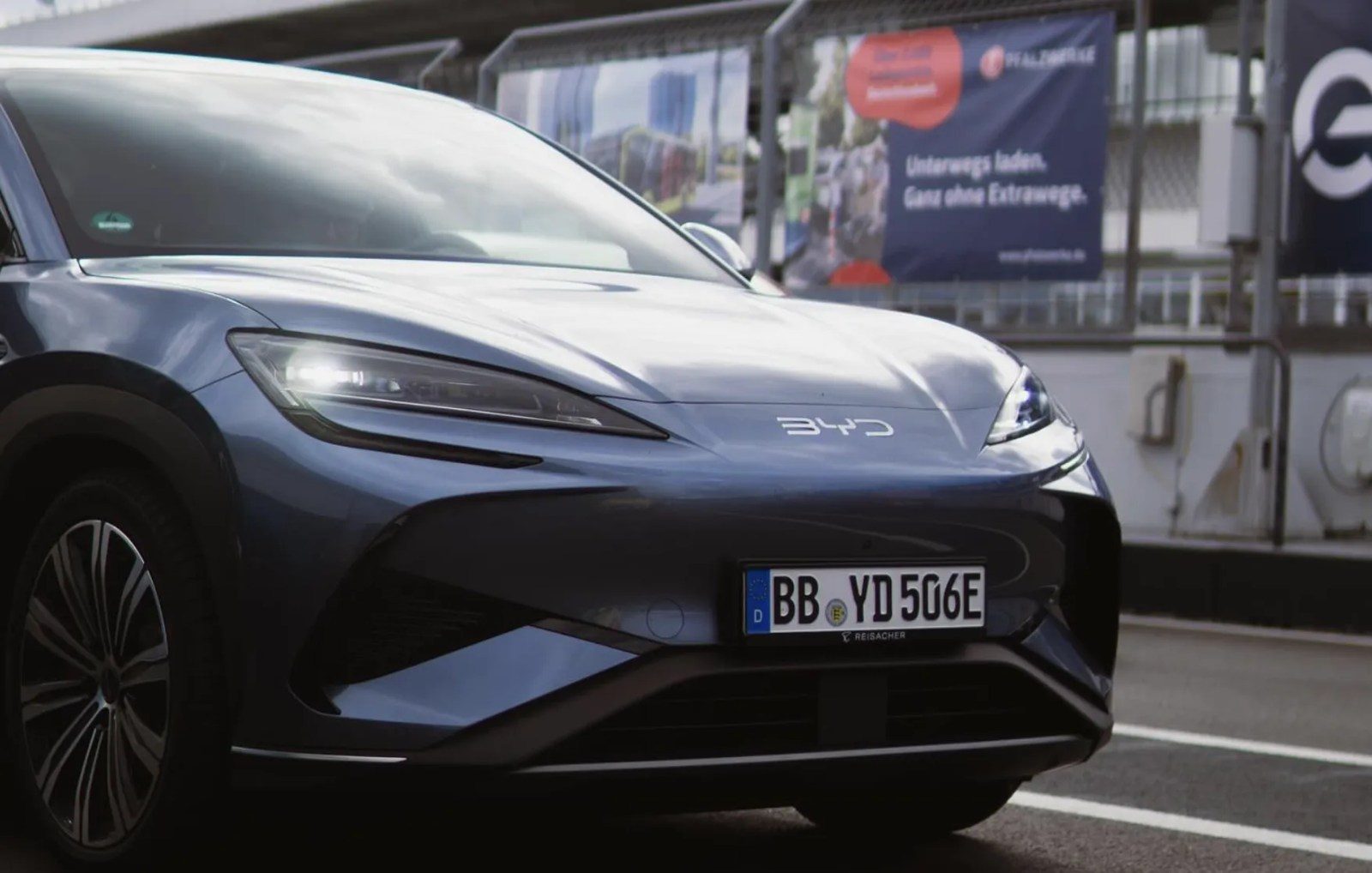

BYD registered 6,265 vehicles in Germany in June, setting a new monthly record in Europe’s largest automotive market and pushing the Chinese automaker’s first-half total to 26,264 units.
The company’s Deputy Country Manager in Germany Patrick Schulz shared the data in a LinkedIn post this Wednesday.
Official registration figures from Germany’s Federal Motor Transport Authority (KBA) are expected to be released over the upcoming days.
The June result represents a 274% year-over-year increase and a 1.6% sequential rise from the 6,168 registrations recorded in May, which had itself been a record.
According to the Shenzhen-based brand, its German market share reached 2.11% in June — up from fractions of a percent twelve months earlier.
Schulz joined BYD in February 2025 after more than 13 years at Hyundai Motor Deutschland, where he served as head of sales strategy and deputy sales director.
He spent approximately four months at MG as Director of Business and Network development before moving to the Shenzhen-based automaker.
First-Half Strength
The first-half total of 26,264 registrations represents a 318.3% increase from the same period of 2025 and gives BYD a cumulative market share of 1.8% in Europe’s largest auto market.
German registrations have climbed steadily throughout 2026: from 2,629 in January to 3,053 in February, 3,438 in March, 4,705 in April, 6,168 in May, and 6,265 in June.
BYD‘s German subsidiary has targeted 50,000 vehicle sales in the country for 2026, a goal first disclosed in February.
The first-half result puts the brand at 52.5% of that target — ahead of the straight-line pace required, though the second half will need to sustain monthly volumes above 4,000 to close the gap.
A total of 23,306 BYD vehicles were registered in Germany in 2025, which suggests that the company has already surpassed its full prior-year total in the first six months of 2026.
BYD entered Germany in late 2022 through a partnership with Hedin Mobility Group.
The company took over the German distribution business directly in 2024 and has since expanded to seven dealership partners — Hedin, Reisacher, Reiss, Senger, Stern Auto, Stern Partner, and Torpedo — forming a nationwide retail network.
BYD is targeting 350 distribution partners in Germany by the end of 2026, Handelsblatt reported earlier this year.
Private Customer Momentum
BYD‘s June figures showed growing traction with private buyers, a metric the company has tracked closely as it seeks to build a consumer brand rather than relying on fleet and dealer self-registrations.
Private registrations reached 3,186 in June, representing a 2.9% share of the private market and 50.9% of all BYD registrations during the month.
For the first half of 2026, private registrations totaled 9,622 vehicles and over a third of all BYD registrations.
The gap between the June private share and the half-year average suggests accelerating consumer adoption in recent months.
Schulz described the private-market progress as a strong indication that more customers are placing trust in BYD’s brand and products.
The private-customer ratio has been a point of scrutiny for BYD in Germany.
Plug-In Hybrid Strength
BYD continued to strengthen its position in Germany’s plug-in hybrid (PHEV) segment in June.
The Seal U DM-i was Germany’s best-selling plug-in hybrid during the month, following the Atto 2 DM-i, which held the top position in May.
BYD ranked third overall in Germany’s plug-in hybrid market in June, according to the company’s data.
The brand’s powertrain mix in Germany has tilted toward PHEVs throughout 2026 — registrations in January were split 59.4% battery-electric (BEV) and 40.6% plug-in hybrid, according to KBA data from earlier in the year.
PHEV imports into the European Union are not subject to the additional tariffs of up to 17% that the European Commission imposed on BEVs imported from China in October 2024, on top of the standard 10% base rate.
Global June Sales
BYD‘s German results arrive alongside a broader acceleration in the company’s overseas business.
The Chinese automaker sold 403,472 new energy vehicles globally in June, a 5.5% year-over-year increase and the second consecutive month of annual growth after an eight-month run of declines.
Overseas sales reached a new all-time monthly record of 175,349 units, a 94.7% year-over-year increase.
International volume accounted for 43.5% of June’s total.
BYD‘s cumulative first-half sales stood at 1,808,511 units, still down 15.7% year over year.
The company has guided to full-year sales of 5.0 to 5.5 million new energy vehicles for 2026, with an overseas target of 1.5 million units — up from an initial 1.3 million set in January.
Wider European Push
BYD‘s June registration data from markets such as France, the Netherlands, and Spain were also published on Wednesday, broadening the picture of the automaker’s European momentum.
In France, registrations soared 398.5% in June to 5,040 vehicles, while in the Netherlands the company sold 1,236 vehicles, a 200% jump from a year ago.
Spanish sales more than doubled (124.2%) to 4,872 vehicles in June.
Germany has been BYD‘s second-largest European market behind the United Kingdom for most of 2026 — the UK recorded 5,157 registrations in May, while Spain has been one of BYD‘s fastest-growing markets, surpassing 40,000 cumulative registrations by the end of March.
At the same time, and as it aims to bypass tariffs on EVs, the company has been looking to localize production.
Trial production of the compact Dolphin Surf began at BYD’s Szeged, Hungary, facility in January, though Executive VP Stella Li told Reuters in May that series production is now expected in the fourth quarter — roughly a year behind the original timeline.
BYD has also been in discussions with Stellantis and other European automakers about acquiring underutilized factories across the continent.