XPeng said on Thursday it aims to surpass Tesla’s Full Self-Driving (FSD) capabilities in China by August, arguing that its technology is better adapted to local driving conditions.
Executives from the Guangzhou-based company used the media session following the launch of the company’s GX flagship SUV to draw detailed comparisons between the brand’s second-generation VLA autonomous driving system and Tesla’s FSD — currently only partially approved in China.
Tesla included China in a post on its official social media account on Wednesday, in which it mentioned all markets where the software is currently available.
The post prompted several media reports suggesting the software had been officially approved in the country.
However, as of press time, Tesla had not clarified whether it represents any change in regulatory status.
Tesla has included China in its list of countries with FSD availability since at least June 30, 2025, when it wrote on X that “FSD Supervised can drive you anywhere in the US, Canada, China, Mexico & Puerto Rico.”
The version of FSD available in China since last year has been a supervised, limited deployment — not the fully featured system running in the United States.
During the company’s first-quarter earnings call in April, management said Tesla is working with Chinese regulators to obtain comprehensive approval by the third quarter of 2026.
The post came a week after CEO Elon Musk traveled to Beijing as part of President Donald Trump’s state delegation for the May 13–15 summit with Chinese leader Xi Jinping — and followed the approval of the software in its second European country, Lithuania.
VLA Advantages
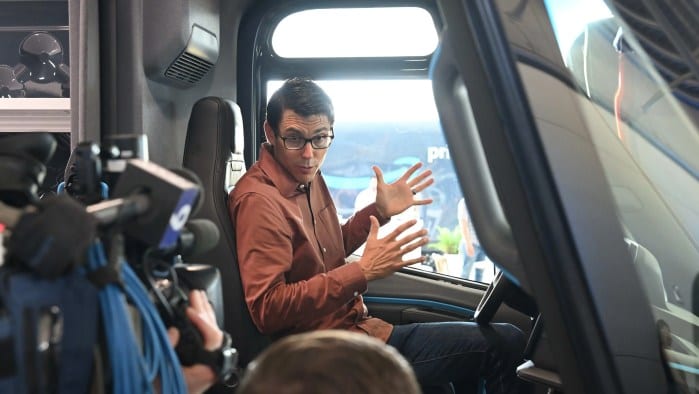
Speaking with journalists on Thursday, XPeng‘s General Intelligence Center Head Liu Xianming said that Tesla’s FSD entering China is a positive development.
“It creates healthy competition and helps drive industry progress,” Liu stated.
He added that XPeng welcomes what he described as high-level comparison between the two systems.
Liu acknowledged that Tesla has advantages in certain technologies and said the two companies would improve through competition — while outlining several areas where he believes XPeng holds an advantage over the Elon Musk-led company.
“Compared with Tesla FSD, XPeng‘s advantages lie in adapting to Chinese local driving scenarios, accumulating local driving data, and optimizing local computing power, allowing it to better handle road conditions unique to China,” he said.
The country’s data export laws had previously forced Tesla to train the model on publicly available video rather than real-world driving data collected locally.
Earlier this year, Tesla established an AI training center in China, which allows the company to further train its AI models in the country.
XPeng‘s founder and CEO He Xiaopeng experienced Tesla’s FSD in the US in mid-2024.
“I experienced FSD version V12.3.6 in California over the past couple of days and also hailed a Waymo to experience it,” he wrote then.
According to He Xiaopeng, “overall, the Waymo performed better in the San Francisco urban area, while FSD performed extremely well in Silicon Valley and on highways, where it could achieve high scores and many road conditions were handled smoothly.”
LiDAR
Both Tesla’s FSD and XPeng‘s VLA driver-assistance system currently follow a pure vision-based approach.
The shared technical philosophy has been a recurring theme in comparisons between the two companies.
Tesla first rolled out an earlier version of the software in China.
By then, CEO He Xiaopeng said that the two automakers are “the only two companies capable of achieving intelligent driving without relying on high-definition maps or LiDAR, working towards a unified AI-driven solution that functions well globally.”
Industry data suggests that an increasing proportion of vehicles priced above 150,000 yuan ($22,000) are being equipped with LiDAR.
When questioned on Thursday whether XPeng faces pressure by sticking with a pure vision-based approach, the CEO said the company sees none.
“We don’t feel any pressure. LiDAR is a good technology, but in the automotive field, I believe it is no longer necessary,” he stated, adding that “XPeng is very firm on this point. However, in many other industries it is still needed — that’s my view.”
Liu Xianming expanded on the reasoning, noting that LiDAR is necessary depending on a company’s technology stack and that there is no absolute answer.
“For users, the core issue with autonomous driving is the actual driving experience, not the sensor configuration itself,” Liu said.
XPeng remains committed to a no-LiDAR approach, focusing on the real-world performance of its second-generation VLA system.
According to Liu, “even in extreme weather, nighttime driving, and complex road conditions, strong performance can still be achieved through massive computing power, large AI models, and high-density sensor systems.”
August Target
XPeng has set a specific timeline for overtaking Tesla’s system in the Chinese market.
Late last month, He Xiaopeng told reporters that by August, XPeng‘s VLA intelligent driving system would comprehensively surpass Tesla’s FSD in China.
Speaking about the topic on Thursday, he acknowledged that the comparison between the two systems currently is complicated — since the full version of FSD has not yet officially entered the country.
“I think each side has its strengths. For example, on narrow roads and challenging driving situations, VLA’s current performance is clearly better than FSD,” he noted, however.
The CEO provided a technical breakdown of where each system excels, saying that VLA currently performs noticeably better in longitudinal control — meaning forward driving behavior — while admitting that XPeng is still improving its lateral capabilities and performance in extreme U-turn scenarios.
He emphasized that a fair comparison requires accounting for the pace of development on both sides.
“FSD itself is evolving rapidly, and comparing XPeng‘s continuously improving system against a static version of FSD would be unfair,” he added. “Therefore, XPeng has set itself a clear target: by August, to comprehensively surpass FSD in overall capability within the Chinese market.”
FSD’s Troubled Path
Tesla’s road to launching FSD in China has been marked by regulatory setbacks and customer backlash.
The company first began testing the software on public roads in China in early 2025.
In April of that year, the Ministry of Industry and Information Technology (MIIT) banned terms like “autonomous driving” and “full self-driving,” instructing automakers to avoid exaggerated advertising.
Tesla subsequently rebranded the software to “Intelligent Assisted Driving” in the Chinese market.
In September 2025, seven Tesla owners in China sued the company over FSD, claiming that the vehicles they purchased with the software could not deliver the advertised features due to hardware limitations.
The owners said FSD only supported automatic lane changes on highways, while other promised features — like summoning the vehicle in open parking lots — never worked.
Tesla reportedly began internally testing FSD v14.3.2 with employees in China in early May, identified as a version with full functionality.
Employees were required to sign non-disclosure and indemnity agreements.
XPeng’s Autonomous Driving
The comparison with Tesla comes as XPeng is executing an aggressive expansion of its autonomous driving business.
The company started mass production of its GX-based robotaxi earlier this week, targeting pilot operations with safety drivers in the second half of 2026 and fully autonomous operations without on-site safety officers by early 2027.
Earlier this year, XPeng secured Volkswagen as the first commercial customer for its VLA 2.0 system — marking the first time a major Western automaker adopted Chinese-developed autonomous driving software.
The company plans to invest 7 billion yuan ($1 billion) in physical AI-related R&D this year and has dropped “Motors” from its Chinese name as it expands into robotics and AI chips.
Robotaxi Outlook
He Xiaopeng said he holds a neutral view toward robotaxis — cautious in the short term but optimistic over the medium to long term.
The CEO claimed that many publicly available L4 autonomous driving statistics are misleading, singling out Waymo.
“Data from companies such as Waymo is often generated in restricted and repetitive operating environments rather than under truly large-scale real-world road conditions,” he said.
Genuine L4 autonomy, according to the XPeng CEO, must be capable of expanding from limited, closed areas to broad, open environments covering highways, parking lots, and business parks in all scenarios.
He predicted that fully autonomous driving will not spread rapidly within the next one or two years but will also not take another decade.
“Breakthroughs in physical AI will likely happen first in robotics, which will then accelerate the development of autonomous driving,” the CEO noted, stating that “robots have lower safety requirements, whereas self-driving cars require extremely high reliability because even small failures can lead to frequent accidents.”
According to him, “the future of autonomous driving is bright, but only a small number of players will be able to participate. In the short term, I remain neutral.”
XPeng’s full-sized flagship SUV GX officially launched on Wednesday with a starting promotional price of 269,800 yuan — positioning it against models including the Onvo L90 and the Li Auto i8.
The company’s CEO said early demand has surpassed his expectations.
Through the first four months of 2026, XPeng has delivered 93,693 vehicles — below the 129,053 registered in the same period last year — as the company works to ramp demand ahead of a full-year target of 550,000 to 600,000 units.