
Tesla has hired Gary Jiang, a semiconductor manufacturing veteran of nearly 18 years at Intel, to serve as director of its Terafab chip-fabrication project in Austin.
Jiang is the first senior leadership hire to surface for the company’s bid to build advanced chips in-house.
Intel formalized its role on April 7, joining Tesla, SpaceX and the SpaceX-owned xAI as the manufacturing partner, a tie-up that gives the venture process-node and packaging expertise none of the other partners possess.
Jiang lists his current role as “Director, Tera Fab” at the automaker on his public LinkedIn profile, full-time and on-site in Austin, Texas, starting in June 2026.
Electrek reported the hire on Tuesday while choosing not to publish his name. EV identified the hire as Gary Jiang, confirming the appointment via his LinkedIn profile.
Who is Gary Jiang
According to his profile, Jiang spent more than 17 years at Intel, most recently as a factory manager from December 2024 responsible for Intel’s 18A technology-development transfer, construction and tool installation, and the startup toward product certification and high-volume manufacturing capacity.
His earlier Intel roles were based at the company’s Ocotillo campus in Chandler, Arizona, and spanned department and area management across Fab 32 and Fab 12, covering 14-nanometer and 22-nanometer high-volume production.
The competencies he lists — technology transfer, fab startup, strategic planning, cost reduction and yield improvement — read like a job description for standing up a semiconductor plant from scratch, which is precisely what Tesla says it intends to do.
Jiang holds a doctorate in materials science, a credential that fits the metallurgical demands of leading-edge fabrication.
What Terafab Is
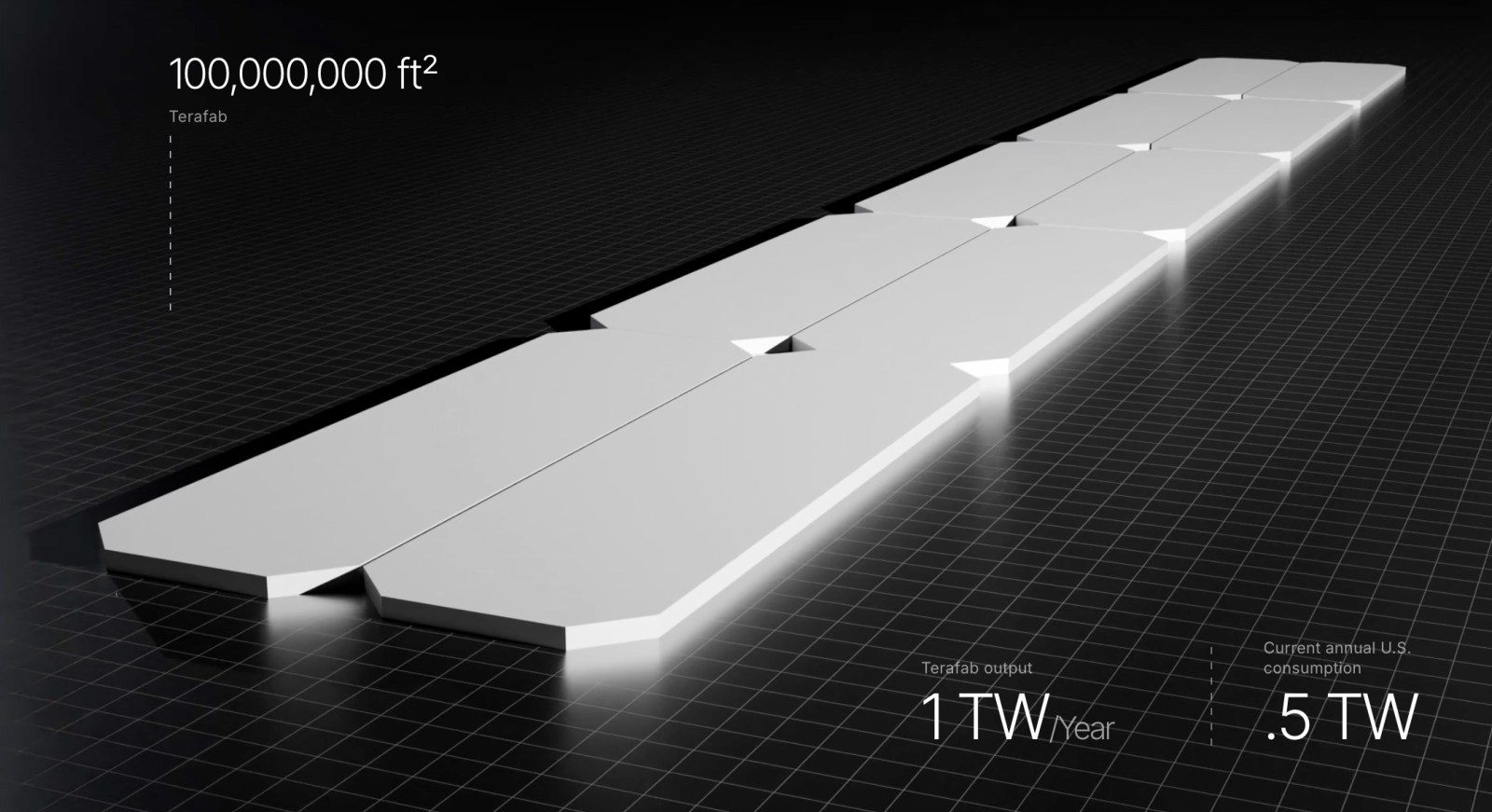
Terafab is the in-house semiconductor venture Tesla and SpaceX unveiled on March 21 at a livestreamed event from the defunct Seaholm Power Plant in Austin, where Chief Executive Officer Elon Musk called it “the most epic chip building exercise in history by far.”
The plan is to consolidate chip design, lithography, fabrication, memory, advanced packaging and testing under one roof, so that new chip revisions can be produced and tested in days rather than the months a conventional supply chain requires.
Musk has said Terafab targets Intel’s 14A node, the chipmaker’s most advanced process, having earlier described the project as aiming at 2-nanometer-class technology before Intel came aboard.
A prototype research fab is planned for the North Campus of Giga Texas in Austin, with a far larger high-volume site earmarked for the Gibbons Creek area of Grimes County, Texas, which secured local tax incentives on June 3.
The headline numbers have only grown since launch.
Musk framed the effort in March as a roughly $20 billion prototype, scaling from 100,000 wafer starts a month toward an eventual one million.
SpaceX’s S-1 filing in May pegged the initial investment at $55 billion and total investment across all phases at up to $119 billion, even as the same filing that detailed the company’s record-breaking listing cautioned that the arrangement with Tesla is only a general framework, with specific projects, timelines and capital outlays not yet determined.
Why Tesla Is Poaching Intel
Standing up a leading-edge fab is among the hardest feats in manufacturing, and it is expertise Tesla does not have in-house.
Intel is one of only three companies in the world, alongside TSMC and Samsung, capable of fabricating chips at advanced nodes, and Jiang’s recent work sat at the center of Intel’s push to bring its 18A process to volume.
The company began advertising Terafab roles in Austin earlier this month, seeking program managers who have overseen more than $100 million in capital expenditure and can run factory design and construction from concept through production readiness.
The Chip Crunch Driving the Build
The hire lands against a silicon strategy Tesla has spent the year racing to secure.
The company taped out its AI5 inference chip in April, the custom processor meant to run Full Self-Driving and the Optimus humanoid robot, with high-volume production not expected until the back half of 2027.
For now Tesla depends on external foundries, dual-sourcing AI5 across TSMC in Arizona and Samsung in Texas and leaning on a reported $16.5 billion Samsung agreement, with further chips including the AI6 mapped out behind it.
Demand is the forcing function.
Musk has argued that all the world’s chip fabs combined produce a small fraction of what his companies will eventually need, and the Optimus program is the single largest driver, with Morgan Stanley estimating that a 10-million-robot capacity at Giga Texas alone could require some 20 million chips a year.
Those ambitions stretch well beyond cars, into Cybercab robotaxis, the third-generation Optimus whose mechanical design Tesla has begun patenting, and a longer-term vision Musk has floated of orbital data centers fed by chips built specifically for space.