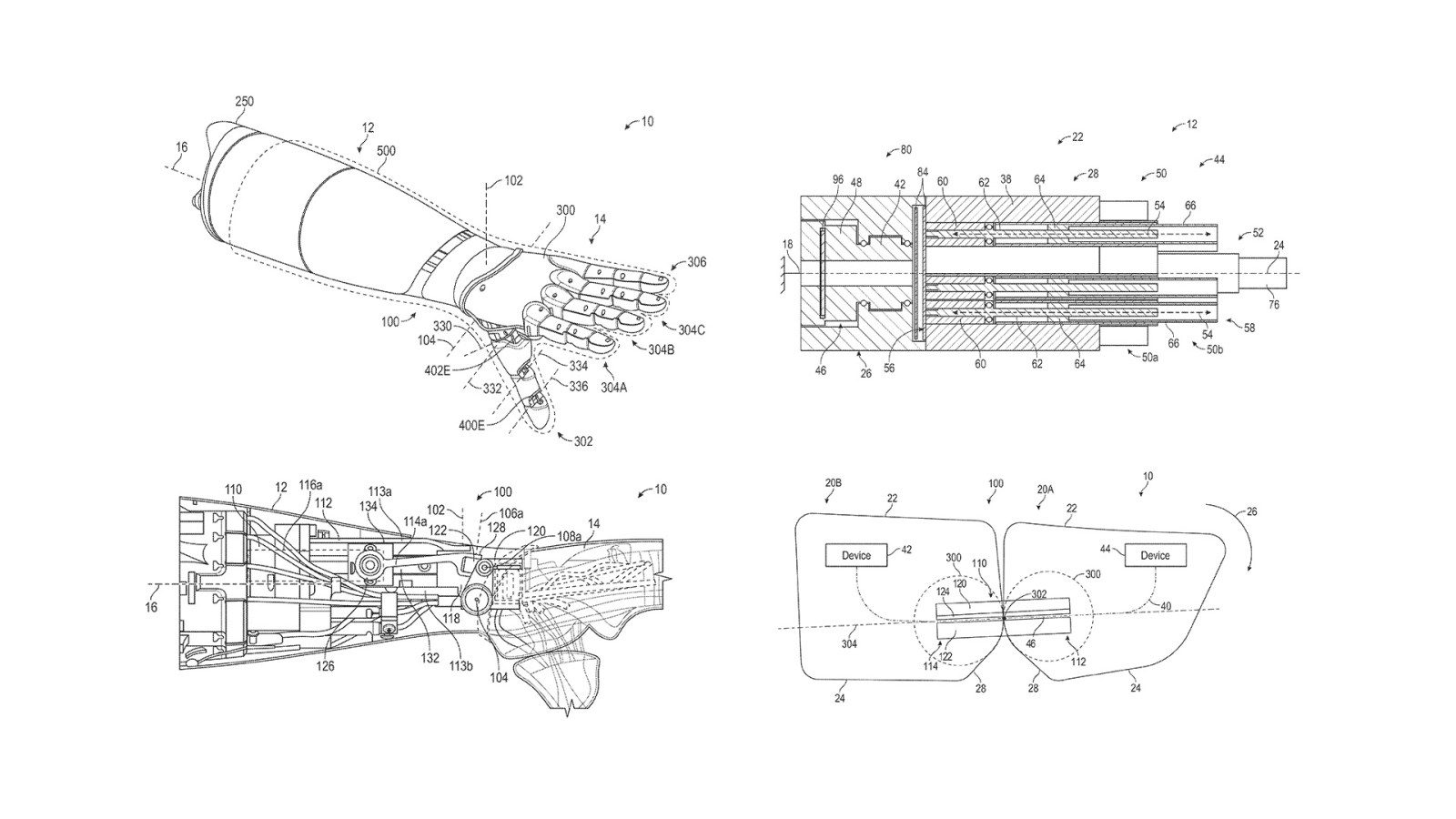

Tesla published four international patents on Thursday covering the forearm, wrist, joint and hand architecture of its Optimus humanoid robot, providing the first detailed mechanical blueprint for the design set for mass production.
The filings describe a robotic forearm assembly of the third generation Optimus which will house 25 linear actuators — 23 controlling the hand and two controlling the wrist — arranged in concentric rings around a central rotary actuator.
That configuration matches the specification Tesla‘s CEO Elon Musk first disclosed on X in November, when he clarified that each Optimus arm packages “25 actuators in each forearm and hand,” for a total of 50 per robot.
The four patents share a priority date of October 10, 2024 — the exact day of Tesla‘s “We, Robot” event in Hollywood.
At the event, the company led by Elon Musk unveiled the Cybercab and the Robovan models.
The publications on Thursday are the first public disclosure of the hardware.
The Four Patents
The ‘Robotic Forearm Assembly’ patent is the most technically detailed of the four, with 14 named inventors including Konstantinos Laskaris — Tesla‘s former chief motor designer, now Optimus program lead.
The claim describes a housing with a central axis, a rotary actuator that rotates the housing sections, multiple hand linear actuators, and a wrist linear actuator, all extending parallel to the central axis.
The ‘Robotic Appendage’ patent covers a tendon-driven hand with a palm body, finger assemblies, phalanxes and a tensile member extending through the palm, consistent with the hand architecture Musk has described publicly.
The two remaining patents filed are the ‘Joint Assembly for Robotic Appendage’ and the ‘Wrist Joint for Robotic Hand.’
Musk’s Public Statements
The patent language ties directly to Musk’s own descriptions of the Gen 3 hand.
On November 15, 2025, Musk wrote on X that Optimus uses “50 actuators (25 in each forearm and hand).”
That maps onto Tesla‘s independent claim: 23 hand linear actuators plus two wrist linear actuators, all packaged inside the forearm housing.
Musk has repeatedly stated that the hand and forearm are the hardest component of the entire robot.
He has called the Gen 3 hand “an incredible piece of engineering” and “the most advanced robot hand in the world — nothing even close.”
On February 5, 2025, he said the Optimus hand was “so sophisticated that it makes a Fabergé seem simple.”
Laskaris, the lead inventor on the forearm patent, described Gen 3 in Tesla‘s fourth-quarter earnings update in January as the first version “mass manufacturable” — designed to be useful, safe, reliable and scalable for high-volume production.
Musk said on March 31 that the Gen 3 robot was already “walking around” internally and only needed finishing touches before a public reveal.
Production Timeline
Tesla plans low-volume production beginning in the summer of 2026, initially for internal use at its Fremont factory, where the company is converting the former Model S and Model X line into a humanoid robot site.
High-volume production is targeted for 2027, ramping toward an eventual capacity of one million units annually.
Musk’s most recently approved pay package is tied in part to the delivery of one million humanoid robots by 2035.
Tesla has guided toward a cost of goods sold of roughly $20,000 per unit at scale, with a selling price expected in the $20,000 to $30,000 range.
AI5 Chip Taped Out
The patent publications follow Musk’s confirmation on Tuesday that Tesla’s next-generation AI5 chip has been taped out, with Samsung Electronics producing the first sample.
Musk described AI5 as designed for both cars and robots, positioning it as the inference chip for Optimus as well as for Tesla vehicles running Full Self-Driving.
A tape-out marks the point at which a chip design is locked and sent to the foundry for fabrication.
Musk claimed the AI5 delivers approximately 5 times the compute performance of the current AI4 chip used in Tesla vehicles.
The CEO had previously said AI5 was refocused specifically on Optimus performance requirements, and the timing places the chip in the same April window as the upper-limb patent disclosures.
Combined, the two events provide the hardware and silicon foundations for the Gen 3 robot: the mechanical architecture for the arms and hands is now publicly disclosed, and the AI inference chip that will run the neural network has entered fabrication.
Mass production of the AI5 is expected to trail the tape-out by 12 to 18 months, roughly aligning with Tesla‘s 2027 high-volume Optimus timeline.
China Manufacturing
Earlier this week, Allan Wang Ho, president of Tesla China, said Gigafactory Shanghai could serve as a “golden key” to the mass production of the humanoid.
Speaking at a media briefing on Tuesday, Wang said the plant could “shoulder important responsibilities in manufacturing all new products, including robots.”
It was the first time a Tesla executive publicly floated the Shanghai facility as a potential Optimus production site.
Chinese Competition
Tesla is filing the upper-limb moat claims against the backdrop of accelerating Chinese humanoid programs.
XPeng is preparing mass production of its Iron humanoid at a dedicated Guangzhou facility, with a target of more than 1,000 units per month and annual sales potentially reaching one million by 2030, according to founder He Xiaopeng.
Iron has been described by XPeng as using 70 to 80 joints built to car-grade standards.
On Tesla‘s January earnings call, Musk acknowledged that China is “by far” the biggest competition in humanoid robots, adding that “China is incredibly good at scaling manufacturing” and “very good at AI.”
He said Tesla does not see any significant competitors outside China but still framed Optimus as “much more capable than any robot that we are aware of under development in China.”
State-owned Changan and Chery are also developing humanoid robots. Nio founder William Li has said his company is pursuing a “late-comer strategy” and will enter robotics only after achieving sustained profitability.