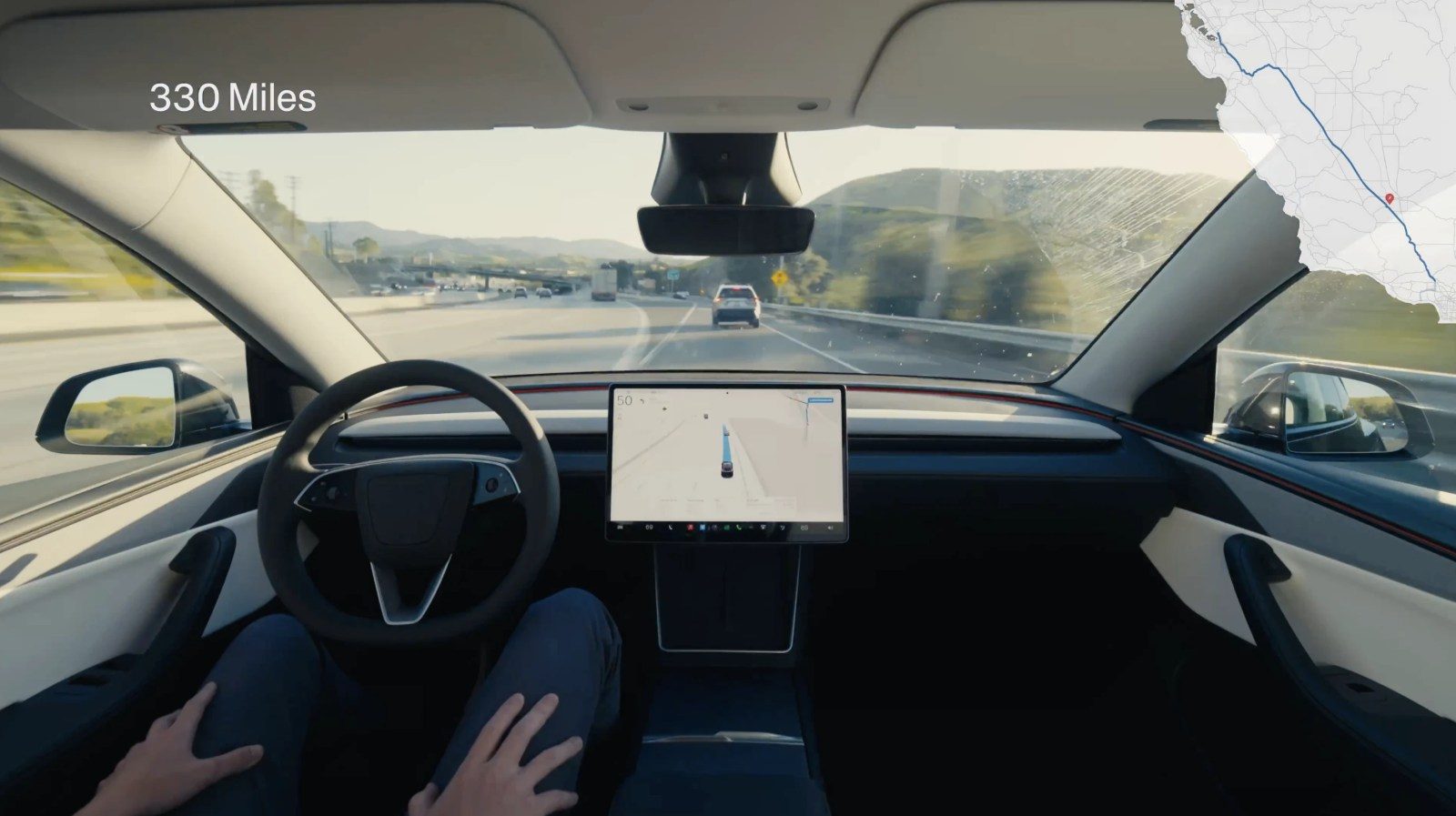

Tesla began rolling out its FSD V14 Lite software to a first wave of Hardware 3 owners on Monday.
The long-promised update that narrows the gap with newer cars but stops short of the unsupervised driving the company has said the hardware will never support.
VP AI Software Ashok Elluswamy said on X that the build was reaching early-access AI3 customers, Tesla‘s in-house label for Hardware 3, and would expand to more of the roughly four million affected cars over the next few weeks depending on feedback.
Investor and commentator Sawyer Merritt, who tracks Tesla closely, separately flagged the rollout, writing on X that it had “officially started rolling out” to Hardware 3 owners.
What V14 Lite delivers
Tesla said V14 Lite distills the driving behavior of the Hardware 4 version of V14 into both the cameras and the compute of Hardware 3, letting the older computer learn to handle scenarios using the newer stack as a guide.
That process passes improvements made on Hardware 4 to the legacy fleet, including reinforcement learning and offline models, according to the release notes.
The update sharpens both proactive and reactive responses across navigation, merges and forks, pedestrian interactions, traffic lights and vehicle cut-ins, the company said.
Comfort gains include fewer false slowdowns, smoother steering and more consistent lane centering, alongside new parking, unparking and reversing functions.
Drivers also gain Arrival Options that let them choose where the car parks, whether in a lot, on the street, in a driveway or at the curb, plus Speed Profiles available at all times.
Owners would “basically have all the features that V14 for Hardware 4 has,” Tesla‘s head of Autopilot, Ashok Elluswamy, had said when previewing the build, describing a compressed neural network rather than a reduced feature set.
Beyond the new functions, Elluswamy framed the most important change as “significantly improved safety,” writing that the wider release would follow once the build had been validated through early-access feedback.
A hard limit remains, however: V14 Lite stays a supervised, hands-on system, and marks the first major build for Hardware 3 cars that had been frozen on Full Self-Driving version 12.6 since early 2025.
The hardware ceiling
The roughly four million vehicles Tesla built with Hardware 3 cannot achieve unsupervised Full Self-Driving, the company confirmed at its first-quarter earnings call on April 22, capping years of promises to owners who paid as much as $15,000 for the feature.
Chief executive Elon Musk told investors on that call that Hardware 3 “simply does not have the capability to achieve unsupervised FSD.”
Musk attributed the shortfall to memory bandwidth, saying the older computer has roughly one-eighth that of Hardware 4, the generation Tesla began fitting in January 2023.
The chip launched in April 2019 as the self-styled “FSD Computer,” marketed on the claim that every car carrying it had the hardware for full autonomy, a gap that widened as the software moved to larger end-to-end models through versions 12, 13 and 14.
Two paths for owners
For owners who want unsupervised capability, Tesla outlined two options on the April call, neither cost-free.
The first is a discounted trade-in toward a vehicle already fitted with AI4 hardware, a route the company has long greased with FSD-transfer promotions.
A second path is a physical retrofit that swaps the computer, replaces the cameras and overhauls the wiring harness, an operation Tesla plans to run at dedicated conversion sites rather than at service centers.
Converting the cars to Hardware 4 is what would let them join the Robotaxi fleet and run unsupervised, Musk said, framing the upgrade as central to that network’s growth.
Reporting by Electrek and others has pegged the retrofit as labor-intensive and unlikely to enter production before mid-2027, with an out-of-pocket fee expected for owners who only subscribe to the software.
A decade of promises
The arrival of V14 Lite closes one chapter of an arc that began in 2016, when Musk said every car Tesla built would ship with “all necessary hardware for full self-driving capability.”
Buyers acted on that pledge, paying $8,000 to $15,000 for the FSD package over the following years, and Tesla at one point upgraded earlier owners from Hardware 2 to Hardware 3 free of charge while billing subscribers for the same part.
A similar reckoning is now playing out one generation later, though the company has shelved the idea of a free, in-place swap.
On the fourth-quarter 2024 call in January 2025, Musk had pledged to “replace all HW3 computers in vehicles where FSD was purchased,” calling the task painful but achievable.
By the third-quarter 2025 call in October, the plan had shifted to V14 Lite, with finance chief Vaibhav Taneja saying the company had “not completely given up on Hardware 3” and describing those buyers as early adopters.
Owner backlash
The walk-back has drawn legal and public pushback, sharpest in Europe.
A Dutch owner who paid 6,400 euros for FSD in 2019, Mischa Sigtermans, launched a collective claim in April, telling other affected drivers on X that Tesla “owes me €6,400” and owes them too.
The campaign cites Tesla‘s 2019 Dutch marketing, which told buyers every car had the hardware needed to become fully self-driving in almost all circumstances.
Some US owners have separately taken the company to arbitration and won over the undelivered software, sharpening a dispute that touches a fleet of about four million cars worldwide.
The Robotaxi rationale
The Hardware 3 question has grown more pointed as Tesla leans on autonomy for its valuation.
The company has ramped an unsupervised Robotaxi service across Texas cities and removed the chase vehicles that once trailed driverless trips, with Musk declaring the service “100% unsupervised” in January.
Every retrofitted or newly sold AI4 car widens the pool eligible to join that fleet, which is why management casts the conversion of legacy vehicles as a way to enlarge the network rather than a sunk liability.
Investor attention has tracked the issue, with the question “How will hardware 3 cars reach unsupervised FSD?” topping the retail list submitted ahead of the April call.
What comes next
Outside North America, Hardware 3 owners face a longer wait, with Tesla saying V14 Lite will expand to other markets only after the US rollout, citing technical verification, regional adaptation and regulatory approval.
The constraint bites hardest in Europe, where Tesla won its first Full Self-Driving (Supervised) approval in the Netherlands in April for an HW4 build, leaving the older fleet behind the newer generation and any Hardware 3 version to clear its own review.