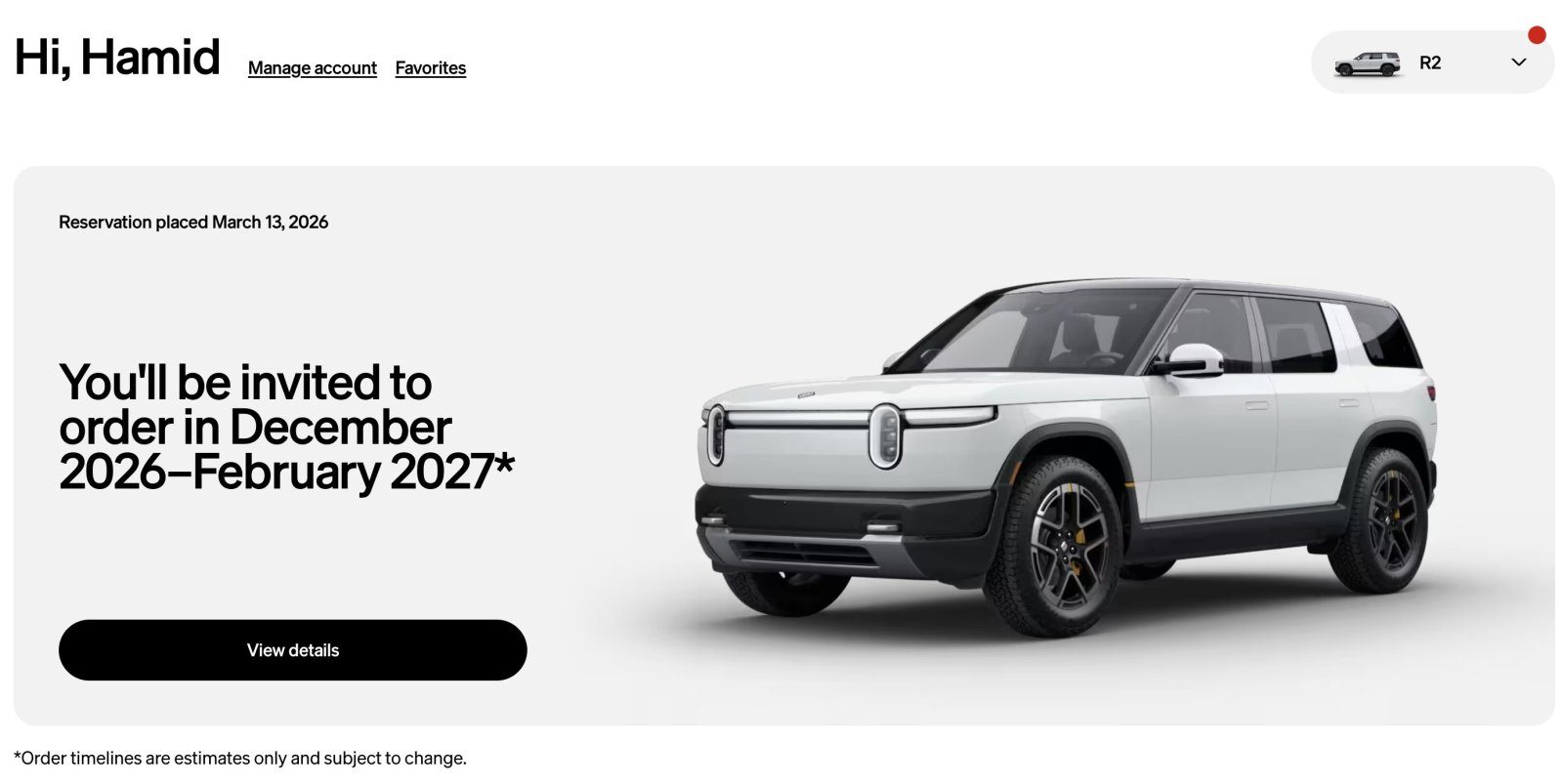

Rivian began showing US reservation holders for its R2 electric SUV an estimate of when they can expect an invitation to order, meeting a self-imposed end-of-June deadline as windows appeared in customer accounts on Tuesday.
The dates landed in accounts from around 11:30 a.m. Eastern on June 30, the final day of the company’s commitment to show every US holder a timing estimate and the close of its second quarter.
Each reservation now carries a calendar range under the line “You’ll be invited to order,” with a footnote that the timelines are estimates only and subject to change.
The ranges vary widely by holder, from windows as near as August and September 2026 to ones stretching into early 2027, the furthest visible example reading December 2026 to February 2027.
An order invitation unlocks the configurator, the step that turns a reservation into a firm order, after which buyers choose trim, paint and options and confirm in their account.
What the Window Shows
The windows function as a queue position rendered as a date range rather than a fixed appointment.
One holder who reserved on the opening day in March 2024 saw a window of December 2026 to February 2027, while another early reservation from May 2024 returned the same range.
A reservation placed in April 2024 showed September to October 2026, and an account flagged as a fast first-minute reservation without an existing Rivian returned August to September 2026.
The spread underlines how much the sequencing depends on factors beyond reservation date, since holders who reserved within weeks of one another received windows months apart.
The estimate appeared for some holders before any email arrived, with one buyer noting the account page showed a timeline even though no notification had been sent.
The dates also surface against a backdrop of impatience, with one holder posting that a wait already exceeding two years would probably run to three before a car arrived.
The Email That Followed
Rivian reinforced the in-account windows with a second wave on Tuesday, emailing reservation holders their estimated invite timing from around 1 p.m. Eastern, roughly 90 minutes after the dates first surfaced in accounts.
The message restated the window shown on the account page and added a delivery estimate, telling each holder that once an order is placed and confirmed, delivery follows within four to eight weeks for most configurations.
Rivian‘s email also spelled out in writing what drives the timing, with the EV maker saying the estimate reflects “production schedules, your delivery location and vehicle preferences you selected.”
The sentence restates the build-matching logic in the company’s own words, naming the saved configuration as one of three inputs alongside production capacity and delivery location.
The note told holders the launch trim would stay reserved until their turn to order and promised to flag any change to the estimate so they could plan for delivery.
Zak Winnick, an R2 reservation holder, posted his email publicly and wrote that “Rivian is sending out R2 delivery timeframe e-mails too,” sharing a message that showed a September to October 2026 window.
Confirmation of the Build-Matching Logic
The rollout settles a question that had been a matter of inference.
In presenting the windows, the company tied the timing directly to a holder’s saved configuration and queue position, rather than reservation date alone.
The link matters because not every paint and interior combination is available at launch, so pairing the configurations buyers favor against what the line can supply lets Rivian invite the holders it can fulfill soonest.
A buyer who has saved a build around a color or trim that the factory cannot yet produce would, under that logic, see a later window than one whose preferences match current output.
The approach gives the company a tool to smooth its production ramp while holding buyers in the queue rather than losing them.
What the Early Tracker Data Suggests
Owners have filled the information gap with their own tracking, and one early analysis of the crowd-sourced data points in the same direction as the company’s framing.
‘Coney129’ — an owner of a 2025 R1S — examined the rows of a community tracker where a VIN had already been assigned and cautioned that the sample was small and self-reported rather than definitive.
Color stood out as the clearest signal in his read, since the early builds share the Performance Launch Package and a Black Crater interior, leaving paint as one of the few variables.
Half Moon Grey and Glacier White showed the highest VIN-assignment rates in his count, each around three-quarters of logged entries, while Launch Green, Catalina Cove and Esker Silver trailed well behind despite Launch Green appearing popular overall.
The pattern, he wrote, suggested those two colors were being pulled forward, consistent with a system that invites the configurations the line can build first.
Geography appeared to matter too, with California forming the largest cluster of assigned VINs and Missouri standing out given its proximity to the Normal, Illinois, plant, a spread he read as batching by transport lane or delivery-center readiness rather than strict reservation order.
Order date looked more influential than original reservation date in his analysis, with many assignments clustered around buyers who ordered in mid-June, though some later reservation holders had VINs and some earliest ones did not.
Purchases also appeared to move faster than leases in the sample, and notably, current R1 ownership did not look like a decisive factor, with VIN-assigned rows split fairly evenly between owners and non-owners.
The Configurator as Rivian’s Read on Demand
Underpinning the build-matching logic is a feature buyers have been using for weeks.
Rivian opened the configurator before invitations began and let reservation holders save a favourite build, selecting an exterior color, interior and options well ahead of any invite.
Those saved preferences hand the company a live read on what buyers actually want, color by color and trim by trim, before a single firm order is placed.
Pairing that demand signal against what the Normal line can currently supply lets Rivian move the holders it can fulfill soonest to the front, which is the practical expression of the configuration-based timing the windows now reflect.
The mechanism also explains why two buyers who reserved on the same day can see different windows, since the one whose saved build matches a buildable batch is easier to schedule than the one waiting on a color or trim still months from the line.
The Trim Roadmap Behind the Dates
The order of the windows tracks the order in which Rivian plans to build the R2’s variants.
The company launched with the Performance trim at $57,990 and began customer deliveries and invitations together on June 9.
The launch trim ships with the company’s Autonomy+ package and its in-house hands-free assisted driving, one of the features buyers weigh when deciding whether to configure now or hold for a later version.
A Premium version at $53,990 is due in late 2026, followed by a rear-wheel-drive Standard Long Range at $48,490 in early 2027 and a Standard model with a longer-term target near $45,000 by the summer of that year.
Holders set on a cheaper or later configuration therefore see windows that fall closer to when those versions enter production, a sequencing that explains some of the spread into 2027.
Customers who receive an invitation but prefer to wait for a later trim, more paint options or upcoming technology keep their place in line, the company has said.
Built at the company’s plant in Normal, Illinois, the R2 is a five-seat midsize SUV that Rivian has called its highest-volume future product and assembles alongside the R1.
A Quarter-End Conversion Push
The timing of the rollout was no accident, landing on the last day of a quarter that doubles as the R2’s first on the market.
Rivian is on track to deliver more than 1,100 R2s in the period, and giving every reservation holder a visible window before the close supports conversion as deposits remain fully refundable and easy to walk away from.
The earliest holders have waited more than two years since reservations opened with the model’s March 2024 unveiling, and priority for existing R1 owners and customers with expiring leases has meant some day-one reservations watched others get invited first.
Most of the company’s 2026 delivery growth, guided at 62,000 to 67,000 vehicles, rests on the R2, with Rivian having said it expects 20,000 to 25,000 of the model this year and the majority in the second half.
The windows arrive days after the company told buyers their SUVs had entered pre-production ahead of VIN assignment, another step meant to keep reservation holders engaged through the wait.
US VIN assignments have now climbed past 2,200 within weeks of the first orders.
What Comes Next
The invitation system applies only to the US, with Rivian having delayed the R2 in Canada and Europe to 2027, leaving reservation holders abroad outside the current rollout.
Attention now turns to the second-quarter production and delivery figures, due in the first days of July, which will give the first hard read on how quickly reservations are converting.