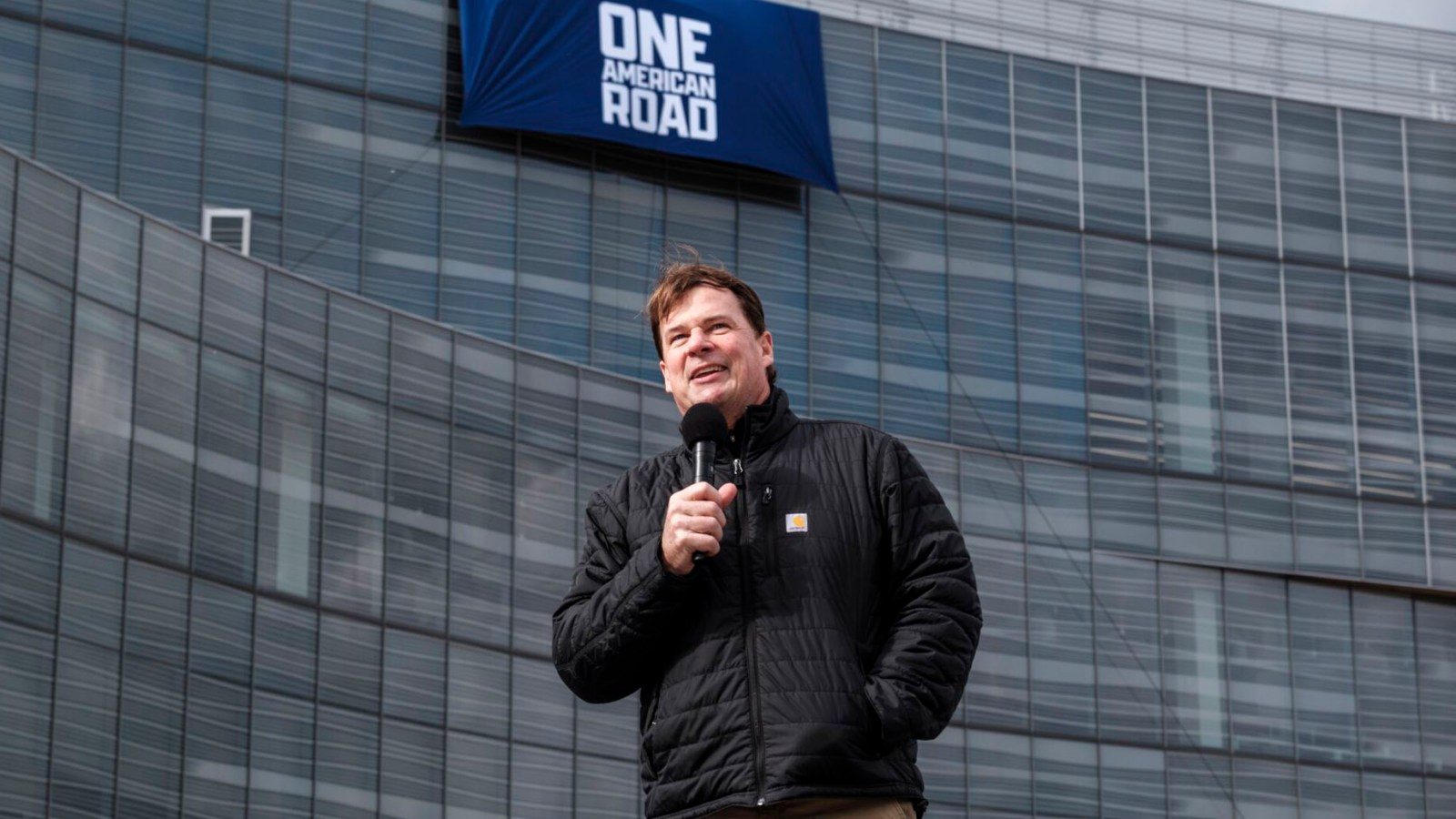

Ford CEO Jim Farley said there is “no real competition from Tesla or GM or Ford” against Chinese automakers in electric vehicles, dismissing the Elon Musk-led company’s leading position in the world’s largest auto market.
Tesla‘s Model Y led China’s SUV sales in both 2024 and 2025.
Farley’s comments, made in an interview with Joanna Stern were recorded in September 2025 and published on The Verge‘s Decoder podcast late last week.
At the time of the recording, Tesla‘s Model Y had just posted 59,900 wholesale units in China in September 2025, crowning it the best-selling passenger vehicle in the country that month, according to the China Passenger Car Association (CPCA).
Tesla’s Sales Tell Different Story
Farley’s characterization of Tesla as unable to compete in China was already at odds with the data at the time of the interview — and the nine months since have only widened the gap between his assessment and Tesla‘s actual performance in the country.
For full-year 2025, Tesla‘s retail sales in China totaled 625,698 units, according to CPCA data.
Wholesale volume from Giga Shanghai — which includes both domestic deliveries and exports — reached 851,732 units for the year.
The Model Y closed 2025 as China’s best-selling SUV with 425,337 retail units, leading the segment by a margin of roughly 180,000 units over the runner-up, the Geely Xingyue L.
The Model Y also ranked as the third best-selling new energy vehicle in the country overall.
Tesla separately confirmed earlier this year that the Model Y had been the world’s best-selling passenger car for three consecutive years, with cumulative global deliveries surpassing four million units.
The final quarter of 2025 saw a particularly strong surge, driven in part by consumers accelerating purchases ahead of less favorable purchase tax policies in 2026.
At the same time, it was aided by the launch of the six-seat Model Y L, which began deliveries in September 2025 and quickly sold out its entire 2025 production allocation.
In December, Tesla hit a record 93,843 retail units in China, surpassing the previous monthly high of 82,927 set in December 2024.
Wholesale volume that month reached 97,171 units, Tesla China’s second-highest total on record, trailing only November 2022’s 100,291 units.
Export Focus
Giga Shanghai reached its four-millionth vehicle in the final month of 2025.
The plant runs a localization rate above 95% and routinely accounts for more than half of Tesla‘s global deliveries, making it one of the company’s most critical manufacturing assets worldwide.
Tesla‘s first quarter wholesale deliveries from Shanghai represented approximately 60% of its global total.
Exports over the first five months of 2026 totaled 192,823 units — more than double the year-earlier figure — and have now outpaced domestic retail sales in the country.
Retail sales for January through May stood at 186,035 units, down 7.87% from the same span of 2025, reflecting Tesla‘s decision to allocate more Shanghai capacity to overseas markets.
In May, the latest month for which full data is available, Tesla‘s retail sales in China jumped 22.5% year over year to 47,281 units, snapping a two-month streak of year-on-year declines.
Wholesale volume hit 85,982 units, the highest monthly total of 2026 and a 39.4% increase from May 2025.
According to data from CPCA, the Model Y led all passenger vehicle models in China by wholesale volume in May with 54,800 units, a 38.6% year-over-year increase, and ranked second in BEV retail delivery volume with 25,100 units.
The Model 3 ranked fifth in wholesale with 31,200 units, up 41% year over year.
The ‘700-Pound Gorilla’
Farley framed the competitive landscape in stark terms, stating that “the competitive reality is that the Chinese are the 700-pound gorilla in our industry for EVs.”
According to the Ford CEO, “there’s no real competition from Tesla or GM or Ford with what we’ve seen from China. They are completely dominating the EV landscape globally and more and more outside of China.”
The Ford chief cited scale as the central advantage.
“They have 20 million units locally, about 11 million are EV or E-Revs. So half their market,” Farley said, contrasting China’s volume with roughly one million EV sales in the United States — which he described as “one-tenth of the China volume” — and a European market only “twice as big as us.”
The Chief Executive credited Chinese manufacturers’ competitiveness to a combination of factors.
“They have great innovation, low cost. For example, they’ve bet on LFP technology, not these expensive lithium batteries,” he said. “There’s hundreds of companies. They’re all sponsored by their local governments. So they have huge subsidies.”
Farley singled out several brands by name, which he has been highlighting for the past months.
“It’s BYD and Geely and, you know, companies like Nio and Xiaomi that many of them never been in the car business before. And that’s a big advantage for them,” he said.
He described the competitive challenge as requiring a fundamentally different approach rather than simply matching on price or volume.
“If you sell an affordable EV in the U.S. for $30,000, but it costs you $50,000 to make it, you could say you have an affordable one, but that’s not a sustainable business,” the Detroit automaker’s CEO noted.
Ford‘s chief said the realization prompted him to create an internal skunkworks team several years ago.
“It became very obvious to us or to me personally, that we have to go outside of Ford, create this maverick group, give them resources and stay out of their way,” he admitted, “but make sure that they delivered on a completely new approach because the Chinese are so formidable.”
Farley on Chinese EVs
In the nine months since the interview was recorded, Farley has continued to position Chinese automakers as Ford‘s primary benchmark — while delivering increasingly contradictory signals on the trade and policy dimensions of that relationship.
In February, Ford and Xiaomi denied a Financial Times report that the two companies had held discussions about forming a joint venture to build electric vehicles in the United States.
Farley had previously praised Xiaomi‘s debut model, revealing he personally drove the company’s SU7 sedan for several months and describing his trips to China as “epiphanies.”
That same month, the CEO described Ford‘s upcoming EV platform as among the company’s “most audacious” projects, designed to match BYD‘s cost structure in markets like Mexico.
He reiterated the subsidy argument from the Decoder interview, saying Chinese brands benefit from “huge subsidies” and that the best way for Ford to compete is to “get close to the IP and then run the plants at Ford.”
By April, Ford restructured its EV business for the second time in months, merging its Electric Vehicle, Digital and Design team with its global Industrial System.
Doug Field — a former Tesla and Apple executive who had joined Ford nearly five years earlier to lead its electrification shift — departed as part of the reorganization.
Ford‘s EV unit, Model e, had recorded $4.8 billion in losses in 2025, with an additional $4 to $5 billion in losses projected for 2026.
CFO Sherry House said the company does not expect its EV business to turn profitable until 2029.
Farley’s public posture on Chinese competition then took a sharp turn within a matter of days.
In an appearance on Fox News in April, Farley said Chinese EVs should be kept “out of our country.”
When the host suggested Canada had “sold their soul to China” through its quota deal allowing limited Chinese EV imports, Farley agreed.
Days later, Farley appeared to walk the comments back, telling reporters that Ford “values its Chinese partners” and would “continue to expand these partnerships.”
Tesla CEO Elon Musk responded directly to Farley’s framing of BYD — not Tesla — as the primary competitive benchmark.
Musk pointed to two factors Farley had not addressed: the pending approval of Tesla‘s Full Self-Driving software in China and the output capacity constraints of Giga Shanghai.
“This is before supervised FSD is approved in China. Limiting factor is production output in Shanghai,” Musk wrote on X.
In May, Ford opened its Long Beach EV Development Center to media for the first time, offering a look inside the 350-person skunkworks hub Farley had referenced during his September 2025 interview.
The company is investing approximately $5 billion in its next-generation EV platform, including a $2 billion upgrade to Louisville Assembly Plant.
Farley described the project as a “Model T moment” for Ford.