
Tesla expanded its retail and charging presence in Portugal on Thursday, opening a fifth store and switching on a new Supercharger station in the Porto area.
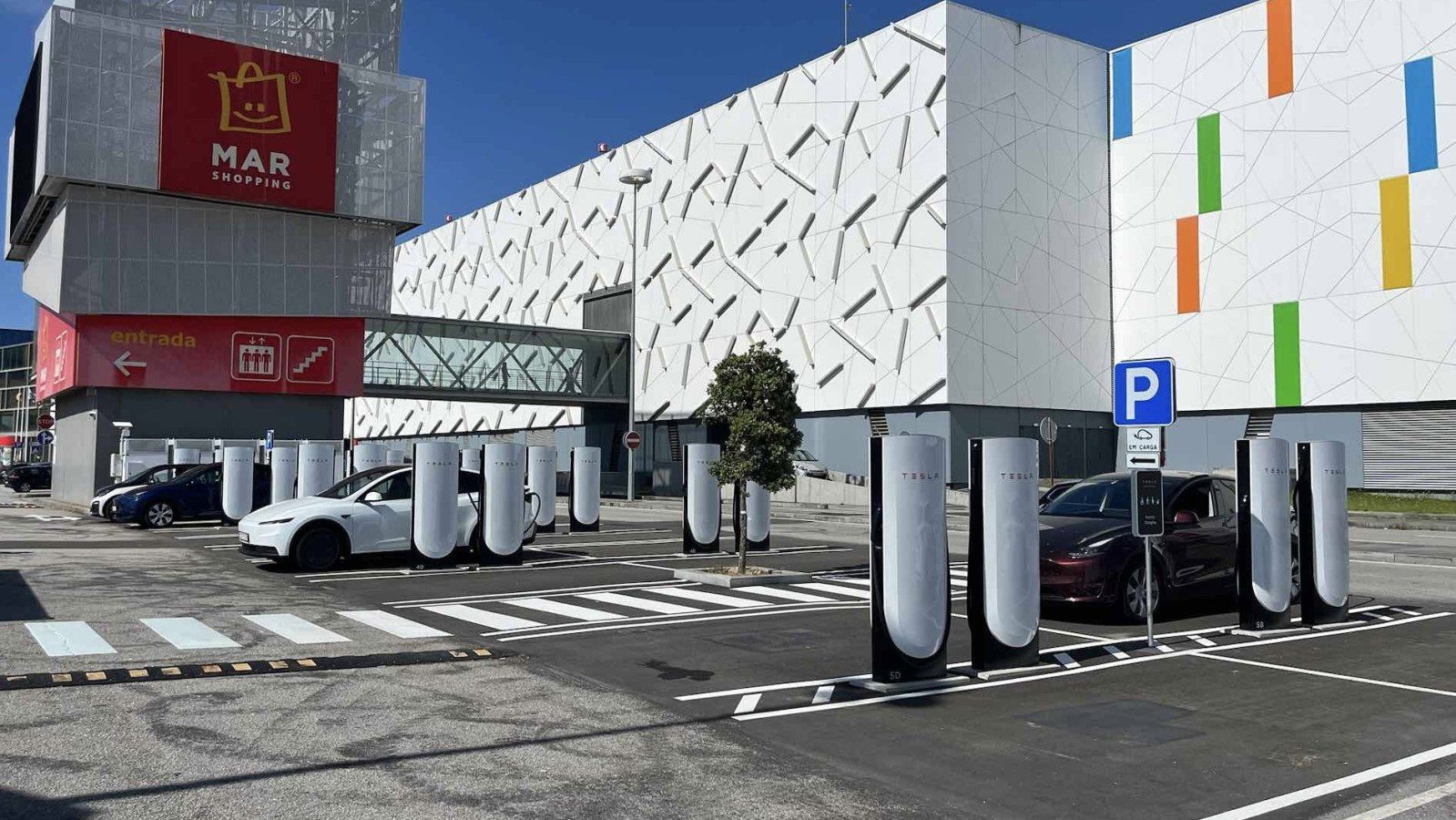
The store sits at the entrance of MAR Shopping Algarve in Almancil and brings Tesla‘s sales points in Portugal to five.
A new charging site in Matosinhos adds 20 V4 stalls and lifts Tesla‘s Portuguese Supercharger network to 10 stations and 196 charging posts.
Both openings land as Tesla‘s Portuguese registrations climb, with May sales up more than fourfold from a year earlier.
A Fifth Store
The location of the new store follows the format Tesla uses across Europe, placing cars where foot traffic is highest and letting shoppers sit in the vehicles before arranging a drive.
Almancil sits in the Algarve, Portugal’s heavy summer-tourism region in the south.
An Algarve outlet extends Tesla‘s coverage toward the country’s busiest holiday coast, its southernmost point of sale in Portugal.
The Model 3 was the best-selling EV model in Portugal in the first half of the year, and described the Model Y as a draw for its safety, space and comfort.
Tesla tied the Model 3’s domestic lead to its lower price, performance and technology, the same mix it credits for the model’s broader European appeal.
Those two cars drove the early adoption of EVs in the country, the company said, by pairing performance with a lower entry price.
Both models also anchor Tesla‘s European volume.
The Model Y ranked as Europe’s best-selling EV in the first quarter, when Tesla registered more than 79,500 vehicles across the region.
Tesla recently brought its Grok AI assistant to cars in Portugal and eight other European markets, part of a software rollout that runs alongside the retail push.
Demand Climbs
Tesla registered 1,463 new passenger cars in Portugal in May, up from 326 a year earlier, according to data from ACAP, the country’s automobile association.
The May result marked a 349% jump and lifted Tesla‘s share of the passenger-car market to 5.8%, from 1.4% a year earlier.
Across the first five months of 2026, Tesla registered 4,392 cars, a 58% rise from 2,773 in the same period last year.
Tesla‘s share over those five months reached 4.0%, up from 2.7%.
Both gains far outpaced the wider market, where passenger-car registrations rose 6.5% in May and 9.8% through May.
The surge tracks Tesla‘s quarter-end delivery pattern, which concentrates sales in the final month of each quarter.
Those figures cover every Tesla model, led in Portugal by the Model 3 and the Model Y.
New Supercharger
The Matosinhos station is Tesla‘s first Supercharger location serving Porto, Portugal’s second city.
The station accepts electric vehicles of any brand.
Its 20 stalls use Tesla‘s V4 hardware, the newest generation, built for higher speeds and easier use by non-Tesla cars.
V4 stalls carry longer cables and built-in screens, a design meant to serve cars from other makers as well as Tesla‘s own.
Tesla has described its V4 cabinets as capable of up to 500 kilowatts, though most European sites still deliver less.
Peak speeds depend on the car and the local grid connection, not the cabinet alone.
The company began rolling out V4 posts in Europe in early 2023, starting in the Netherlands, though many early stalls drew from older cabinets that held output below the hardware’s ceiling.
A Wider Charging Network
Tesla said it has upgraded several existing Portuguese stations, swapping older chargers for V4 equipment.
Older V3 cabinets cap output near 250 kilowatts, so the change roughly doubles peak speeds at upgraded sites for cars that can use them.
The company plans to expand its Loulé station, in the Algarve, with eight more posts in the coming weeks.
With the Porto site, Tesla‘s network in Portugal reaches 10 stations and 196 posts, all open to every EV brand.
Tesla installed its first 500-kilowatt V4 hardware in Europe earlier this year and has steadily opened its Superchargers to rivals across the region.
The Supercharger network passed 80,000 stalls worldwide in early 2026 and now admits brands including Ford, General Motors, Rivian, Hyundai and several Stellantis marques.
Drivers of other brands can use the stalls through the Tesla app, without owning a Tesla.
Opening the network to rivals has become a steady part of the company’s European strategy, lifting use of sites that once served Tesla cars alone.
European Momentum
Tesla‘s Portuguese expansion lands as the company regains ground in Europe after a weak 2025.
Sales had fallen through 2025 amid tougher competition and an aging lineup before cheaper variants, a refreshed model Y and incentives turned demand around.
Tesla registrations quadrupled in Germany and rose 20% in the UK in March, led by the Model Y.
March marked Tesla‘s best month in Germany, Europe’s largest car market, since December 2022.
The Model Y also led the UK’s EV segment over the quarter.
Cheaper Standard versions of the Model Y and Model 3 reached European showrooms over the past year, widening the funnel for both models.
The company has also leaned on incentives, offering a year of free Supercharging to Model Y buyers in parts of Europe.
Approval of Tesla‘s Full Self-Driving Supervised software in Europe is also drawing closer, a potential further demand lever.