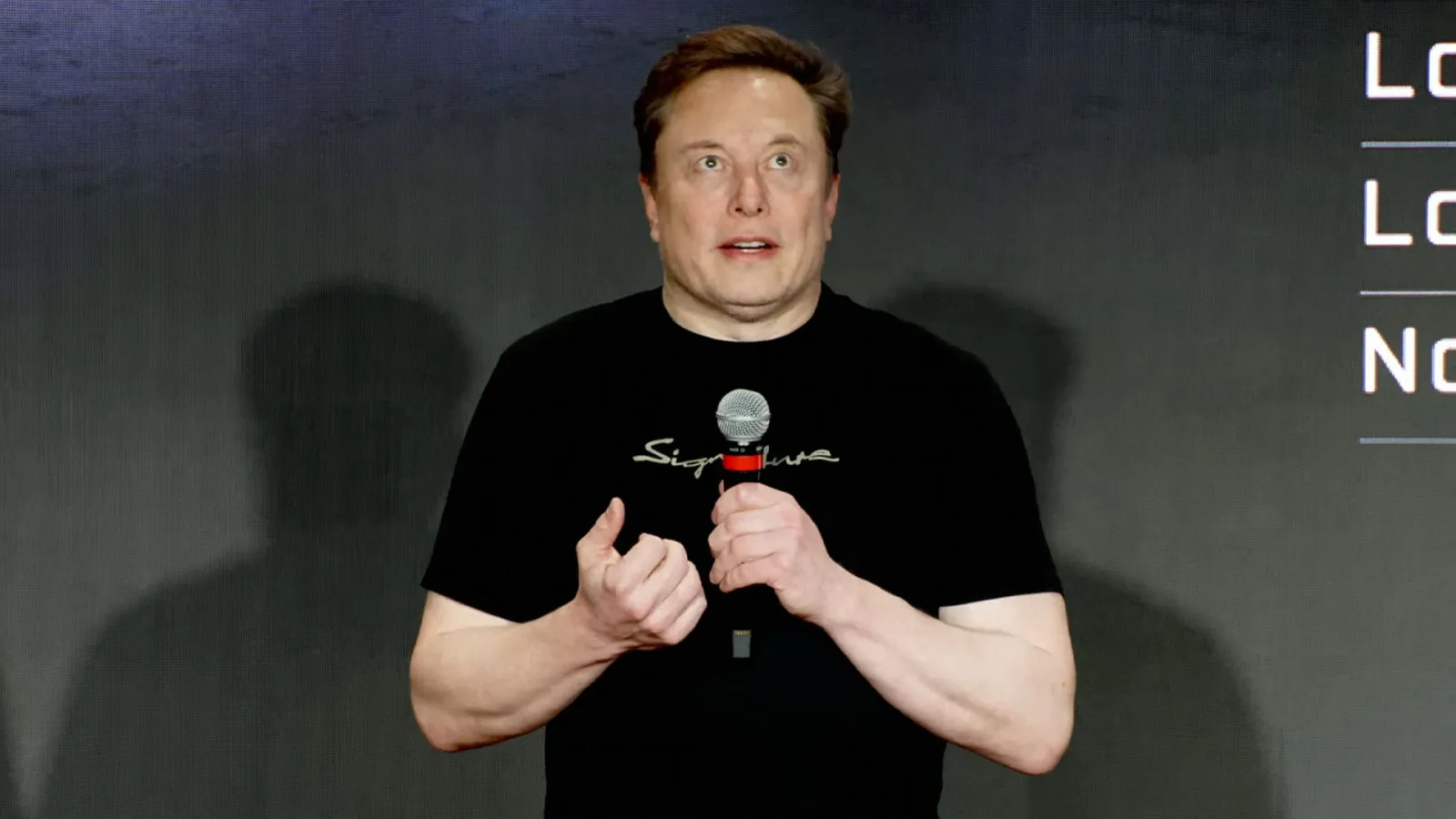
Tesla has completed the design of its next-generation AI5 chip, CEO Elon Musk announced on Wednesday, a critical step in the company’s ambitions to build custom silicon for its autonomous driving and robotics programmes.
“Congrats to the Tesla AI chip design team on taping out AI5!” Musk wrote on X, adding that “AI6, Dojo3 & other exciting chips” are under development.
He shared a photograph of the packaged chip and detailed the new generation in a separate X post.
“A single AI5 has ~5 times the useful compute of a dual SoC AI4,” Musk wrote.
Tapeout is the semiconductor industry term for the final stage of chip design, after which the layout is sent to a foundry for fabrication.
First silicon samples are expected later this year, with high-volume production targeted for mid-2027.
What AI5 Is
AI5 is Tesla‘s custom system-on-chip designed primarily for real-time AI inference in vehicles and the company’s Optimus humanoid robot.
It replaces the current AI4 hardware, which has been installed in Tesla vehicles since early 2023 and was manufactured by Samsung on a 7-nanometre process.
Musk has described AI5 as delivering approximately 8 times the compute power, 9 times the memory, and 5 times the bandwidth of AI4.
He has benchmarked a single AI5 chip as roughly equivalent in inference performance to an Nvidia H100 GPU for Tesla‘s specific workloads, and a dual-chip configuration as comparable to Nvidia’s Blackwell-class processors — but at significantly lower cost and power consumption.
“This will be a very capable chip. Roughly Hopper class as single SoC and Blackwell as dual, but it costs peanuts and uses much less power,” Musk wrote in January.
The chip is optimised for low-precision inference operations — heavy use of INT4, INT2, FP8, and mixed-precision tensor accelerators — and drops legacy hardware blocks for what Musk has called “radical simplicity.”
Total estimated performance for the full AI5 computer is in the range of 2,000 to 2,500 TOPS, compared to approximately 300 to 500 TOPS for AI4.
“Existential” to Tesla
Musk has repeatedly described the AI5 programme as critical to the company’s future.
“Solving AI5 was existential to Tesla, which is why I had to focus both the teams on that chip and I’ve personally spent every Saturday for several months working on it,” he wrote in January.
The chip is central to Tesla‘s strategy of vertical integration in AI — designing both the hardware and the full software stack to maximise efficiency.
“AI5 will punch far above its weight, because the entire Tesla AI software stack is designed to make maximally effective use of every circuit. We co-designed our AI software and hardware,” Musk wrote in March.
He has also framed the chip as superior to third-party alternatives for Tesla‘s purposes: “It will perform — for our purposes — much better than anything else available. To borrow Jensen’s phrase, we wouldn’t use any other chip in our cars and robots even if they were free.”
Manufacturing
AI5 will be dual-sourced at TSMC’s Arizona facility and Samsung’s Texas plant — both US-based — ensuring volume production and supply chain resilience.
Samsung already fabricates AI4 for Tesla and secured a reported $16.5 billion eight-year agreement with the company in July 2025.
Musk has noted that both foundries will produce the same chip design, though the physical implementation will differ due to each foundry’s manufacturing process.
Tesla is also building an in-house fabrication facility called Terafab in Austin, Texas, which will handle higher volumes in the future.
The company has allocated $20 billion in capital expenditure for 2026 to fund Terafab and other non-vehicle projects including the Cybercab robotaxi and Optimus robot.
Production Timeline
Small-batch engineering samples are expected in late 2026, potentially for early Optimus testing or development vehicles.
High-volume production for vehicles is targeted for mid-to-late 2027.
The Cybercab, Tesla‘s dedicated robotaxi scheduled to begin production this month, will launch on the current AI4 hardware rather than waiting for AI5 — a decision driven by the chip’s production timeline.
Musk has outlined an aggressive cadence for future chip generations, targeting a new design reaching volume production roughly every 12 months with a goal of nine-month design cycles.
AI6 tapeout is targeted for December 2026, with AI7 and beyond already in planning.
Impact on Products
Musk has said AI4 alone will “achieve self-driving safety levels very far above human,” while AI5 “will make the cars almost perfect and greatly enhance Optimus.”
The chip enables Tesla to run significantly larger neural network models on-device — critical for the company’s vision-only, end-to-end autonomous driving approach.
Tesla‘s current FSD software runs on a model with approximately one billion parameters; the next-generation version 15 will use a model roughly ten times larger, which AI5 is designed to support.
For Optimus, the chip provides the real-time edge inference needed for humanoid robotics tasks that require rapid processing of sensor data without relying on cloud connectivity.