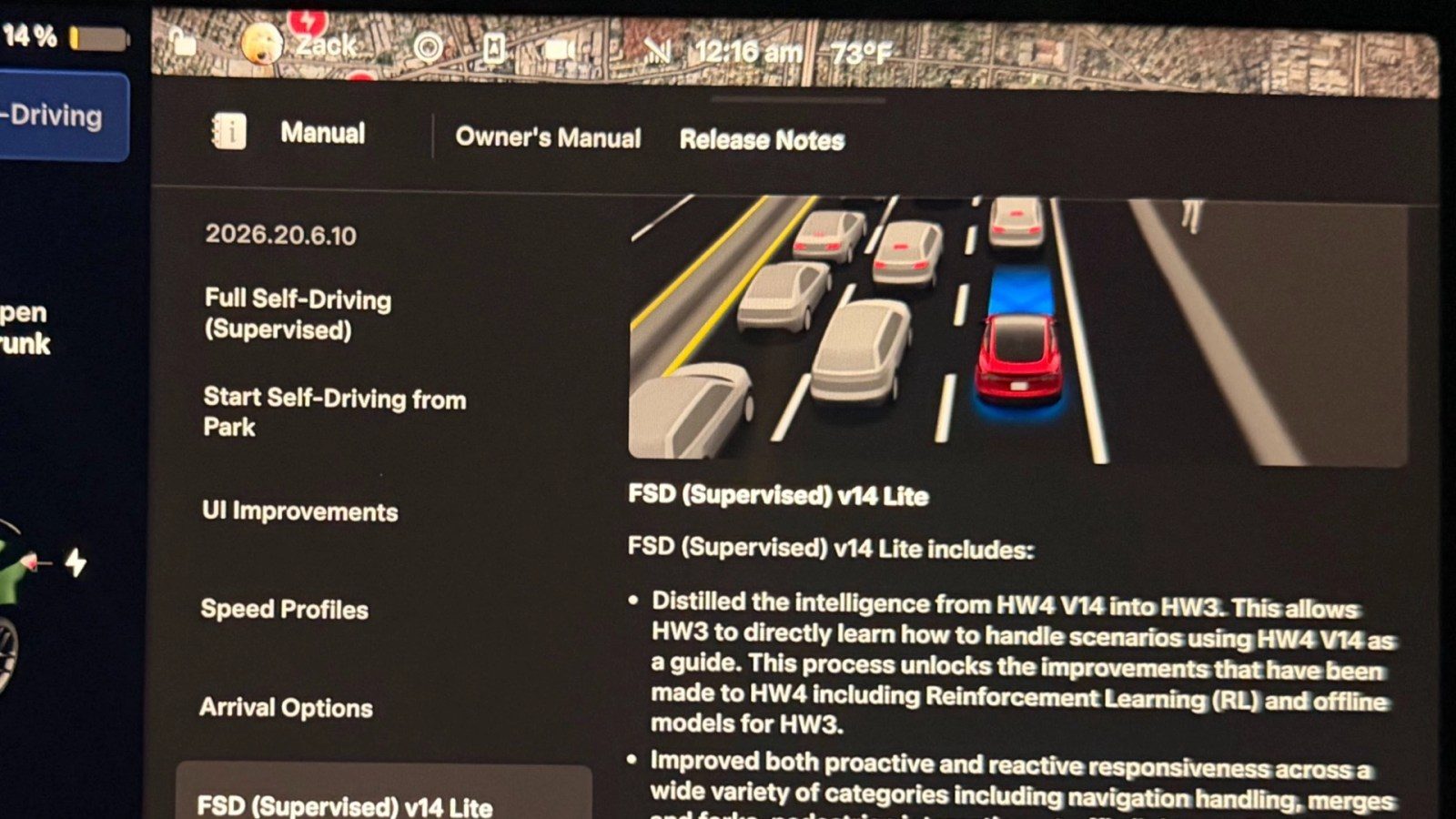

Tesla has begun pushing Full Self-Driving V14 Lite to a wider group of Hardware 3 owners, expanding the software beyond the small early-access pool that had tested it for three weeks.
Ashok Elluswamy, the company’s VP of AI Software, confirmed on X on Sunday that the updated build, software version 2026.20.6.10, is “the version that’s likely going to wide release.”
The wider rollout comes one day before Tesla‘s second-quarter earnings call, scheduled for Wednesday, July 22.
Tesla first shipped FSD V14 Lite to a narrow group of Hardware 3 owners on June 29 under firmware version 2026.20.5.1.
The initial release remained limited to fewer than 0.1% of the fleet while the company gathered feedback.
What 2026.20.6.10 Adds
Release notes for the new build carry the same core driving improvements as the original V14 Lite deployment, but layer on several interface features previously exclusive to Hardware 4 vehicles.
Owners running 2026.20.6.10 gain the ability to start FSD directly from park without pressing the brake pedal, a change that matches the behavior on the full V14 branch.
A new Self-Driving Stats display shows intervention-free driving data when FSD is engaged, alongside a streak counter that tracks consecutive miles driven without driver takeover.
Early tester Zack — X user ‘BLKMDL3,’ whose detailed review Elluswamy shared — logged a 100-mile intervention-free streak.
Parking and destination interfaces also received an overhaul.
Approaching-destination alerts now surface an Arrival Options tab matching the Hardware 4 layout, letting drivers choose whether FSD parks in a lot, on the street, in a driveway or at the curb.
Speed Profiles, which let owners adjust driving style between settings ranging from conservative to aggressive, remain available at all times.
The underlying driving stack carries the same V14 Lite architecture Tesla introduced in late June: a distillation of the Hardware 4 version of V14 into the older computer.
The process allows Hardware 3 to learn how to handle scenarios using Hardware 4 V14 as a guide, unlocking reinforcement learning and offline model improvements that had been developed exclusively on the newer chip.
Improvements span navigation handling, merges and forks, pedestrian interactions, traffic lights and vehicle cut-in scenarios, according to the release notes.
Comfort gains include fewer false slowdowns, smoother steering and more consistent lane centering.
Rollout Timeline
Tesla‘s FSD V14 Lite deployment has moved in stages.
Elluswamy first announced the rollout on June 29, describing the initial 2026.20.5.1 build as going to “AI3 early-access customers” with a broader push planned over the following weeks.
For three weeks the software stayed within that narrow testing pool.
By then, software-tracking platforms TeslaFi and Tessie showed fewer than 0.1% of the fleet receiving the update during that stretch, and Tesla issued no further updates on the timeline.
South Korea became the first market outside the United States to receive V14 Lite on July 10, with Tesla Korea pushing the build to eligible Hardware 3 vehicles sequentially.
Only US-built Model 3 and Model Y units already subscribed to or owning FSD qualified for the Korean rollout.
In Europe, Hardware 3 owners face a longer wait.
Tesla won its first FSD (Supervised) approval in the Netherlands in April for a Hardware 4 build, and any V14 Lite deployment on the continent would need to clear its own regulatory review.
Elluswamy’s Sunday confirmation that 2026.20.6.10 is the wide-release build, followed by its expansion beyond the early-access group, marks the first broad deployment of V14 Lite across the roughly four million Hardware 3 vehicles worldwide.
A Hard Ceiling Remains
V14 Lite narrows the gap between older and newer Tesla vehicles but does not eliminate a fundamental constraint.
At Tesla‘s first-quarter earnings call on April 22, CEO Elon Musk confirmed that Hardware 3 cannot achieve unsupervised Full Self-Driving.
Musk attributed the shortfall to memory bandwidth roughly one-eighth that of Hardware 4, the generation Tesla began fitting in January 2023.
FSD V14 Lite remains a supervised, hands-on Level 2 system.
Hardware 3 owners who paid as much as $15,000 for FSD still cannot access the unsupervised capability that Tesla has been running in its expanding Robotaxi service across several Texas cities — and, more recently, Miami.
For those seeking unsupervised capability, Tesla outlined two paths on the April call: a discounted trade-in toward a Hardware 4 vehicle, or a paid retrofit swapping the computer, cameras and wiring harness.
Shareholder Pressure
Hardware 3 and FSD remain among the most closely watched issues heading into Wednesday’s call.
On the Say Technologies platform, where retail investors submit and vote on questions for management, two of the highest-ranked entries as of Monday morning focused squarely on the topic.
One question, backed by 221 votes representing 448,800 Tesla shares, asked when owners can expect unsupervised FSD with point-to-point summon capability.
A second, with 219 votes and 396,900 shares represented, pressed Tesla on the plan for Hardware 3 owners who paid for FSD, asking whether they would receive free hardware upgrades, transfers or refunds, what the timeline would be, and what cost Tesla has accrued.
Both questions ranked 11th and 12th on the platform, with the top 10 most-voted entries focused on other autonomy projects including Optimus and Cybercab, as well as Terafab and SpaceX.
Tesla has previously faced pointed shareholder questions on the topic.
Ahead of the Q1 call, the question of how Hardware 3 cars would reach unsupervised FSD topped the retail investor list.