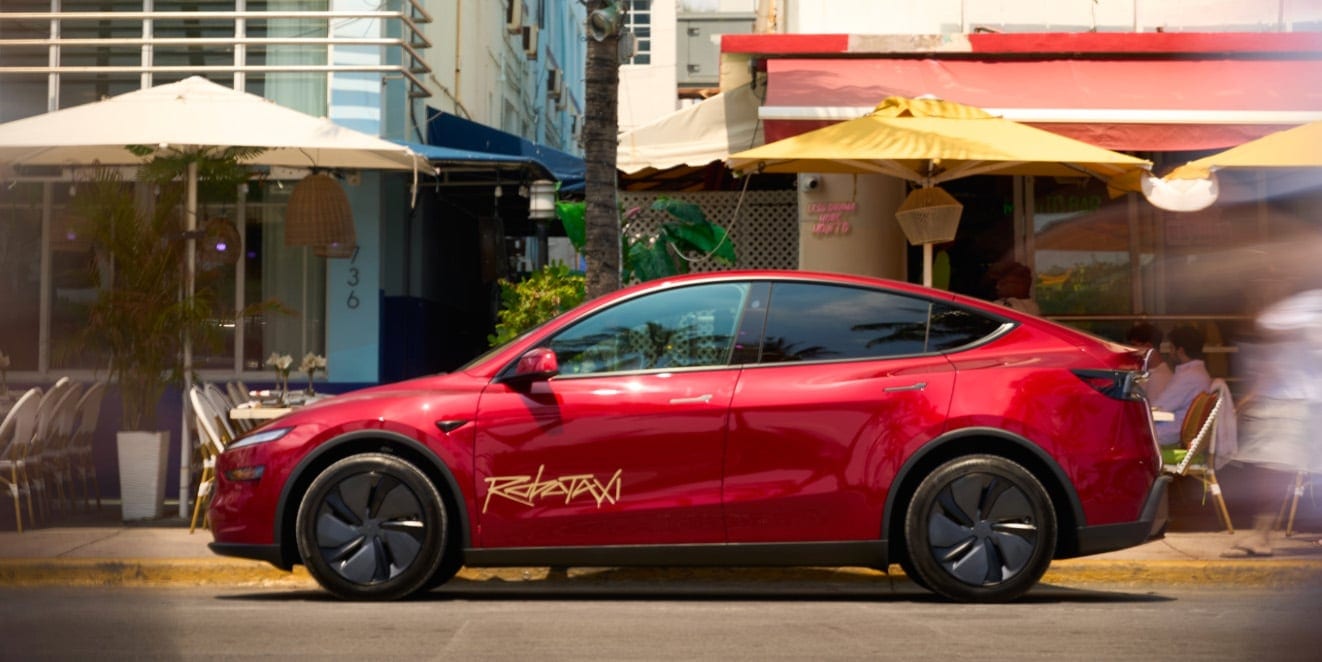

Tesla launched its robotaxi service in Miami on Friday, extending the autonomous ride-hailing programme to a third state and opening the first of five cities whose rollout had slipped past the company’s own first-half deadline.
The company’s official robotaxi account announced the launch on X on Friday afternoon, with the message “Robotaxi now available in Miami” and a map of the service area.
The geofenced zone spans across the western Miami-Dade area, taking in West Miami, Doral and Coral Gables rather than the full city or Miami Beach.
Miami is Tesla‘s first robotaxi market outside Texas and the San Francisco Bay Area, and its arrival three days into the second half of the year marks the first opening in a backlog of delayed launches, though it lands months after the timeline the company set in January.
Tesla did not say whether the Miami vehicles carry a safety monitor.
Florida law permits fully driverless operation provided a vehicle meets federal standards, but the company has opened earlier markets with an in-car monitor before removing it, and Coral Gables fire crews completed emergency-response training with Tesla days before the launch.
The launch is a real milestone for a program whose reach has trailed its promises.
More than a year after its debut, the service runs without a human on board in three Texas cities, has entered commerce with a purpose-built vehicle, and sits at the center of how Wall Street values the company, yet it remains a small, geographically narrow operation whose deployed fleet numbers in the dozens, far short of the nationwide rollout Chief Executive Elon Musk has repeatedly promised.
Where It Runs Today
Tesla launched the service in Austin on June 22, 2025, with roughly 10 modified Model Y vehicles, each carrying a safety monitor in the front passenger seat.
The operation has advanced in steps since. The company began driverless employee trips in Austin in December, started removing safety monitors from some customer rides in January, and in early June stretched the unsupervised Austin service across the entire metro area, where riders can now hail a driverless Model Y.
The expansion followed a Texas driverless-vehicle law that took effect on May 28, alongside Tesla‘s same-day self-certification to operate at Level 4, meaning no human oversight.
Tesla extended the service beyond Austin in April, launching unsupervised rides in Dallas and Houston, its first markets outside the Texas capital and the San Francisco Bay Area. The company operates in Texas under a transportation-network-company permit valid through August 2026.
The Bay Area operation is different in kind. C
alifornia law bars driverless ride-hailing without permits Tesla has not applied for, so the service there runs with a safety driver behind the wheel under a state charter-permit designation, making it a human-driven taxi rather than a robotaxi. The company had registered more than 1,600 vehicles for ride-hailing in the state by late 2025, a far larger footprint than its driverless Texas fleet.
Friday’s Miami launch adds a fourth metropolitan market and pushes the service into Florida, whose autonomous-vehicle rules are among the most permissive in the country, though the size of the initial fleet and whether it runs supervised were not disclosed.
The Expansion That Slipped
At its fourth-quarter earnings call on January 28, Tesla laid out its most aggressive plan yet: robotaxi service in seven new cities during the first half of 2026, adding Dallas, Houston, Phoenix, Miami, Orlando, Tampa and Las Vegas.
Only Dallas and Houston opened during the first half. When the company reported first-quarter results in April, its investor deck quietly changed the status of the other five cities from a firm “1H 2026” timeline to the vaguer “preparations underway,” a shift Electrek read as the company pushing those launches back.
The first half ended in June with all five still closed to the public, until Friday’s Miami launch made it the first of the group to open, days into the second half.
Arizona had looked furthest along before Miami. Around 60 robotaxi-configured Model Ys were staged in a Phoenix parking lot in April, the state granted Tesla ride-hailing approval in late 2025, and the company recently filed a first-responder interaction plan naming nine cities across the Phoenix metro.
Tesla has also filed for private, robotaxi-only Supercharger stations in Arizona. Las Vegas, Orlando and Tampa have seen staging and marketing but no confirmed service.
Fleet Reality Versus Ambition
The clearest illustration of the program’s state is the distance between its coverage and its cars.
When Tesla ramped its unsupervised fleet to 25 vehicles across the three Texas cities in late April, Austin accounted for 19, with Dallas and Houston running three each.
Even after the June expansion blanketed the whole Austin metro, independent trackers estimated only around 20 vehicles actually operating across that zone, even as Reuters reported the company had registered on the order of 50 to 100 Model Ys for the service in Texas by early July, a registered-versus-running gap that runs throughout the program.
Those figures sit against a run of missed targets.
Musk said in October 2025 he expected 500 robotaxis in Austin and more than 1,000 in the Bay Area by year end; the actual counts were roughly 42 and 130, most still carrying safety monitors.
Morgan Stanley said earlier this year that it projects Tesla will operate 1,000 robotaxis by the end of 2026, and Musk has said he expects the service to reach a quarter to half of the US population by then, an echo of a similar claim for the end of 2025 that did not materialize.
The company points to momentum in usage rather than fleet size, reporting that paid robotaxi miles nearly doubled quarter-over-quarter in the first quarter, building on close to 700,000 paid rides logged by late January.
The Cybercab
The vehicle meant to scale the network is the Cybercab, a two-seat model with no steering wheel or pedals designed solely for autonomous use.
The first production unit rolled off the Giga Texas line in February, and by April drone footage showed Tesla had shifted to steering-wheel-free builds.
The model secured a US Environmental Protection Agency certificate listing an introduction-into-commerce date of May 29, meaning it has officially entered the market, and the filing revealed its specifications for the first time: a 3,113-pound curb weight, a single front motor rated at 219 horsepower, and a usable battery of roughly 48 kilowatt-hours.
The filing lists a combined range of 418 miles, but that is an unadjusted laboratory figure; after the EPA’s standard downward adjustment it corresponds to about 293 miles, close to the roughly 300 miles Tesla has claimed.
At a certified 165 watt-hours per mile, the Cybercab is among the most efficient production vehicles yet certified, drawing that range from a pack smaller than those in most mainstream electric cars.
Tesla targets annual Cybercab output of at least 2 million units at a price below $30,000, using an “unboxed” manufacturing method it says can eventually build a unit every 10 seconds, with an operating cost near 20 to 30 cents per mile.
The company has not said when it will offer the first public rides in a Cybercab; the network today runs entirely on modified Model Y vehicles.
Production Cybercabs have begun testing autonomously on public roads in Austin, and more than 150 have been spotted staged at Texas lots, though no jurisdiction has yet approved the vehicle for driverless operation and none carry paying passengers.
Tesla‘s vehicle-engineering chief Lars Moravy has teased an announcement about Giga Texas scaling for July 7, which may bear on the ramp.
Safety and Regulation
The service has drawn regulatory scrutiny since its debut.
The National Highway Traffic Safety Administration opened an inquiry in June 2025 after online videos showed Austin robotaxis driving on the wrong side of the road, braking without cause, and stopping in intersections, and Tesla has reported a handful of incidents to the agency, which by the company’s own account amounted to roughly one crash per 312,500 miles.
The legal ground is shifting as the fleet grows.
Texas cleared driverless operation in late May, while California’s motor-vehicle regulator adopted rules effective July 1 allowing police to issue notices of noncompliance to autonomous vehicles that break traffic laws, closing a gap that had left driverless cars largely beyond enforcement.