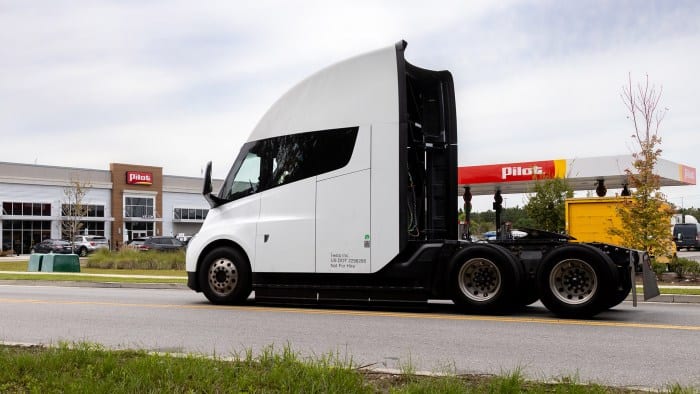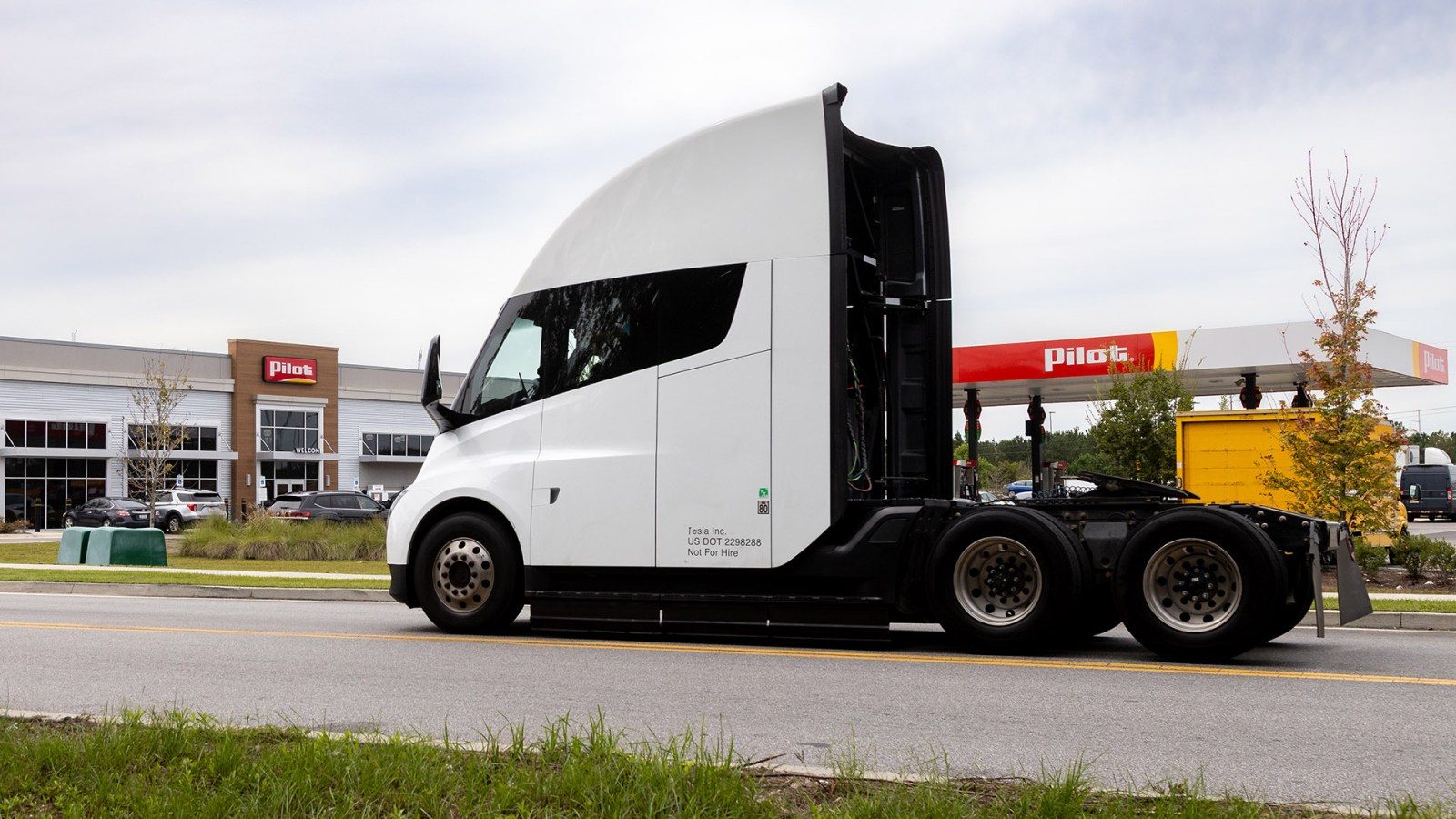

Tesla and Pilot have opened their first Megacharger site for the Tesla Semi at a Pilot travel center in Ellabell, Georgia, starting a heavy-duty truck charging network that Pilot had expected to launch in the summer.
The site, at Pilot #1390 on Interstate Exchange Way, has six charging stalls, Pilot said on Thursday.
Twelve more heavy-duty charging locations are under construction, and three of them are near completion, the Knoxville, Tennessee-based travel center operator said.
The Flying J travel center in Tulare, California, is scheduled to open on Friday, October 9.
The Flying J in Fort Stockton, Texas, and the Pilot in North Las Vegas, Nevada, are expected to come online soon, Pilot said, without announcing concrete dates.
Each location will have four to eight stalls using Tesla’s V4 cabinet technology. Each stall can deliver up to 1.2 megawatts, allowing a Semi to recover 60% of its charge in 30 minutes, according to Tesla.
“Pilot is proud to bring heavy-duty charging directly to key trucking routes and pair it with the services and amenities drivers rely on,” said Shannon Sturgil, Senior Vice President of Alternative Fuels at Pilot, which describes itself as the largest travel center network in North America.
“With these initial locations, we’re making fleet electrification a more accessible option for long-haul transportation and are excited to continue working with Tesla to move at the pace and preference of our customers,” he added.
Later Than Planned
Pilot announced the partnership on January 27, saying construction would begin in the first half of 2026 and that the first sites were expected to open in summer 2026.
Sturgil said at the time that Pilot was “happy to partner with a leader in the space that provides turnkey solutions and deploys them quickly.”
The first site opened in October.
The list of states has also changed. In January, Pilot named California, Georgia, Nevada, New Mexico and Texas as the states where the chargers were planned.
Thursday’s release names California, Georgia, Indiana, Nevada and Texas, and no longer mentions New Mexico.
Neither release explains the change.
In January, Pilot said the network would initially focus on Tesla’s Semi and could later be expanded to heavy-duty electric trucks from other manufacturers.
Thursday’s release says the network is designed to support heavy-duty electric trucks along major US freight corridors, without naming any other truck makers.
Pilot also said in January that, according to Tesla, most of the Semi’s 500-mile range can be recovered in a 30-minute session, matching the mandated break period for professional drivers.
Where the Sites Are
The Ellabell travel center sits at Exit 143 on Interstate 16, west of Savannah, according to Pilot’s location listing.
Ellabell is also home to Hyundai Motor Group’s Metaplant America EV factory.
The Tulare Flying J is at Exit 85 on California State Route 99, the Fort Stockton Flying J at Exit 259 on Interstate 10 and the North Las Vegas Pilot at Exit 48 on Interstate 15, according to Pilot’s listings.
Of the three sites due next, only Fort Stockton sits on one of the two corridors named in both releases.
Second Georgia Site in Two Days
The Ellabell opening came a day after Tesla opened its first Megacharger on the East Coast, an eight-stall site in Conley, near Atlanta.
Tesla’s charging account announced Conley on X on the evening of October 7, US Eastern time.
Tesla’s Semi account called it the “First Megacharger on the East Coast.”
Tesla’s first customer-facing Megacharger opened in Ontario, California, in March, according to Electrive.
Tesla’s charging account announced six-stall Megachargers in Bloomington, California, in July and in Vernon, California, in August.
In September, Tesla said it had deployed its first pre-assembled Megachargers, each a V4 cabinet with two posts delivering up to 1.2 megawatts per post.
Semi Ramp
The network is opening as Tesla begins to scale up Semi production.
Tesla launched high-volume production of the truck at a dedicated factory in Sparks, Nevada, on September 24, nearly nine years after unveiling it.
The company delivered its first hand-built units to PepsiCo in December 2022.
Filings with the California Air Resources Board put the battery capacity of the two Semi versions at 822 kilowatt-hours and 548 kilowatt-hours.
IMC Logistics, a marine drayage operator, ordered 50 Semis at the Intermodal EXPO in Long Beach, California, in September.
Einride placed a 500-truck order for Amazon freight in August, and WattEV ordered 370 trucks in May.
In Europe, where Tesla plans to start Semi deliveries in 2027, the company has said it plans more than 100 Megacharger stalls.
Pilot said the truck charging network adds to its existing work on a coast-to-coast passenger EV charging network and on lower-carbon fuels such as renewable diesel and biodiesel.