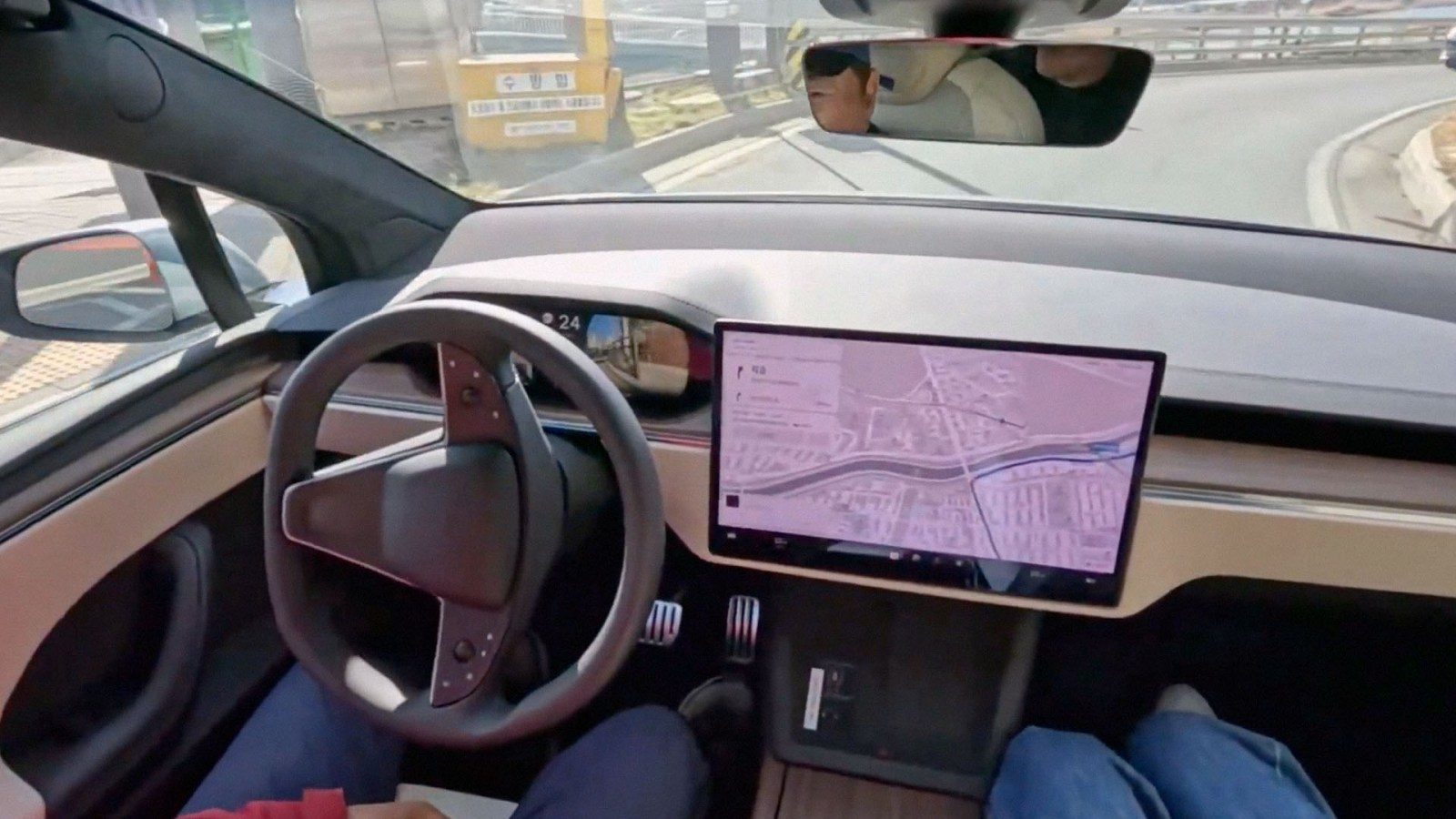

Tesla Korea began rolling out Full Self-Driving (Supervised) V14 Lite on Friday, extending the Hardware 3 (HW3) update to eligible vehicles in the country — roughly two weeks after the software started reaching US owners.
The company said the update is being pushed out sequentially by vehicle, with application timing varying from car to car.
Friday’s release is limited to a narrow slice of the local fleet — as only US-built Model 3 and Model Y vehicles running HW3, and already subscribed to or owning FSD (Supervised) — qualify for the update.
The company’s flagship Model S and Model X were fully built in the US (until production stopped by March 31), unlike the cheaper models, which are also manufactured at GigaShanghai.
Tesla has not clarified if the new software is rolling out to any S/X eqquiped with the HW3 computer.
What V14 Lite Delivers
The Elon Musk-led company began the same rollout in the United States on June 29, pushing the build to a first wave of Hardware 3 owners.
Tesla has described V14 Lite as distilling the driving behavior of the Hardware 4 version of V14 into the older computer, rather than shipping a stripped-down feature set.
The process carries improvements developed on Hardware 4 over to the roughly four million-strong legacy fleet, including reinforcement learning and offline-trained models, according to Tesla‘s release notes.
Tesla‘s latest FSD version sharpens navigation, merges and forks, pedestrian interactions, traffic lights and cut-in handling, the company has said.
Comfort gains include fewer false slowdowns, smoother steering and steadier lane centering, alongside new parking, unparking and reversing functions.
Drivers also gain Arrival Options, letting them choose whether the car parks in a lot, on the street, in a driveway or at the curb, plus Speed Profiles available at all times.
A Hard Ceiling for Hardware 3
Tesla has been explicit that the update does not close the gap entirely.
At the company’s first-quarter earnings call in April, executives confirmed the roughly four million Hardware 3 vehicles worldwide cannot reach unsupervised FSD, a limitation CEO Elon Musk attributed to memory bandwidth roughly one-eighth that of Hardware 4.
For owners who want unsupervised capability, Tesla has pointed to two paths: a discounted trade-in toward a car already fitted with AI4 hardware, or a future paid retrofit that swaps the computer, cameras and wiring harness.
Reporting has pegged the retrofit as unlikely to reach production before mid-2027.
South Korean Hardware 3 owners had been frozen on FSD version 12.6 since early 2025, making V14 Lite their first significant capability update in more than a year.
Purchase Terms Set to Change
Tesla has also notified customers that the purchase structure for FSD (Supervised) and Enhanced Autopilot is scheduled to change starting August 10.
The company said lump-sum, one-time purchases of FSD (Supervised) will remain tied to the specific vehicle they are bought for, distinguishing that payment structure from a subscription option.
Tesla cautioned that the details are not final.
Actual implementation timing, scope, pricing and conditions may still shift depending on policy finalization and system readiness.
FSD (Supervised) remains available only on certain eligible vehicles rather than the full lineup.
According to Tesla, the South Korean rollout of V14 Lite will continue sequentially over the coming weeks, following the same vehicle-by-vehicle pattern used in the US launch.
Sales Context
The software rollout lands during Tesla’s strongest sales stretch yet in South Korea.
The company registered 11,119 vehicles in the country in June, a 74% increase from a year earlier, according to data from the Korea Automobile Importers & Distributors Association (KAIDA).
The figures pushed second-quarter sales to 35,175 units, Tesla‘s best quarter on record in the country and a 144% jump from the same period in 2025.
First-half registrations reached 56,139 units, giving Tesla a 30.5% share of South Korea’s imported passenger car market and making it the country’s best-selling overseas brand, ahead of BMW‘s 21.3% share and Mercedes-Benz‘s 16.2%.
June marked Tesla‘s third straight month above 10,000 units in the country, following an April record of 13,190 vehicles.
The six-seat Model Y L, which only went on sale in Korea in early April, was the best-selling imported vehicle in June with 5,155 units.
Tesla raised prices across its Model 3 and Model Y lineup in Korea by up to 7 million won ($4,500) on July 1, a day after the government confirmed the company had passed its national EV subsidy eligibility evaluation.
The same review cycle excluded BYD from the subsidy program for the second half of 2026.