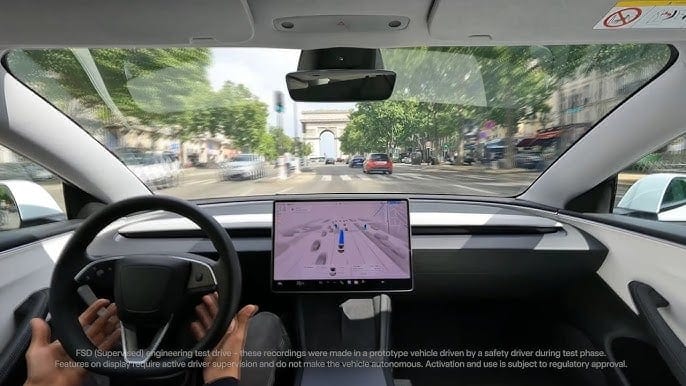

France’s Transport Minister Philippe Tabarot laid out the government’s case against authorizing Tesla‘s Full Self-Driving (Supervised) system on Wednesday, citing speeding behavior and insufficient driver-monitoring safeguards as the main barriers to approval.
“In France, we consider that this system brings a number of technological advances, but that the safety trade-offs are not yet sufficient to authorize it as it currently stands,” Tabarot said in a video statement.
The response landed on the same day Tesla reports second-quarter earnings results.
France becomes the first major European economy to detail its specific objections to FSD through a cabinet-level statement, after months of deferrals to the European Commission’s Article 39 review process.
FSD’s European expansion has been central to the company’s growth narrative in the region, where registrations have surged — France itself posted 7,474 units in June, a 105% year-over-year increase and a new monthly record.
Tesla‘s global FSD subscription base stood at 1.28 million at the end of Q1 2026, representing roughly 14% of its 9.2 million-vehicle fleet.
France’s ride-along program, originally launched in late November 2025 alongside Germany and Italy, has been extended through September 30.
Traffic Code Violations
The minister’s first objection targeted the system’s handling of speed limits.
“We’ve found that the system allows for speeding,” Tabarot said. “If it detects that surrounding vehicles are going faster, it can — in plain terms — drive at 70 km/h instead of 50 if traffic is moving at that speed, and without the driver explicitly requesting it.”
Tabarot added that “in some cases, a vehicle can end up going as much as 50% above the speed limit,” concluding bluntly: “So the traffic code isn’t being respected.”
The concern mirrors objections raised by Sweden’s Transport Administration, which formally recommended a vote against FSD at EU level unless Tesla removes the Speed Offset feature.
Denmark’s road traffic authority raised similar questions about speed-limit handling during its own review before ultimately approving the system on June 9.
Tesla‘s Speed Offset function adjusts the vehicle’s cruising speed relative to the flow of traffic and has been one of the most contested features in the European regulatory debate.
France’s highway code, like those of most EU member states, does not permit exceeding posted limits regardless of ambient traffic speed.
Driver Attention in Urban Settings
Tabarot identified a second concern around driver monitoring.
“According to the data we have, the system doesn’t guarantee an optimal level of driver attention in urban settings and during the most complex maneuvers, such as lane changes, intersections, or roundabouts,” he said.
The stakes are high, the minister warned: “A lapse in attention can have very serious consequences, both for people outside the vehicle and for its occupants.”
He reminded viewers that “even when the driving aid is activated, the driver remains criminally liable in the event of an accident.”
France’s Centre National de Réception des Véhicules (CNRV) had previously communicated a similar position to Tesla owners, telling them the system does not fully comply with UN Regulation No. 171 because it permits system-initiated maneuvers in urban environments.
Tabarot’s statement elevates that technical assessment to a ministerial-level position for the first time.
Not Isolated, Tabarot Says
The minister noted that “several other European countries share these reservations about the system’s safety level, so our position is not an isolated one.”
He did not name any of these countries, however.
Sweden has been the most vocal, with its Transport Agency expressing surprise that Tesla allowed FSD to exceed speed limits.
Italy’s Transport Ministry has said it will wait for EU-level discussions to conclude.
The European Transport Safety Council sent letters to transport ministers across nearly all member states in June, calling on them to withhold recognition until safety questions are answered independently.
Five countries have approved FSD since April: the Netherlands, Lithuania, Estonia, Denmark, and Belgium.
European customers have driven more than 50 million kilometers on the software in roughly three months.
Tabarot noted that the Netherlands “decided to depart from the international and European regulatory framework and authorize its use on Dutch territory,” language that frames the Dutch decision as an exception rather than a precedent.
EU-wide authorization requires a qualified-majority vote at the Technical Committee on Motor Vehicles, where at least 15 of the 27 member states representing 65% of the bloc’s population must vote in favor.
Germany, France, and Italy together carry enough demographic weight to shape the outcome, and none has moved to approve FSD nationally.
The June 30 TCMV meeting produced discussion but no vote, pushing the next opportunity to October 2026.
Technical Talks Continue
Tabarot disclosed that a representative from the Ministry of Transport traveled to the Netherlands last week for technical discussions with the Dutch authority.
“We’re currently continuing our technical discussions with the Netherlands, other European states, and Tesla to refine our analysis,” he stated.
The minister added that “France supports these technologies, and their deployment must happen within a framework of trust that allows us to evaluate the systems and determine what adjustments FSD needs to guarantee a high level of safety.”
Additionally, France has granted exemptions in the past for advanced driving-assistance systems that met its safety requirements.
“This was the case, for example, with Ford and, more recently, BMW,” Tabarot said.
Ford‘s BlueCruise and BMW‘s Motorway Assistant both received EU-wide Article 39 exemptions through the TCMV in early 2024, allowing hands-free highway driving across the bloc.
BMW later secured full international approval under UN Regulation 171 for its Neue Klasse iX3 in late 2025, removing the need for case-by-case exemptions.
Ford‘s and BMW‘s systems operate on highways with clear highway-only operational design domains.
FSD is designed to function in all driving environments, including dense urban settings with pedestrians, cyclists, intersections, and roundabouts.
“Driving assistance systems as advanced as Tesla‘s are new because they’re designed to work in all driving environments, including cities, where situations are particularly complex,” Tabarot said. “So it’s only normal that we take the time to properly evaluate them, in order to protect both the driver and all road users.”