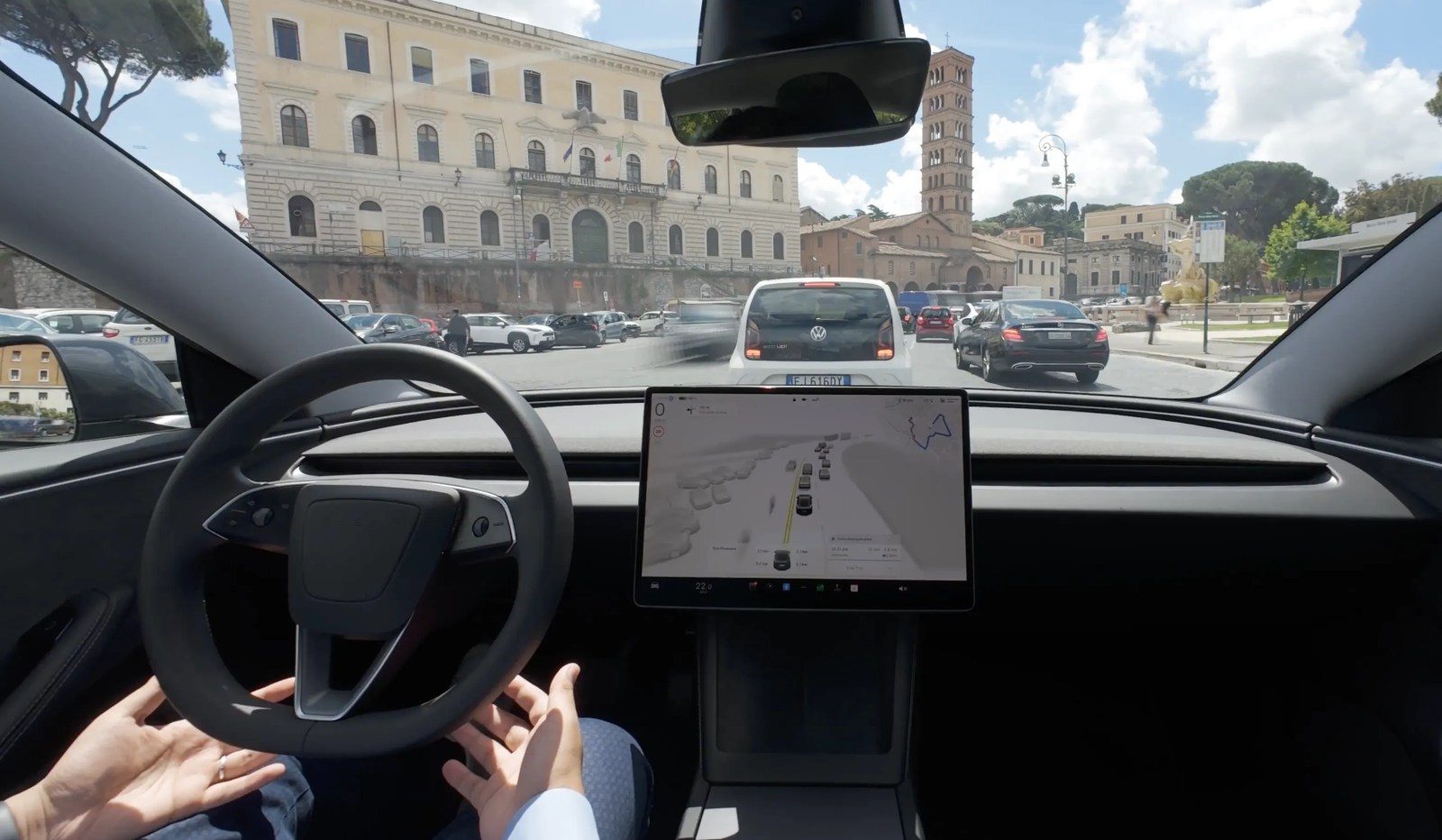

Tesla‘s Full Self-Driving (Supervised) software is expected to be discussed by the European Union next month, after it was formally approved by the Dutch regulator RDW last Friday.
The Netherlands became the first country in Europe to allow Tesla owners to use the assisted-driving system in the continent, though still limited to the Dutch territory.
RDW typically sets the framework that other EU countries follow, a process expected to expand approval of the software across Europe in the coming months.
The authority granted the type approval after more than 18 months of testing on its own track and on public roads.
Throughout that time, Tesla completed over 1.6 million kilometres of test drives with FSD Supervised in Europe, including demonstration rides with around 13,000 customers.
Tesla‘s European account has recently stated that it anticipates “a possible EU-wide approval during the summer,” while the European Commission has not committed to a timeline.
In posts made over the weekend, CEO Elon Musk and the company’s vice president of AI software Ashok Elluswamy suggested the Dutch approval could open the way for countries beyond Europe to authorise the system.
“The European regulation is followed by a lot more countries than just the ones in EU,” Elluswamy wrote on X, replying to a user who said the list of FSD countries was about to increase.
Non-EU countries including the United Kingdom, Norway, Switzerland, Turkey and several Balkan states follow UN-ECE vehicle regulations — the same framework under which the RDW issued its type approval.
FSD in the Netherlands
Tesla began pushing the software to customer vehicles in the Netherlands just one day after the RDW issued its approval, with Dutch owner ‘KRoelandschap’ among the first to receive software update 2026.3.6.
FSD Supervised is priced at €99 per month in the Netherlands, with a reduced rate of €49 per month for owners who previously purchased Enhanced Autopilot.
Over the past three days, Dutch owners have begun testing the software across the country, putting it through stress tests on narrow roads that are also designed to be shared with cyclists and pedestrians.
Italy Defers to Brussels
Tesla enthusiasts and owners have been contacting regulators and government bodies across Europe seeking clarity on approval in their own countries — as has been the case in Italy and Ireland.
X user ‘antlopang’ shared on Tuesday that he had contacted the Italian Ministry of Infrastructure and Transport to ask about the status of FSD in the country.
The ministry told Antonio Lopez that Italy is not taking any decision on FSD until the upcoming EU meeting and discussions have concluded.
In an e-mail reply, the Ministry said that “provisional type-approval has national validity and it is at the discretion of each individual Member State to decide whether to accept such type-approval on its own territory.”
According to an executive at the government body, “no decision has yet been taken at the European level as provided for in the month of May, when a joint analysis of the proposed solution will be carried out by the Commission and the Member States.”
Meloni-Musk Ties
The ministry’s wait-and-see stance comes despite the good relationship between Tesla‘s CEO Elon Musk and Italian Prime Minister Giorgia Meloni, which dates back to her election in 2022.
Musk visited Meloni at Palazzo Chigi, Italy’s official prime ministerial residence, with both expressing mutual admiration.
The Italian PM has defended Musk publicly, calling him a “genius” and pushing back against critics who have labelled him for his political views.
Meloni referred to Musk as a “friend” in 2025 when she posted a video of the two together at the White House during her meeting with US President Donald Trump.
Other Markets’ Status
Irish Tesla owners have also been contacting government members in Dublin to ask about FSD availability, but have so far received no response.
Ireland is one of the European markets where Tesla has been preparing the ground for a potential rollout.
The company previously posted a listing for a vehicle operator role in Dublin, likely in connection with self-driving testing.
The Dublin job is part of a broader European hiring spree for vehicle operator roles across the continent, which has spanned cities including Prague, Budapest, Berlin, Prüm, Paris, Lisbon and Ljubljana.
The company offered test rides of FSD across European cities over the past months, with safety drivers inside the vehicle.
Belgium is another market being closely watched.
The software currently deployed on Dutch roads is geo-fenced to the country’s borders, and vehicles alert the driver that FSD will become unavailable when approaching the boundary with Belgium or Germany.
The feature cannot be activated outside the Netherlands, where the type approval is currently valid.
Neighbouring markets could be among the first to recognise the Dutch approval on their own territory, given the cross-border traffic with the Netherlands and the shared regulatory framework under UN-ECE rules.
EU Regulation
The Technical Committee on Motor Vehicles (TCMV) has scheduled two meetings in the coming months, with the first set for 5 May and a second by 30 June.
The approval of self-driving software in the EU is governed by Regulation (EU) 2018/858, the main framework law that determines how cars and their software systems are officially type-approved before being sold or used across the bloc.
It replaced the older Directive 2007/46/EC in 2020 and covers safety, environmental standards, and market surveillance.
Every new vehicle or major system update, including advanced driver-assistance software, requires this approval.
The matter in question falls under the procedure set out in Article 39, which covers derogations for new technologies or new concepts.
Normal type-approval rules, listed in Annex II of the regulation, assume traditional, rule-based driver-assistance systems.
FSD Supervised is an AI-based, probabilistic system that does not fit neatly into those rules, including specific requirements on steering, driver monitoring, and automated lane changes under UN regulations such as R79 or R171.
Article 39 allows exemptions for new technologies that are incompatible with existing rules, provided three conditions are met.
The manufacturer must explain why the new technology does not comply, it must demonstrate that safety, and environmental protection are at least equivalent to what the standard rules require.
The approval authority must be satisfied with the evidence, including testing and risk assessment.
The Role of the TCMV
RDW has already notified the Commission that it will present Tesla‘s Article 39 file in May, which coincides with the upcoming TCMV meeting.
The TCMV is the committee where representatives of all 27 EU Member States advise the European Commission on the technical implementation of vehicle legislation.
It operates under the comitology procedure, a formal voting and consultation mechanism.
For the EU-wide rollout of FSD Supervised, the process under Article 39 works as follows.
After the national authority grants the provisional approval, it informs the Commission and all other Member States.
The Commission then prepares an implementing act that would authorise the Netherlands to convert the provisional approval into a full EU-wide type-approval.
The TCMV then meets to examine the file, hear the Dutch presentation of the evidence — including test results and safety data — and deliver its opinion through a majority vote.
If the TCMV gives a positive opinion, or raises no objection, the Commission adopts the implementing act and FSD Supervised becomes legally usable in all 27 Member States with a single software update.
The May 5 meeting is the key presentation and vote step, while the June 30 session is likely to handle any follow-up or final clearance.
While individual EU member states can also recognise the Dutch approval on their own territory before the bloc-wide vote takes place, most are likely to be cautious and wait for the meeting, as Italy is doing.
FSD (Supervised) is currently available in the United States, Canada, Mexico, Puerto Rico, Australia, New Zealand, South Korea, and in the Netherlands.