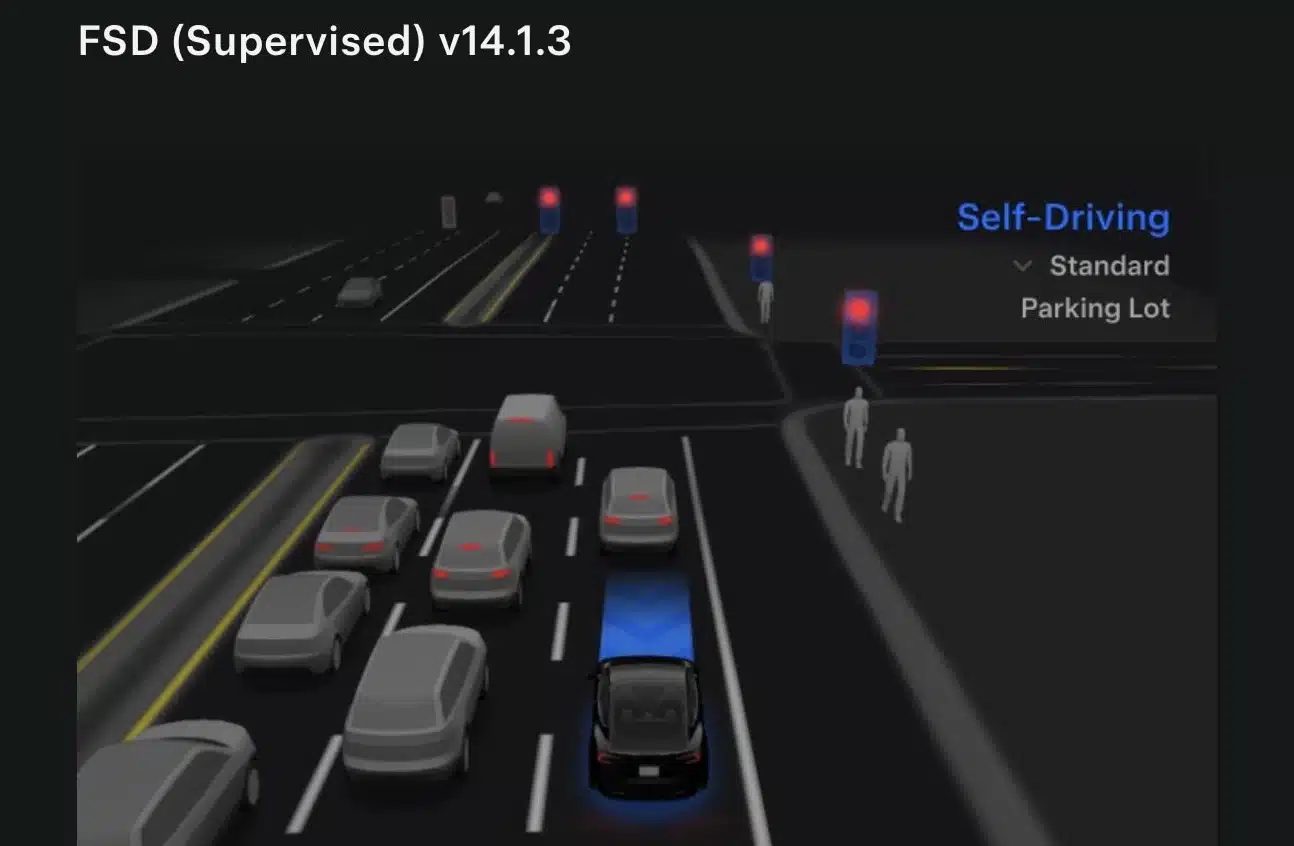

Tesla’s Full Self-Driving (Supervised) system has cleared an initial regulatory screening by the Flemish administration, advancing the system one step closer to becoming available in Belgium’s Dutch-speaking northern region.
Flemish Minister of Mobility Annick De Ridder announced on X on Friday afternoon that her administration has completed an accelerated screening of Tesla’s FSD file, with results recommending limited additional testing before homologation can be granted.
“News on the Tesla FSD: the accelerated screening by my administration is in,” De Ridder wrote.
“It shows that, with a view to homologation, they still want to do additional limited-scale testing to be able to provide comfort regarding traffic safety (differences between NL-VL road network),” she added.
If Flanders proceeds with the limited additional testing and grants homologation before the June 30 TCMV vote, Belgium would become only the second European market — after the Netherlands — where Tesla’s FSD (Supervised) is available to owners.
However, a Flemish approval would not automatically extend to Wallonia or the Brussels-Capital Region, both of which retain separate regional competencies over vehicle homologation.
The minister said she has contacted federal Mobility Minister Jean-Luc Crucke — who holds federal authority over the authorisation of vehicle tests — to expedite the next step.
“He promised me to look at this on very short notice, since like me he is a great believer in innovation,” De Ridder added. “To be continued!”
The Friday update comes after De Ridder publicly committed on Tuesday to delivering “clarity by the end of the week” on whether a fast-track homologation was possible.
The Flemish Process
The Friday screening result confirms two things.
First, the Flemish administration considers Tesla’s existing FSD file insufficient as-is for homologation in Flanders, requiring additional region-specific testing.
Second, the testing requirement is described as “limited” rather than expansive — suggesting the administration views the gap between Dutch and Flemish road conditions as narrower than between, say, the Netherlands and the Nordic countries that have raised broader safety concerns.
The cited concern centres on differences between the Dutch (NL) and Flemish (VL) road networks.
Flanders shares a 450-kilometre border with the Netherlands, and the two regions share substantial similarities in road design, signage conventions, and traffic patterns.
The “limited additional testing” framing implies a narrower validation exercise rather than a full re-evaluation.
The federal coordination with Crucke is significant.
Belgium’s federal structure splits vehicle homologation competence between the regions and the federal level, with regions handling regional roads and the federal level overseeing testing authorisation.
By bringing in Crucke proactively, De Ridder appears to be attempting to compress the federal-regional handoff that typically slows multi-region approval processes in Belgium.
The Tuesday Backdrop
The Friday update follows De Ridder’s Tuesday announcement that she had instructed her administration to deliver clarity within four working days.
The minister framed the move as part of positioning Flanders as innovation-friendly, writing that “innovation shouldn’t be slowed down, but enabled in a thoughtful and safe way.”
The Tuesday announcement landed on the same day that the European Commission’s Technical Committee on Motor Vehicles convened in Brussels to review the Dutch FSD approval.
The Dutch vehicle authority RDW presented its Article 39 file for Tesla’s FSD (Supervised) to the 117th TCMV meeting, which was extended from a 20-minute morning slot to a one-hour dedicated afternoon session.
The earliest realistic window for a formal qualified-majority vote remains the next TCMV session on June 30.
A vote requires at least 15 of the 27 member states representing 65% of the bloc’s population.
A Fragmented European Picture
The Flemish movement adds momentum to Tesla’s European FSD push but does not change the broader uncertainty surrounding EU-wide approval.
Several Nordic regulators — including those in Sweden, Finland, Denmark, and Norway — have publicly raised concerns about FSD’s handling of icy road conditions, the system’s tendency to exceed posted speed limits, and the potentially misleading “Full Self-Driving” branding.
A Danish official cited by Reuters described the system as performing “very well in the complex traffic” of Copenhagen rush hour during a demonstration, but Danish authorities have not formally moved toward approval.
Sweden’s Transport Agency, in correspondence dated 15 April, expressed surprise that Tesla allowed FSD to exceed speed limits — a position the agency made clear “should not be permitted.”
France’s Centre National de Réception des Véhicules has stated that it will not authorise FSD until the European Commission’s Article 39 examination concludes.
Italy’s Transport Ministry has signalled it will await EU-level discussions before deciding.
Germany has not made a public statement.
Spain has been testing 30 Tesla vehicles equipped with FSD since November 2025, logging nearly 80,000 kilometres without reported incidents.
The system is currently available in the United States, Canada, Mexico, Puerto Rico, Australia, New Zealand, South Korea, and the Netherlands.
The FSD fleet recently crossed 10 billion cumulative miles globally — a threshold CEO Elon Musk had cited in January as the data volume needed for safe unsupervised self-driving.