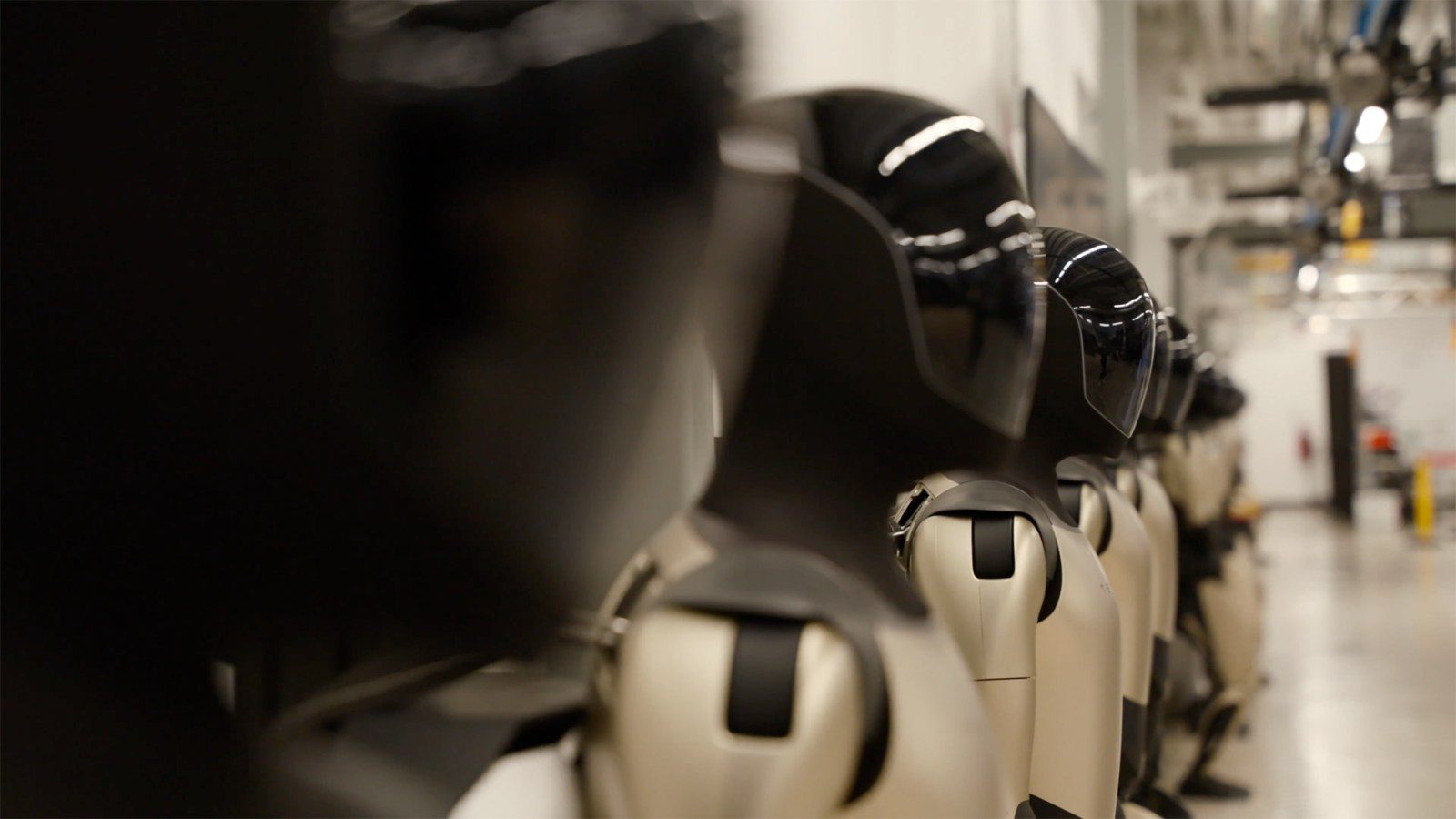

Tesla‘s humanoid-robot team audited suppliers across China’s Yangtze River Delta last week, and several of the companies had already received orders for the Optimus program before the inspections began, Chinese outlet The Paper reported on Monday, citing a single unnamed person familiar with the supply chain.
Tuopu Group, Sanhua Intelligent Controls and Joyson Electronics were among the companies visited, according to the report. All three supply core electromechanical components, joint modules, actuators and precision structural parts, and all three already supply Tesla’s car business.
The South China Morning Post separately reported the audits, naming the same three companies and citing people familiar with the matter.
“Before this round of audits, these companies had all already received orders for Tesla’s humanoid robot, differing only in size,” the industry source told The Paper.
Production will begin shortly after the lines pass quality and compliance assessments, the person added.
Scope of the Audits
Contrary to earlier reports that placed the inspections exclusively in Ningbo, Tesla’s robotics team also visited suppliers in Hangzhou, Shanghai and other parts of the Yangtze River Delta, according to the report.
Chinese financial outlet 21jingji reported last week, citing separate industry chain sources, that a Tesla team arrived in Ningbo on September 16 and began a new round of mass-production audits the following day, having already placed orders with supply chain companies.
A previous round of supplier audits ran from September 2025 through around February of this year, focused on preparing for the redesign and mass production of the third-generation model, according to the same media outlet.
Those inspections applied automotive-grade standards, requiring fast cycle times, high yields, per-unit cost breakdowns and supplier capabilities for overseas manufacturing and tier-two supply chain management.
The second round, per the same outlet, is focused on production economics and consistency, including equipment commissioning and per-unit cost against Tesla’s target price.
Third-generation Optimus
The model set to enter mass production is Tesla’s third-generation Optimus — its first designed for volume manufacturing.
Compared with previous iterations, the robot features major upgrades to its dexterous hand mechanism and joint actuators.
Initial deployment will target industrial applications, including material handling inside factories and assistance with simple assembly-line tasks.
Tesla’s long-term target is to bring the per-unit cost down to $20,000–$30,000.
CEO Elon Musk has described mass production of the humanoid robot as the hardest product Tesla has ever attempted to scale.
Production Capacity
Tesla has converted its former Model S and Model X production line at the Fremont plant into a dedicated Optimus line, with a planned annual capacity of one million units.
The company ended production of both flagship models earlier this year as part of a broader shift toward autonomy and robotics.
Musk told the first-quarter call in April that limited production would begin in late July or August, warning that output would be “quite slow” and the rate “literally impossible to predict” given roughly 10,000 unique parts on an entirely new line.
The July shareholder update said the Fremont lines were being installed with production “anticipated later this year.” Both capacity figures are design targets. Tesla has reported no Optimus output in any production release.
A second line is being prepared at Gigafactory Texas, designed for long-term annual capacity of 10 million robots, per the same filing. Musk has called that figure aspirational and Tesla has given it no date.
Wang Hao, President of Tesla China, told the South China Morning Post on April 14 that Giga Shanghai could provide a “golden key” to mass-producing Optimus.
“Like other Tesla factories, Giga Shanghai can shoulder important responsibilities in manufacturing all new products, including robots,” he said, without saying whether that would mean existing lines or a new plant.
It was the first time a Tesla executive had publicly linked the Shanghai factory, which built 851,000 vehicles in 2025, to robot manufacturing.
Tesla has announced no plan to assemble Optimus in China, and every schedule it has published puts final assembly at Fremont first and Texas second.
Suppliers’ Robotics Businesses
Several of the companies audited have been building their robotics businesses for years, drawing on existing capabilities developed for Tesla’s automotive supply chain.
Tuopu Group has supplied joint actuators, dexterous hands and other components to leading Chinese humanoid-robot companies such as AgiBot and Unitree Robotics, according to publicly available information.
Joyson Electronics focuses on robotics domain controllers, leveraging its strengths in automotive-grade hardware and software integration, and has supplied companies including AgiBot and Galbot.
Sanhua Intelligent Controls has developed integrated joint modules designed to address overheating in high-power joints, drawing on its expertise in thermal-management systems.
Unitree Robotics and UBTECH are among its robotics customers.
Musk on Chinese Competition
During Tesla’s fourth-quarter earnings call in January, Musk acknowledged that China will pose the biggest competitive threat in humanoid robotics, citing the country’s strength in both manufacturing and artificial intelligence.
“People outside of China kind of underestimate China. China’s next level,” Musk said.
He added that Tesla sees no significant competitors outside China, while still framing Optimus as more capable than any robot currently under development there.
Chinese Automakers’ Robotics Push
Tesla’s supply-chain push comes as Chinese automakers accelerate their own humanoid robot programs.
XPeng commissioned its humanoid robot production lines in Guangzhou on September 8, with the first IRON unit walking off the assembly line on its own.
The Guangzhou-based company is targeting monthly production capacity above 1,000 units by year-end, ahead of a planned global rollout in 2027 that will begin with deploying robots as sales assistants in its own stores.
XPeng‘s robotics subsidiary, Dogotix, raised more than $900 million in late August at a post-money valuation above $6.3 billion, with IDG Capital leading the round and Tencent and Alibaba among the strategic investors.
State-owned Changan Automobile and Chery Automobile Group are also developing their own humanoid robots. Dongfeng Motor, another state-backed automaker, said last week it plans to trial-produce humanoid robots by year-end.